
I’ve always found the exploration of Brahman fascinating because it challenges our conventional understanding of existence. Unlike the tangible world we interact with daily, Brahman represents an abstract, all-encompassing truth. Understanding Brahman’s relation to ultimate reality can offer profound insights into the nature of existence and our place within it.
Understanding Brahman
Brahman stands as the central concept in Hinduism, representing the ultimate reality and the highest universal principle. Brahman encompasses all existence, combining both material and immaterial aspects of the universe.
- Ultimate Reality: Brahman pervades everything, merging the physical and metaphysical into a single, cohesive ultimate reality. The material universe and its unseen, immaterial facets both stem from Brahman.
- Eternal and Unchanging: While the universe undergoes constant change, Brahman remains unchanged and permanent. This characteristic sets Brahman apart from the transient phenomena we observe.
- Infinite and All-Pervasive: Present everywhere, Brahman infuses every living being and penetrates the entirety of the cosmos. Its infinite nature ensures it’s an ever-present force within and around us.
- Beyond Conception: Beyond human comprehension, Brahman cannot be encapsulated by literal definitions. Its essence defies ordinary understanding, pushing us to think beyond conventional logic.
By grasping these key characteristics, we deepen our understanding of Brahman’s relationship to ultimate reality in Hindu philosophy.
Philosophical Context of Brahman
Brahman stands at the core of Hindu philosophy, addressing fundamental metaphysical questions about the nature of reality. It is viewed as eternally constant, contrasting with the temporary, changing nature of the observed universe (Maya).
Vedic Literature
The Vedic literature, such as the Rig Veda, Brahmanas, and Upanishads, provides significant insights into Brahman’s relationship with ultimate reality. These texts explore the connections between language and thought, delving into the concept of an all-encompassing force. The Rig Veda refers to Brahman as the source of creation, laying the groundwork for understanding Brahman as the ultimate reality.
Upanishads
The Upanishads, part of the Vedic literature, offer profound philosophical interpretations of Brahman. They describe Brahman as an infinite and unchanging reality beyond human comprehension, emphasizing its all-pervasive nature. By interpreting the statements and inquiries within these texts, readers gain a deeper understanding of Brahman’s significance in Hindu philosophy and its crucial connection to ultimate reality.
Brahman and Its Attributes
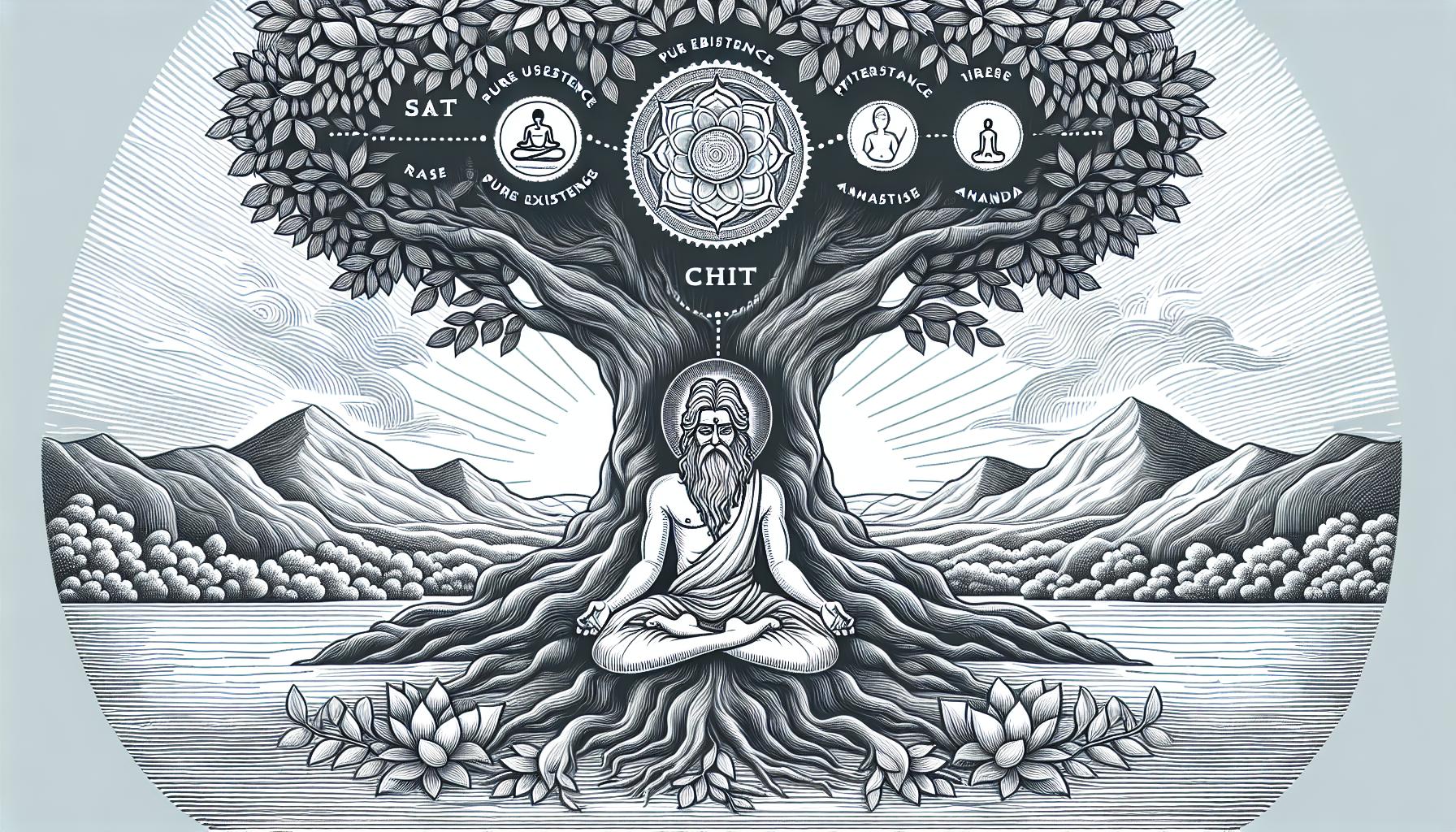
Brahman, the ultimate reality in Vedanta tradition, embodies three essential attributes: Sat (Being), Chit (Consciousness), and Ananda (Bliss). These attributes constitute the essence of Brahman, transcending individuality and manifest reality.
Sat (Being)
Sat represents pure existence, beyond any identification with social status, body, emotions, thoughts, or mind. It’s the intrinsic nature of all beings, existing beyond the physical and transcending individuality. Sat also signifies a dimension of transcendental reality, describing what exists beyond the manifest domain. This essence remains constant and immutable, providing a foundation for all existence.
Chit (Consciousness)
Chit denotes pure awareness or pure consciousness. This awareness remains inaccessible without achieving nirvikalpa samadhi, a state of deep meditation. Chit isn’t about specific forms or aspects but is Brahman itself. It’s the omnipresent consciousness that forms the core of all experiences. Recognizing this pure awareness elevates understanding beyond ordinary perception.
Ananda (Bliss)
Ananda signifies pure bliss, intrinsic to Brahman. It’s a state of absolute joy, free from external influences or conditions. This bliss emanates from the realization of one’s unity with Brahman, transcending mundane happiness. Ananda is not merely the absence of suffering but a profound, boundless joy reflective of the ultimate reality.
The Concept of Ultimate Reality
Brahman represents the pinnacle of ultimate reality in Hindu philosophy. Its core attributes—pure existence (Sat), pure consciousness (Chit), and pure bliss (Ananda)—emphasize its transcendental nature.
Definitions Across Different Schools
- Advaita Vedanta: Brahman is the undivided ultimate reality, synonymous with the universal Self (Atman – The Soul). There’s no distinction between individual souls and Brahman.
- Dvaita Vedanta: Brahman stands apart from Atman. This school advocates a theistic view, portraying Brahman and individual souls as eternally distinct.
- Vedanta Perspective: Each school of Vedanta—whether it’s Advaita, Dvaita, or other sub-traditions—frames a unique relationship between Brahman and Atman, shaping varied metaphysical understandings.
Vedanta Perspective
In Vedanta philosophy, Brahman is pivotal. It’s viewed as the non-dualistic source from which all existence emanates. Whether perceived as identical with Atman in Advaita or distinct in Dvaita, Brahman embodies the ultimate reality encompassing all forms and phenomena. These perspectives elucidate Brahman’s integral role in comprehending the universe’s fundamental truths.
Role of Brahman in Spiritual Practice
Brahman plays a crucial role in Hindu spiritual practices, guiding individuals toward the ultimate reality. Two key aspects of this practice are meditation and devotion.
Meditation
In the Upanishads, Brahman is the ultimate goal of meditation. Practitioners aim to realize the identity of the self (Atman) and Brahman, seeking liberation from the cycle of birth, death, and rebirth. The Advaita Vedanta philosophy, led by Shankara, stresses the significance of meditation in understanding the unity of Atman and Brahman. This understanding is believed to free individuals from the cycle of rebirth.
Devotion
Brahman is often revered as a supreme deity, especially within theistic schools like Dvaita Vedanta. Devotion (Bhakti) to Brahman is seen as a path to experiencing the divine presence within all beings. Engaging in devotional practices helps individuals cultivate a personal connection with Brahman, fostering spiritual growth and inner peace.
Comparative Analysis with Other Religions
Comparing Brahman’s concept in Hinduism with other religions reveals varied interpretations of ultimate reality. Each perspective offers unique insights into existence and divinity.
Abrahamic Religions
In Abrahamic religions—Judaism, Christianity, and Islam—the ultimate reality centers on a personal divine being known as God. God is the creator and sustainer of the universe, embodying a monotheistic view that contrasts sharply with Brahman’s impersonal and abstract nature in Hinduism. In Judaism, God is a singular, omnipotent entity that established a covenant with the Jewish people, guiding them through laws and commandments. Christianity views God as a Trinitarian being comprising the Father, the Son, and the Holy Spirit, emphasizing God’s incarnation in Jesus Christ for humanity’s salvation. Islam perceives God (Allah) as singular and unparalleled, stressing submission to His will as detailed in the Quran.
Eastern Philosophies
Brahman’s concept shares some similarities with Eastern philosophies like Buddhism and Taoism. In Buddhism, although there’s no direct counterpart to Brahman, the ultimate goal is the realization of Nirvana, an enlightened state beyond suffering and individual existence. This somewhat parallels Brahman in its transcendence and ultimate repose. Taoism, another Eastern philosophy, introduces the concept of the Tao, an indefinable force underlying the universe, resonating with Brahman’s immanent and transcendent aspects. Both philosophies emphasize a harmonious existence aligning with the ultimate truth, though their methodologies and interpretations vary significantly.
Conclusion
Understanding Brahman’s relation to ultimate reality offers profound insights into the essence of existence and consciousness. Whether one follows the non-dualistic approach of Advaita Vedanta or the dualistic perspective of Dvaita Vedanta, the concept of Brahman remains central to spiritual practice and philosophical inquiry. Meditation and devotion serve as vital paths to realizing this ultimate truth.
Comparing Brahman with ultimate reality in other religions reveals both unique interpretations and shared quests for enlightenment. This exploration underscores the universal human pursuit of understanding our place in the cosmos and achieving a harmonious existence.
Sources & further reading
These themes are explored in greater depth across the following authoritative resources:
- Stanford Encyclopedia of Philosophy, Hindu Philosophy
- Britannica, Moksha
- Britannica, Brahman
- Internet Sacred Text Archive, Upanishads
- Sarvepalli Radhakrishnan, Indian Philosophy (2 vols., Oxford University Press, 1923)
External resources for further reading. Apam Napat is not affiliated with these publishers; citation does not imply endorsement.
Frequently asked questions
What is Brahman in Hindu philosophy?
How is Brahman eternal and unchanging?
Why is Brahman called all-pervasive?
Why is Brahman considered beyond conception?
What is Maya in relation to Brahman?
Based on the classical texts of Hindu mythology, see our sources.