
I find Brahman’s connection to ultimate reality fascinating because it challenges our conventional understanding of the universe. Unlike other spiritual concepts that focus on individual gods or moral codes, Brahman invites us to consider a unified, all-encompassing truth. This exploration can lead to transformative insights about our place in the cosmos and the nature of reality itself.
Understanding Brahman
Ultimate Reality
Brahman represents the ultimate reality that permeates all existence. This concept includes both material and immaterial aspects of the universe. Hindu philosophy posits Brahman as the fundamental essence from which everything arises and to which everything returns. It remains unchanged and eternal, unlike the temporary physical world. Vedic scriptures frequently describe Brahman as an all-encompassing presence that binds every part of existence.
Eternal and Unchanging
Brahman exists eternally and is unchanging, forming a stark contrast to the transient nature of the observed universe. This permanence underscores its role in Hindu thought as the final cause behind all phenomena. It’s described as nitya (eternal) and satya (truth), properties that separate it from everything else in the universe. While the material world undergoes constant change and decay, Brahman remains a steady, unaltered reality.
Cosmic Principle
Brahman functions as a cosmic principle, acting as the creative force underlying the universe. It’s seen as the source from which all creation emerges and into which it’s eventually absorbed. This conceptualization highlights Brahman’s role as both the origin and the sustainer of everything. Hindu texts often describe it as sarva-karana-karanam (the cause of all causes), emphasizing its integral involvement in the cosmic order.
Historical Context
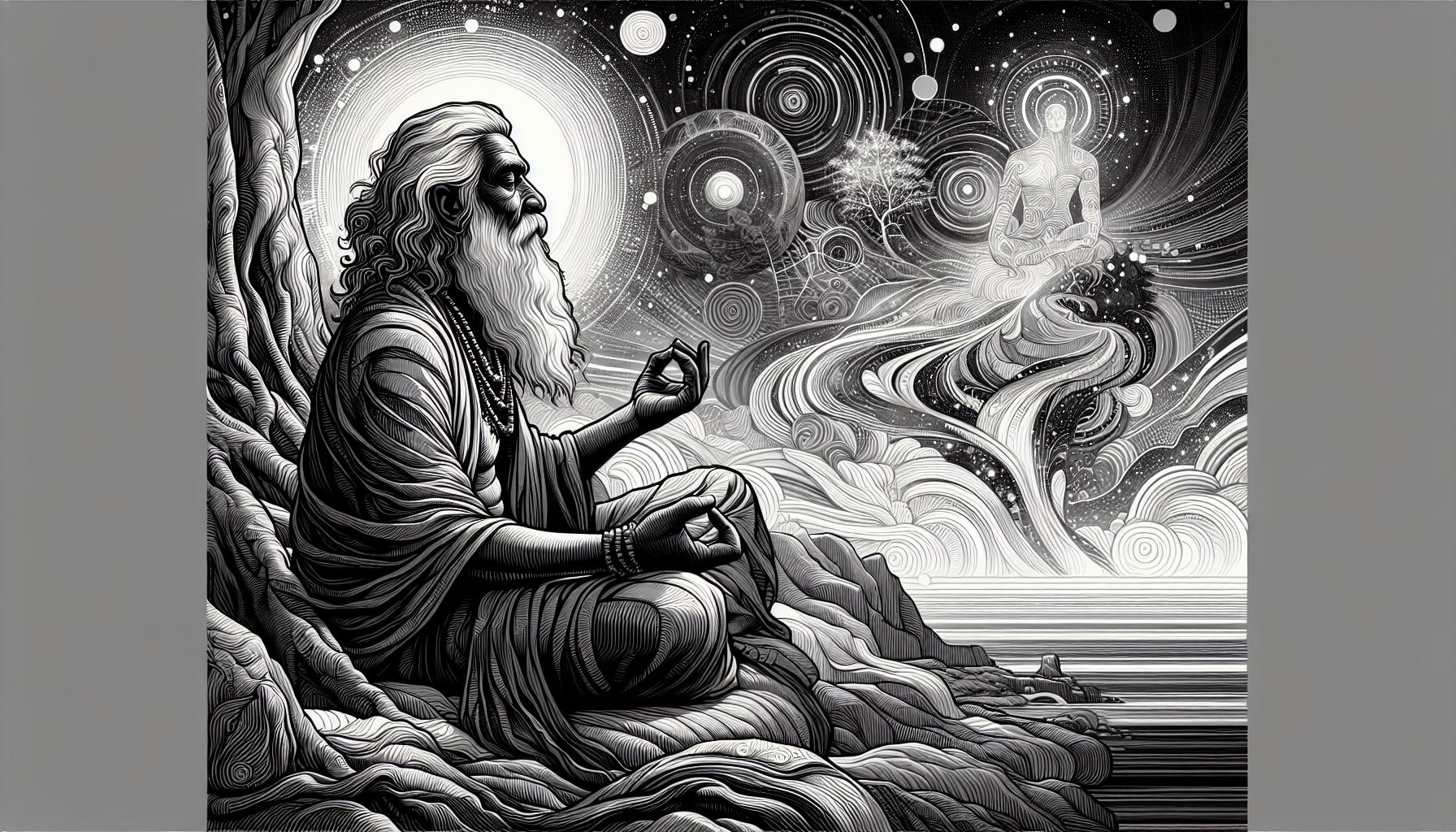
Brahmanism, originating during the Late Vedic Period (c. 1100-500 BCE), formed the backbone of early Hindu beliefs. The Vedas, regarded as eternal words deciphered by sages in meditative states, positioned Brahman as the supreme being and the essence of the universe. This philosophical framework profoundly influenced Hinduism, cementing Brahman’s role as both creator and cosmic principle.
Ancient Texts and Scriptures
The Upanishads, integral parts of the Vedas, present the foundational discussions on Brahman. These texts investigate into complex metaphysical ideas, portraying Brahman as the ultimate reality and source of all beings. For example, the Chandogya Upanishad states, “In the beginning, this world was only Brahman,” emphasizing its primordial status. The Brihadaranyaka Upanishad explores Brahman’s indescribable nature, suggesting it’s beyond human perception yet inherent in everything.
Philosophical Interpretations
Philosophers have variously interpreted Brahman’s connection to ultimate reality. Shankara, an 8th-century philosopher, promoted Advaita Vedanta, asserting that Brahman is the only reality and everything else is an illusion (Maya). Conversely, Ramanuja, an 11th-century thinker, proposed Vishishtadvaita, affirming that Brahman and the universe are distinct yet inseparable. These perspectives demonstrate the richness of philosophical discourse surrounding Brahman and its significance in understanding ultimate reality.
The Concept of Ultimate Reality
Ultimate reality represents the supreme, final, and fundamental power in all reality. It’s the unchanging essence from which all existence arises and to which it returns.
Defining Ultimate Reality
Ultimate reality in various philosophies encompasses the highest universal principle, the source of all that exists, and the ultimate truth. This concept is seen as the unchanging and eternal power underlying all existence. In Hinduism, Brahman embodies this principle, characterized as infinite, pervasive, and beyond physical attributes. Brahman transcends ordinary understanding and graces Hindu philosophical discourse as the eternal truth and consciousness.
- Greek Philosophy: Different Greek philosophers had varying conceptions of ultimate reality. Anaximander proposed the infinite and eternal substance of apeiron as the fundamental nature of the universe. Aristotle, on the other hand, identified the unmoved mover, an unchangeable entity responsible for the existence and motion of everything in the cosmos, as the ultimate reality.
Brahman’s Role in Ultimate Reality
Brahman stands as the highest universal principle and ultimate reality in Hinduism. It’s viewed as the non-physical, efficient, formal, and final cause of all existence.
Non-Duality and Brahman
Advaita Vedanta, a prominent school of Hindu philosophy, stresses Brahman’s non-dual nature. Brahman is the solitary ultimate reality, stating there’s no duality between Brahman and the individual self (Atman – The Soul). This principle underscores the unity of all existence, suggesting that individual differences are merely illusions (Maya).
Brahman in Vedantic Philosophy
Vedantic philosophy, particularly through the works of philosophers like Shankara, elaborates on Brahman’s nature. Shankara interprets Brahman as Nirguna (without attributes) and asserts that realizing Brahman’s essence leads to Moksha (liberation). Ramanuja, another Vedantic philosopher, presents a differing view, describing Brahman as Saguna (with attributes), highlighting the personal aspect of Brahman related to devotion (Bhakti).
Experiencing Brahman
Understanding Brahman involves a deep journey into self-awareness and inner realization. This process is central to Hindu philosophy, particularly in the teachings of the Upanishads.
Spiritual Practices
Several spiritual practices guide individuals toward experiencing Brahman intimately:
- Meditation and Yoga: Practicing meditation and yoga helps quiet the mind and focus on the inner self. By turning inward, individuals can realize their unity with Brahman.
- Jnana Yoga: Jnana Yoga emphasizes knowledge and wisdom. Through studying scriptures and contemplation, seekers gradually perceive Brahman’s nature.
- Bhakti Yoga: Bhakti Yoga fosters devotion and love for the divine. Through worship and faith, practitioners experience a personal connection with Brahman.
- Karma Yoga: Karma Yoga involves selfless action and duty. By performing actions without attachment, one transcends ego and aligns with Brahman’s cosmic order.
Mystical Experiences
Mystical experiences offer profound insights into Brahman’s essence:
- Samadhi: Samadhi, a deep meditative state, leads to the direct experience of Brahman. In this state, boundaries between the self and the universe dissolve.
- Intuition: Intuitive understanding transcends rational thought, allowing glimpses into the nature of Brahman. Mystics often speak of sudden moments of revelation.
- Bliss (Ananda): Bliss or Ananda arises when one’s consciousness merges with Brahman. This experience is characterized by profound joy and peace.
These practices and experiences illuminate the path to understanding Brahman, making the concept of ultimate reality accessible to seekers.
Contemporary Perspectives
Brahman is considered the ultimate reality, transcending both physical and metaphysical realms. Modern interpretations and cross-cultural comparisons help illuminate this connection.
Ultimate Reality in Hinduism
Brahman embodies the origin of all things, representing ultimate truth in Hinduism. This concept addresses both the seen and unseen worlds, placing Brahman as the foundation of existence. Influential texts like the Upanishads and Bhagavad Gita elaborate on Brahman’s pivotal role in the cosmos.
Philosophical Models
Philosophers propose Brahman as a fundamental aspect of reality, incorporating metaphysical, valuational, and fulfillment dimensions. Metaphysically, it explains the nature of existence. Valuationally, it establishes the ultimate standard for what is worthy. In terms of fulfillment, it offers a path toward spiritual completion and enlightenment.
Cross-Cultural Comparative Religious Ideas
Comparative studies relate Brahman to other ultimate concepts. For instance, it’s paralleled with God in Abrahamic traditions and the Dao in Daoism. These comparisons highlight both similarities and differences, showcasing diverse paths toward understanding ultimate reality.
Modern Spiritual Teachers
Swami Vivekananda championed four yogas (Karma, Bhakti, Raja, Jnana) as pathways to liberation, converging toward the goal of human perfection. He emphasized that these paths, though distinct, all lead seekers to the same spiritual summit. His teachings resonate with individuals pursuing diverse spiritual practices, reinforcing the universal relevance of Brahman.
Scientific Insights
Contemporary science intersects with spiritual concepts, exploring consciousness and the nature of reality. Quantum physics, for example, questions the fabric of the universe, hinting at deeper, unseen truths akin to Brahman. Studies in neuroscience examining consciousness provide intriguing parallels, suggesting an interconnected, ultimate reality aligning with ancient spiritual insights.
Conclusion
Exploring Brahman’s connection to ultimate reality reveals a profound world of philosophical, spiritual, and modern insights. Through various yogas and mystical experiences, we can glimpse Brahman’s essence as the foundation of existence. Contemporary perspectives and cross-cultural comparisons enrich our understanding, showing that the quest for ultimate reality transcends time and tradition. Whether through ancient scriptures or modern scientific inquiry, the journey towards comprehending Brahman continues to inspire and guide seekers on their path to enlightenment.
Sources & further reading
These themes are explored in greater depth across the following authoritative resources:
- Stanford Encyclopedia of Philosophy, Hindu Philosophy
- Britannica, Moksha
- Britannica, Brahman
- Internet Sacred Text Archive, Upanishads
- Sarvepalli Radhakrishnan, Indian Philosophy (2 vols., Oxford University Press, 1923)
External resources for further reading. Apam Napat is not affiliated with these publishers; citation does not imply endorsement.
Based on the classical texts of Hindu mythology, see our sources.