
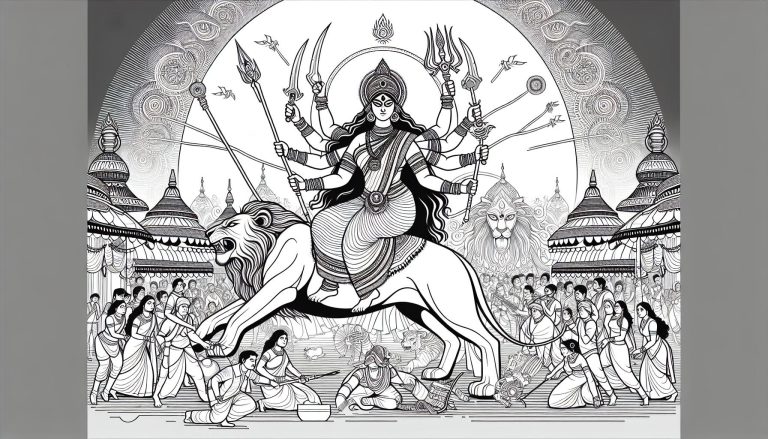
Exploring Durga’s origins reveals a tapestry of narratives where gods and demons clash, and cosmic balance hangs in the balance. From her creation by the combined energies of the gods to her epic battles against the forces of evil, Durga’s story is one of empowerment and resilience. Join me as I journey through these timeless myths, shedding light on the goddess who embodies the triumph of good over evil.
The Birth of Durga
Durga’s mythological origins are rooted in Hindu mythology. According to the Devi Bhagvatam, Durga was born to defeat the demon Mahishasura – Buffalo Demon, who was born to an Asura. The story of her birth is narrated in the Devi Bhagvatam, which describes her creation by the gods to slay the buffalo demon Mahishasura.
Durga was created by Brahma – The Creator, Vishnu, Shiva, and the lesser gods, who were otherwise powerless to overcome Mahishasura. They collectively embodied their energy, known as shakti, to create Durga. She was born fully grown and beautiful, presenting a fierce and menacing form to her enemies.
Durga is often depicted riding a lion or tiger and having multiple arms, each holding the special weapon of one of the gods who gave them to her for her battle against Mahishasura. This mythological origin highlights her role as a powerful warrior goddess, associated with protection, motherhood, and strength.
Significance in Hindu Mythology

Durga holds a central place in Hindu mythology, embodying divine strength and protection.
Protector of the Universe
Durga is revered as the ultimate protector of the universe. With her formidable presence and array of divine weapons, she represents the invincible shakti (energy) that safeguards the cosmos from chaos and malevolence. According to Hindu legend, Durga was born to vanquish the buffalo demon Mahishasura, who couldn’t be defeated by any male god. Her role as the universe’s guardian reflects her unparalleled power and the belief in divine intervention for restoring cosmic balance.
Symbol of Feminine Power
Durga epitomizes feminine power in Hindu culture. Created by the principal gods, she channels their collective energy to defeat evil, highlighting the essential role of feminine strength in mythology. Durga’s multiple arms, each holding a weapon, symbolize various aspects of combat, strategy, and protection. Her depiction riding a lion or tiger underscores her dominion over nature and her fearless spirit. Durga’s narrative stands as a testament to the vital force of feminine power, inspiring reverence and worship among Hindus.
Key Mythological Stories
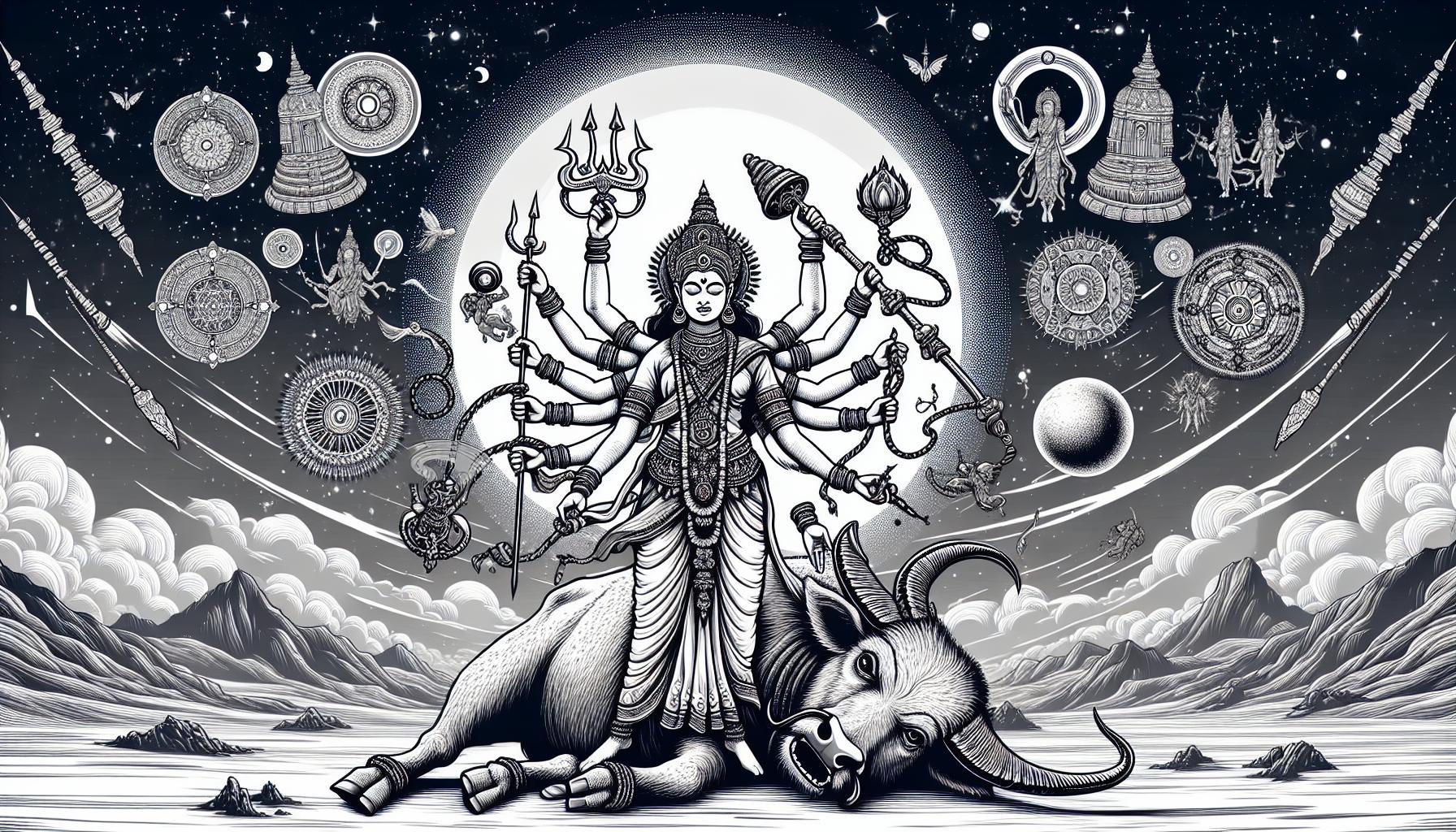
Durga’s mythological origins are rich with fascinating tales. Two key stories showcase her creation and the fierce battles she fought.
Battle with Mahishasura
Mahishasura, a powerful buffalo demon, received a boon from Lord Brahma that no man or god could kill him. This made him arrogant, and he started terrorizing the universe, even driving the gods out of heaven. Faced with this menace, the gods, led by Brahma, Vishnu, and Shiva, combined their energies to create Durga. She emerged as a powerful goddess with the sole purpose of defeating Mahishasura.
The Creation by the Gods
Durga’s creation was a remarkable event. The gods pooled their collective energy, known as Shakti, to give birth to her. This made her both derivative from and the true source of their power. Durga was created fully grown and strikingly beautiful, with eight to ten arms. Each arm held a special weapon, gifted by different gods. Shiva granted her a trident, Vishnu gave her a spinning disc, and Varuna – The Waters provided a conch and a noose.
These stories underline Durga’s role as a warrior goddess and her significance in Hindu mythology as the ultimate protector against evil.
Depictions in Ancient Texts
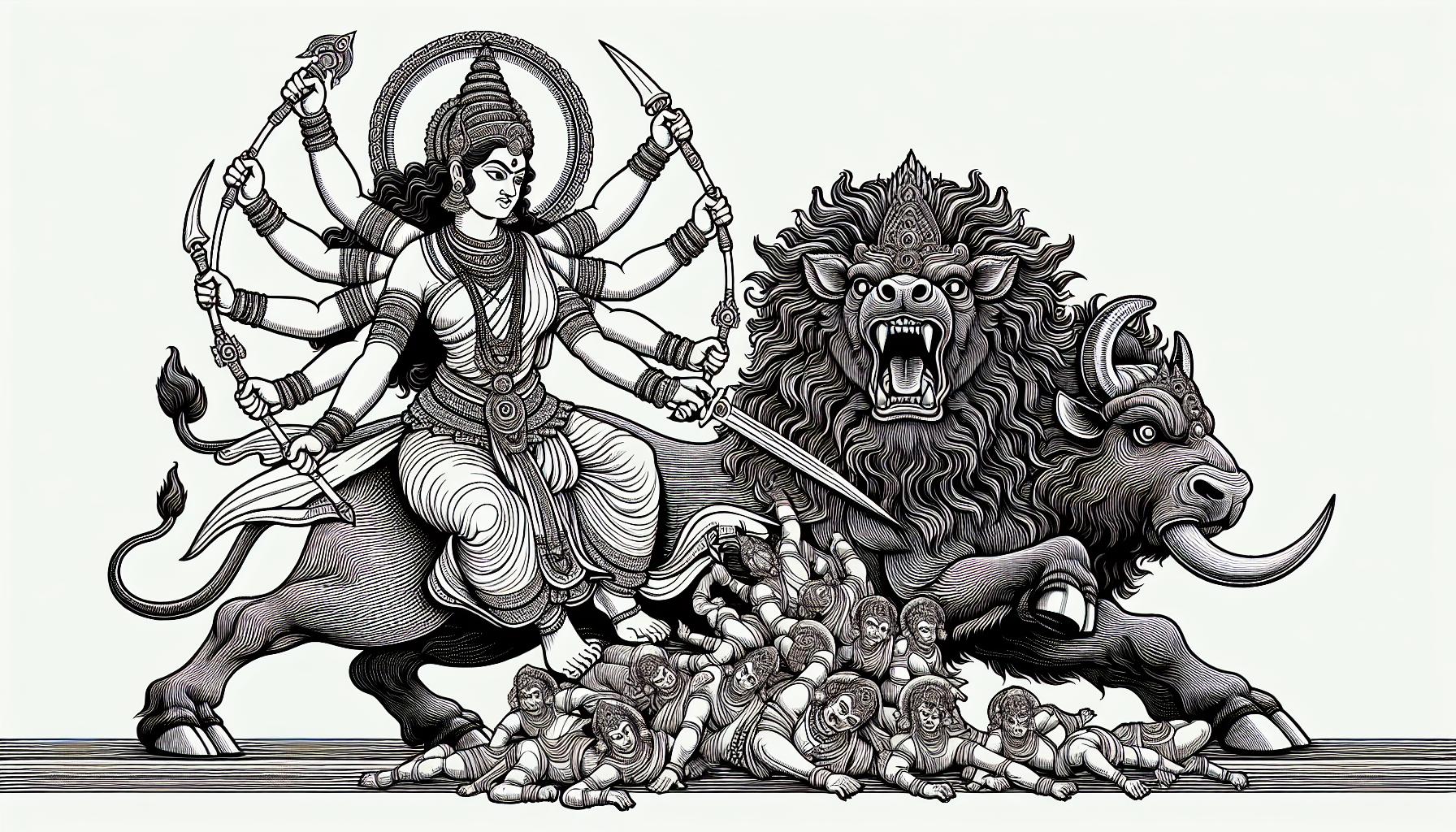
Durga’s depictions in ancient texts highlight her status as a powerful, multi-armed goddess riding a lion or tiger. These texts often portray her fighting demons, reflecting her role as a protector and warrior goddess.
Devi Mahatmya
The Devi Mahatmya, a significant Hindu text, describes Durga as a manifestation of the supreme goddess Devi. It tells the story of her battle against the buffalo demon Mahishasura. After a nine-night struggle, Durga emerges victorious. This narrative emphasizes her divine strength and role in vanquishing evil, solidifying her status in Hindu mythology.
Skanda Purana
The Skanda – Commander of the Army of Devas Purana provides additional stories about Durga, portraying her as a fierce warrior goddess. It’s known for recounting her battles against various demons and highlighting her role in protecting the gods. Durga’s association with the destruction of evil forces enhances her image as a divine protector and warrior.
Celebrations and Cultural Impact
Durga’s mythological origins have a profound impact on cultural practices and festivals. The key celebration dedicated to her is Navaratri.
Navaratri Festival
Navaratri, a nine-night festival, venerates the goddess Durga and signifies the triumph of good over evil. Devotees engage in various rituals to honor nine forms of the goddess. Worship includes stage decorations, recital of legends, and chanting of Hindu scriptures. Many observe fasting, while others partake in feasts. Navaratri culminates on the tenth day, known as Vijayadashami or Dussehra.
Regional Variations
Durga’s celebrations vary across India, reflecting diverse cultural expressions.
- Eastern and Northeastern India: Durga Puja is the primary celebration. Here, Durga’s battle and victory over Mahishasura are dramatized. Elaborate idols of Durga, accompanied by religious music and dances, feature prominently. This region marks Durga Puja with grandeur, drawing significant crowds.
These regional variations highlight Durga’s widespread influence on cultural practices and religious observances, emphasizing her significance across India.
Conclusion
Durga’s mythological origins highlight her as a powerful symbol of empowerment and resilience. Her creation by the gods to defeat Mahishasura underscores the eternal struggle between good and evil. As a warrior goddess, Durga’s depiction riding a lion with multiple arms holding divine weapons captures her fierce and protective nature.
The celebration of Durga during Navaratri and the regional variations like Durga Puja demonstrate her profound influence on cultural practices and religious observances across India. Durga’s legacy continues to inspire and resonate, embodying the triumph of good over evil in the hearts of millions.
Sources & further reading
These themes are explored in greater depth across the following authoritative resources:
- Encyclopaedia Britannica, Hindu Mythology
- Internet Sacred Text Archive, Hinduism
- Mythopedia, Hindu Mythology
- Harvard Pluralism Project, Hindu Tradition
- Wendy Doniger, The Hindus: An Alternative History (Penguin, 2009), ISBN 978-0143116691
External resources for further reading. Apam Napat is not affiliated with these publishers; citation does not imply endorsement.
Frequently asked questions
How was the goddess Durga born?
Why was Durga created?
How is Durga typically depicted?
What does Durga represent in Hindu mythology?
Who is Mahishasura?
Based on the classical texts of Hindu mythology, see our sources.