
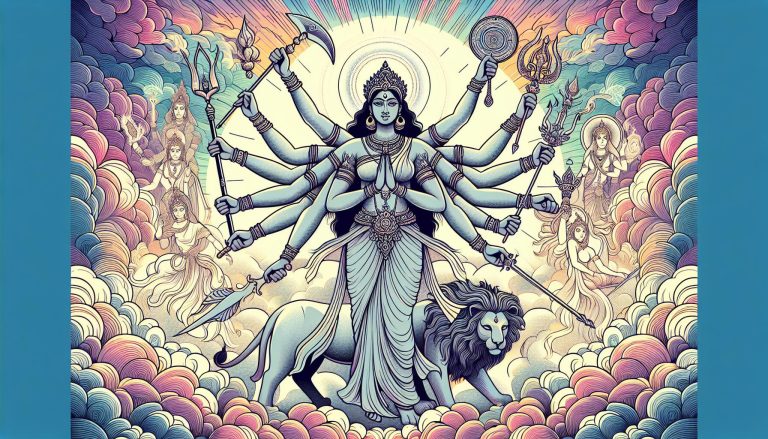
Understanding Durga’s weapon symbolism offers a deeper appreciation of her role as the ultimate protector and warrior goddess. It’s fascinating how each weapon she holds represents different aspects of human struggle and divine intervention. Join me as we explore the layers of symbolism behind Durga’s weapons and uncover the timeless wisdom they convey.
The Importance Of Weapons In Hindu Mythology
Weapons in Hindu mythology carry deep symbolic meanings and embody various divine attributes. Deities wield them not just as instruments of war but as representations of their power and virtues. When examining Durga’s weapons, each one reveals a unique aspect of her divine persona and cosmic responsibilities.
Trishul
Given by Lord Shiva – The Destroyer, the trident or Trishul embodies the three fundamental qualities of every being: Tamas (calmness), Sattva (salvation), and Rajas (energy). It promotes harmony within the human soul, aligning the spiritual and physical realms.
Sword
Presented by Lord Ganesh, the sword symbolizes sharp intellect and wisdom. Its brilliance signifies the power of knowledge, while its sharpness represents the triumph of wisdom over negativity. This weapon underscores the importance of mental acuity in overcoming obstacles.
Spear
Granted by Agni Dev, the God of fire, the spear stands for fiery power and discernment. It embodies Durga’s commitment to righteousness and her ability to distinguish right from wrong. This weapon emphasizes moral integrity as a cornerstone of divine justice.
Axe
Provided by Lord Vishwakarma – The Architect of the Devas, the axe signifies fearlessness and the power to both create and destroy. It represents the courage to face adversity and the dual nature of divine intervention. This weapon highlights the balance between destruction and creation in maintaining cosmic order.
The Iconography Of Durga
The iconography of Durga provides a visual representation of her divine characteristics and symbolic weapons.
Representation Of The Goddess
In Hindu art, Durga is usually depicted as a radiant figure with multiple arms, each holding a weapon. Each weapon represents a specific attribute of her divine function and authority. For instance, the trident, gifted by Shiva, illustrates her command over the three qualities of nature: goodness, passion, and ignorance. The sword embodies her sharp intellect and ability to cut through illusions. Durga’s serene yet powerful visage underscores her role as both a nurturer and a formidable warrior.
Traditional Depictions
Traditional depictions often show Durga in a dynamic pose, usually standing or seated on a lion or tiger. This stance symbolizes her mastery over power and ferocity. She’s often shown during her battle with the buffalo demon Mahishasura – Buffalo Demon, epitomizing the triumph of good over evil. The conch shell, handed by Vishnu – The Protector, signifies the primordial sound “Aum,” embodying creation and ultimate authority. Durga’s traditional imagery emphasizes her role as a divine force bringing balance and righteousness to the cosmos.
Overview Of Durga’s Weapons
Durga’s weapons are rich with symbolism, each representing different facets of the goddess’s divine power and her role as a protector.
The Sword
The sword in Durga’s arsenal symbolizes sharp intellect, wisdom, and the ability to overcome negativity. This weapon, given by Lord Ganesh, signifies the power to cut through ignorance and dispel darkness with clarity and precision.
The Trident
The trident, or trishul, represents the three fundamental qualities of every living being: Tamas (laziness), Rajas (hyperactivity), and Sattva (purity). Given to Durga by Lord Shiva, it symbolizes her control over these qualities, ensuring harmony within creation.
The Bow And Arrow
The bow and arrow stand for energy and the swiftness of action. Representing both the power of discrimination and a focused mind, these weapons were given by Vayu Dev, the god of air, highlighting Durga’s ability to direct her energy with precision.
The Club
The club, not previously mentioned, signifies both physical strength and the power to protect. This weapon embodies Durga’s ability to overpower her enemies through sheer might, maintaining order and justice.
The Spear
The spear represents discernment and righteousness, provided by Agni Dev, the god of fire. This weapon underscores Durga’s role in piercing through evil and establishing moral integrity, reflecting her unwavering commitment to righteousness.
The Discus
The discus, or chakra, symbolizes the cycle of time and the universe’s continuous movement. Typically given by Lord Vishnu, it signifies Durga’s authority over cosmic order and her role in maintaining balance across all realms.
Symbolism Of Each Weapon
Each weapon in Goddess Durga’s arsenal has deep significance, reflecting essential qualities and aspects of human nature needed to overcome life’s challenges. Understanding these symbols gives insight into her divine attributes.
The Sword: Valor And Intelligence
The sword, gifted by Lord Ganesh, symbolizes valor and intelligence. It represents the sharpness of intellect and wisdom. This weapon signifies the ability to cut through ignorance and attachments, leading to spiritual growth.
The Trident: Creation, Maintenance, And Destruction
The trident, or Trishul, represents the three fundamental qualities of every living being: Tamas (inactivity), Rajas (hyperactivity), and Sattva (positivity). Gifted by Lord Shiva, it symbolizes balance and harmony within the human soul and the power to conquer these qualities to emerge victorious.
The Bow And Arrow: Focus And Precision
The bow and arrow represent focus, precision, and the balance of potential and kinetic energy. These weapons signify the ability to aim with intent and execute actions with accuracy and discipline.
The Club: Strength And Courage
The club embodies strength and courage. This weapon signifies the power to face adversities with unwavering resolve and to use inner strength to overcome obstacles. It represents brute force tempered by righteous intent.
The Spear: Protection And Purification
The spear symbolizes protection and purification. It signifies the ability to guard against negative forces and purify the soul. This weapon is a representation of divine intervention in maintaining purity and righteousness in the cosmos.
The Discus: Righteousness And Cosmic Order
The discus represents righteousness and cosmic order. This weapon signifies the cyclical nature of life and the power to maintain justice. Holding the discus, Durga embodies the divine force that preserves order and moral integrity in the universe.
The Narrative Context
Durga’s narrative powerfully frames her role and the significance of her weapons. Emerging from the collective energy of deities, she embodies unity. Each weapon reflects this unity, carrying attributes from various gods.
Durga’s fight against Mahishasura, a shape-shifting demon, is central to her narrative. This fight symbolizes the triumph of good over evil. The gods, recognizing her strength, gifted her weapons to aid in the battle. Shiva gave her the trident, emphasizing her control over material nature’s three aspects: goodness, passion, and ignorance.
Vishnu’s contribution of the discus highlights divine righteousness. The conch, also from Vishnu, underscores the primordial sound “aum,” marking the universe’s origin. The bow and arrows from Vayu Dev signify spiritual elevation and discrimination, crucial in chaotic times. The spear, symbolizing truth and fearlessness, single-handedly reinforces her role as a protector.
These weapons don’t just serve combative purposes. The shield, for instance, extends protection to devotees against transgressing demons. Each weapon, thus, adds layers to Durga’s character, cementing her position as a multifaceted protector and warrior in Hindu mythology.
Contemporary Interpretations
Durga’s weapon symbolism continues to hold significance in modern times. Each weapon offers lessons applicable to daily life and personal growth. These interpretations evolve, reflecting changes in societal values while retaining their traditional essence.
Trishul (Trident)
In contemporary contexts, the trishul represents the ability to balance mind, body, and spirit. It encourages individuals to find harmony in their lives, overcoming negative traits like laziness, excessive passion, and ignorance. Businesses adopt this symbolism to promote balanced leadership and decision-making.
Conch
The conch, or shankha, stands as a symbol of communication and clarity. Its connection to the primordial sound “Aum” inspires practices that enhance mental clarity and focus. In modern wellness routines, the conch signifies the importance of grounding oneself and sustaining inner peace through meditation and mindfulness exercises.
Discus
The discus (chakra) signifies a constant cycle of change and transformation in contemporary interpretations. It reminds people of the need to adapt and evolve. Many interpret this weapon as a symbol of resilience, highlighting the importance of bouncing back and staying strong amidst life’s challenges. Organizations use the discus to symbolize innovative thinking and continuous improvement.
Sword
The sword, often associated with discriminating knowledge from ignorance, represents truth and justice. Modern interpretations focus on using wisdom and ethical judgment to navigate life’s complexities. It’s seen as a tool to cut through illusions and articulate one’s true purpose, frequently employed in leadership training focusing on honesty and integrity.
Bow and Arrow
The bow and arrow symbolize focus, direction, and achieving goals. In today’s context, they encourage setting clear targets and pursuing them with determination and precision. This symbolism is extensively used in motivational speaking and goal-setting strategies, promoting personal and professional development.
Spear
The spear signifies assertiveness and protection. It’s viewed as a manifestation of courage needed to face life’s obstacles. Modern interpretations align with personal security and mental strength, advocating for proactive measures in self-defense and empowerment initiatives, especially for marginalized communities.
These contemporary interpretations of Durga’s weapons keep her legacy relevant, offering timeless wisdom adaptable to modern-day challenges.
Conclusion
Goddess Durga’s weapons carry profound symbolism that transcends time and culture. Each weapon embodies a unique virtue that we can apply to our own lives. By understanding these symbols we gain insights into how to navigate our personal battles with resilience balance and assertiveness.
Durga’s legacy continues to inspire and guide us offering timeless wisdom. Her arsenal isn’t just a collection of divine tools but a roadmap for personal growth and empowerment. Embracing these lessons helps us face modern challenges with the same courage and strength that Durga exemplifies.
Sources & further reading
These themes are explored in greater depth across the following authoritative resources:
- Encyclopaedia Britannica, Hindu Mythology
- Internet Sacred Text Archive, Hinduism
- Mythopedia, Hindu Mythology
- Harvard Pluralism Project, Hindu Tradition
- Wendy Doniger, The Hindus: An Alternative History (Penguin, 2009), ISBN 978-0143116691
External resources for further reading. Apam Napat is not affiliated with these publishers; citation does not imply endorsement.
Based on the classical texts of Hindu mythology, see our sources.