
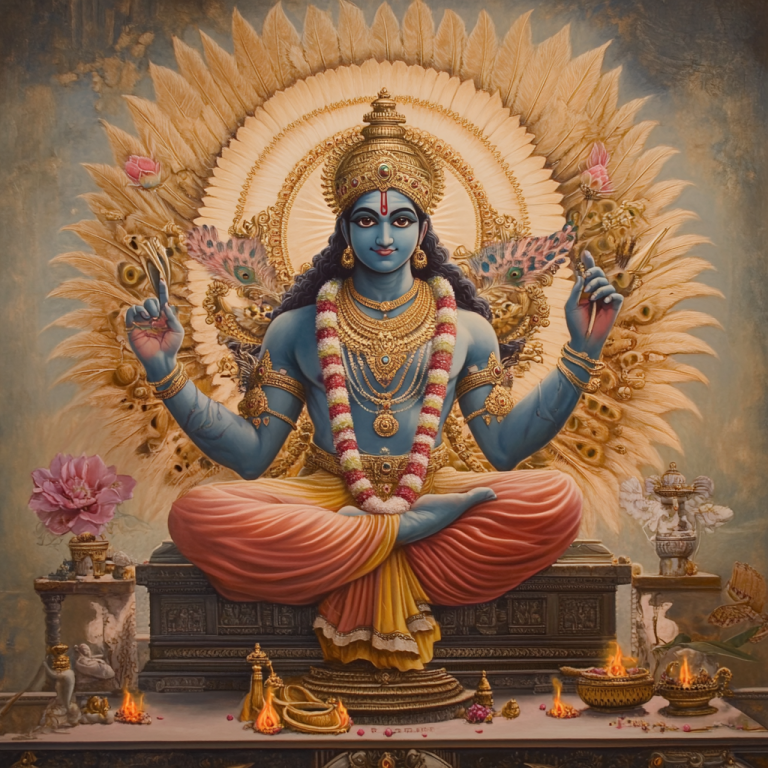
Vishnu: The Protector and Sustainer of the Universe
Vishnu is the protective aspect of the supreme trinity, which also includes Brahma (the creator) and Shiva (the destroyer). Among the three, Vishnu is most often involved in mortal and divine affairs, embodying the principles of preservation and sustenance. While there are varying beliefs regarding his origin-some say he was created by Shiva, while others believe he arose from the cosmic void (Maha Shunya)-all traditions agree on his critical role in maintaining balance and order in the universe.
Attributes and Iconography
- Color and Appearance: Vishnu is often described as having a dark or cloud-colored (mega-varnam) complexion, symbolizing the depth and infinity of the cosmos. His four arms hold:
- Sudharshana Chakra (discus): Symbolizing the mind and the destruction of evil.
- Shankha (conch): Representing sound, creation, and the sacred syllable “Om.”
- Padma (lotus): Signifying purity and spiritual enlightenment.
- Gada (mace): A symbol of strength and authority.
- Abode: Vishnu resides in Vaikunta, a celestial realm of eternal bliss and perfection. Vaikunta is described as a world free from sorrow and suffering, accessible to those who achieve liberation (moksha).
- Adisesha: Vishnu is depicted as reclining on the serpent Adisesha, who floats in an ocean of milk (Ksheera Sagara). Adisesha symbolizes infinity, and his many heads protect Vishnu while he rests.
Lakshmi: The Divine Consort
Vishnu’s consort is Lakshmi, the goddess of wealth, prosperity, and fortune. Lakshmi is said to have emerged from the churning of the ocean of milk during the Samudra Manthan, holding a lotus in her hand. Their union symbolizes the harmony between sustenance (Vishnu) and prosperity (Lakshmi). Together, they uphold the material and spiritual well-being of the universe.
Lakshmi is often depicted seated on Vishnu’s chest, emphasizing her inseparable role in his activities and blessings. Their relationship is celebrated in countless stories, such as those from the Mahabharata – The Great Epic and the Vishnu Purana.
Vishnu’s Incarnations (Avatars)
Vishnu is revered for his ten major incarnations (Dashavatara), each undertaken to restore cosmic order (dharma) and protect the universe from calamities. You can explore a detailed overview of Vishnu’s ten primary incarnations and how each avatar fulfills a specific cosmic need. Beyond the Dashavatara, many texts explore Vishnu’s transformations and lesser-known avatars, showcasing his endless forms adapted for different eras and needs. The widely accepted list includes:
| Avatar | Purpose and Role |
|---|---|
| Matsya (Fish) | Saved the Vedas from being lost during the cosmic deluge. |
| Kurma (Turtle) | Supported Mount Mandara during the churning of the ocean. |
| Varaha (Boar) | Rescued the earth (Bhudevi) from the demon Hiranyaksha. |
| Narasimha | Destroyed the tyrant Hiranyakashipu to protect his devotee, Prahlada. |
| Vamana | Diminished King Bali’s pride and restored balance between the Devas and Asuras. |
| Parashurama – Rama of the Axe | Punished the corrupt Kshatriya class to restore dharma. |
| Rama | Defeated Ravana and exemplified the ideal king and human being. |
| Krishna | Guided the Pandavas in the Mahabharata and delivered the Bhagavad Gita. |
| Buddha | Taught the principles of compassion and non-violence. |
| Kalki | Yet to appear; will destroy evil at the end of the current Kali Yuga. |
Brother of Indra
In his Vamana avatar, Vishnu was born as the younger brother of Indra, the king of the Devas. Born to Aditi and Kashyapa, Vishnu helped the Devas regain their celestial domains from King Bali, a noble Asura ruler. Vamana, one of Vishnu’s key avatars, illustrates the god’s ability to intervene with humility and cosmic purpose. This close relationship between Vishnu and Indra highlights Vishnu’s ongoing commitment to aiding the Devas in their battles against the Asuras.
The Protector of the Devas and Enemy of Asuras
Vishnu is often described as the eternal protector of the Devas and a relentless adversary of the Asuras. This dynamic is central to many mythological episodes, such as the Samudra Manthan, the battle against Hiranyaksha, and the slaying of Hiranyakashipu. Vishnu’s interventions ensure that the balance of power remains tilted toward dharma and cosmic order. His roles, actions, and characteristics as a protector are explored in more detail in this analysis of Vishnu’s avatar characteristics.
Vaishnavism: Devotion to Vishnu
Vishnu is the central deity in Vaishnavism, one of the major traditions within Hinduism. His followers, known as Vaishnavas, consider him the supreme godhead (Para Brahman) and emphasize the importance of devotion (bhakti) to attain liberation (moksha). Many Vaishnavas wear the Namam, a symbolic mark on their forehead, signifying their allegiance to Vishnu.
Prominent Vaishnavite texts include:
- Vishnu Purana: Chronicles Vishnu’s deeds and avatars.
- Bhagavad Gita: Delivered by Krishna, an avatar of Vishnu, it is a spiritual guide on dharma and devotion.
- Divya Prabandham: Tamil hymns composed by the Alvars in praise of Vishnu.
Cultural and Religious Significance
Vishnu’s role as the preserver of the universe makes him central to Hindu cosmology and mythology. His actions and avatars highlight the values of dharma, selflessness, and compassion. Stories of Vishnu are not only integral to Hindu scriptures but also form the basis for numerous festivals, such as:
- Janmashtami: Celebrating Krishna’s birth.
- Rama Navami: Honoring the birth of Lord Rama.
- Vaikunta Ekadashi: Marking the day devotees believe the gates of Vaikunta are open.
Unfinished Tales and Infinite Forms
Vishnu’s stories and attributes are infinite, reflecting his role as the sustainer of the cosmos. From his ten avatars to his countless manifestations in mythological narratives, Vishnu remains a symbol of divine intervention, ensuring the triumph of good over evil, and the preservation of balance in the universe. For a deeper dive into the diverse manifestations and roles Vishnu has assumed across time, visit this exploration of Vishnu’s incarnations and roles.
Sources & further reading
These themes are explored in greater depth across the following authoritative resources:
- Britannica, Asura
- Britannica, Naga
- Mythopedia, Hindu Mythology
- Internet Sacred Text Archive, Mahabharata
- Wendy Doniger, Hindu Myths (Penguin Classics, 1975)
External resources for further reading. Apam Napat is not affiliated with these publishers; citation does not imply endorsement.
Based on the classical texts of Hindu mythology, see our sources.