
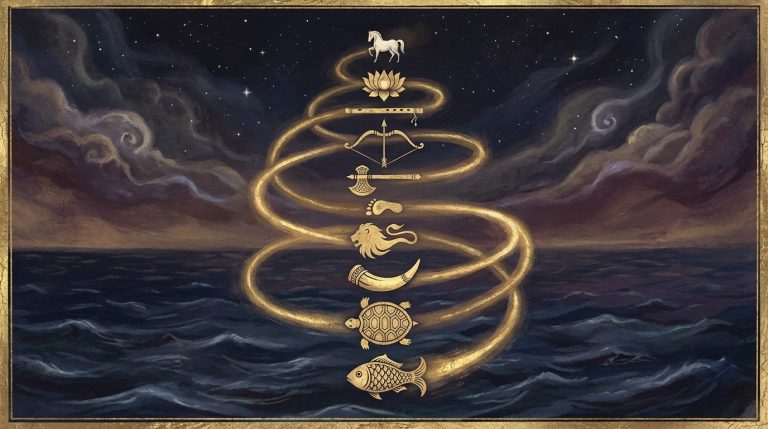
Ten of them make up the Dashavatara, the sequence most people mean when they ask how many avatars Vishnu has. Below is the complete list in order, with the age each belongs to and the crisis each answered. Nine have already appeared. The tenth has not.
The 10 avatars of Vishnu in order
| # | Avatar | Form | Yuga | The crisis it answered |
|---|---|---|---|---|
| 1 | Matsya | Fish | Satya | A world-ending flood; the Vedas stolen |
| 2 | Kurma | Tortoise | Satya | Mount Mandara sinking during the churning of the ocean |
| 3 | Varaha | Boar | Satya | The earth dragged into the cosmic waters by Hiranyaksha |
| 4 | Narasimha | Man-lion | Satya | Hiranyakashipu, made unkillable by a boon |
| 5 | Vamana | Dwarf brahmin | Treta | Bali’s conquest of all three worlds |
| 6 | Parashurama | Axe-bearing sage | Treta | A warrior class grown tyrannical |
| 7 | Rama | Prince of Ayodhya | Treta | Ravana of Lanka |
| 8 | Krishna | Cowherd, prince, charioteer | Dvapara | Kamsa, and the war of the Mahabharata |
| 9 | Buddha | Teacher | Kali | Ritual violence and misplaced faith |
| 10 | Kalki | Rider on a white horse | Kali (future) | The exhaustion of the present age |
The order is not decorative. It runs from water to land, from animal to part-animal to fully human, and from cosmic emergencies to moral and political ones. The early avatars rescue the world; the later ones argue with it.
How many avatars does Vishnu have?
Ten, if you mean the Dashavatara. Twenty-two, if you are reading the first canto of the Bhagavata Purana, which lists that many and then adds that the avatars of Vishnu are in fact beyond counting, “as innumerable as streams from an inexhaustible lake”. Some traditions settle on twenty-four.
These are not competing claims so much as different scopes. The ten are the principal descents, the ones with festivals, temples and iconography attached. The longer lists gather in sages, teachers and partial manifestations — figures such as Kapila, Dattatreya, Vyasa and the Kumaras — who carry divine purpose without being the object of the same devotional focus.
Which avatar is which number?
These questions come up constantly and the answers are worth stating plainly:
- First avatar of Vishnu — Matsya, the fish who towed Manu’s boat through the flood.
- 4th avatar of Vishnu — Narasimha, the man-lion who solved an impossible boon.
- 5th avatar of Vishnu — Vamana, the dwarf who asked for three paces of land.
- 6th avatar of Vishnu — Parashurama, the brahmin who took up an axe.
- 7th avatar of Vishnu — Rama, the prince of Ayodhya.
- 8th avatar of Vishnu — Krishna, though some traditions place Balarama here.
- 9th avatar of Vishnu — the Buddha in most Puranic lists; Balarama in several Vaishnava ones.
- 10th avatar of Vishnu — Kalki, still to come.
The disputed ninth
The ninth position is the one place where the standard list genuinely splits. The Bhagavata, Garuda and Agni Puranas name the Buddha, presenting him as a deliberate incarnation who turned people away from animal sacrifice. Several Vaishnava traditions instead name Balarama, Krishna’s elder brother, and shift the others accordingly.
Both are long-standing textual positions. Where a source you are reading lists nine or ten avatars and the names do not match another list, this is almost always the reason.
Two things are worth adding, because most summaries leave them out. Buddhism does not accept this identification. The avatar claim is a Hindu one, made about the Buddha rather than by the tradition he founded, and many Buddhists regard it as absorbing their teacher into a framework he did not belong to. It is a Puranic position, not a neutral fact.
The Puranic treatment is also not uniformly admiring. Some passages present the Buddha avatar approvingly, as turning people away from animal sacrifice; others frame it polemically, as leading the unworthy away from the Vedas. Both readings sit inside the same corpus, and which one a source emphasises usually says more about that source than about the texts.
Why Vishnu takes form
The clearest statement of purpose is Krishna’s own, in the Bhagavad Gita (4.7–8): whenever dharma declines and adharma rises, he takes birth age after age, to protect the good, to restrain the destructive and to re-establish dharma. Every avatar in the list can be read against that sentence. Matsya answers a flood, Narasimha answers a loophole, Rama answers a tyrant, Kalki will answer an exhausted age.
It is also worth noting what the avatars are not. They are not reincarnations in the sense that applies to ordinary beings working through karma. They are deliberate descents, undertaken with full awareness and for a specific purpose, and they end when that purpose is complete.
Frequently asked questions
How many avatars does Vishnu have?
What are the ten avatars of Vishnu in order?
Who is the 10th avatar of Vishnu?
Who is the 9th avatar of Vishnu?
Why does Vishnu take avatars at all?
Do the avatars follow a pattern?
Do Buddhists accept that the Buddha is an avatar of Vishnu?
Sources & further reading
These accounts are drawn from and can be checked against the following primary texts and reference works:
Based on the classical texts of Hindu mythology, see our sources.