
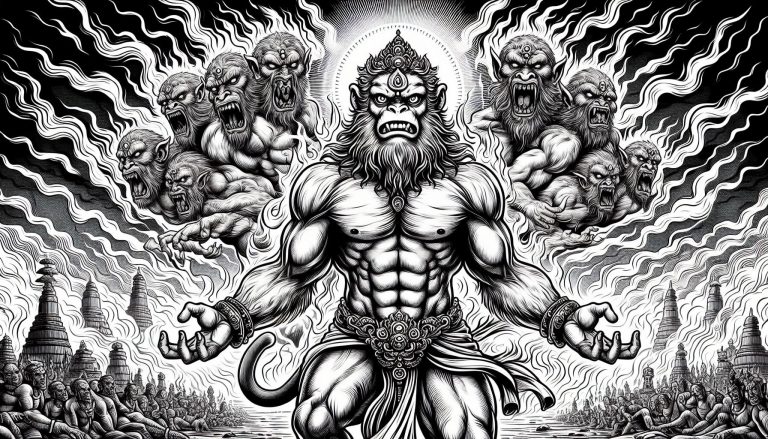
In the heart of the Ramayana – Epic of Hinduism, this encounter showcases the timeless struggle between good and evil. Hanuman, with his boundless courage and supernatural abilities, challenges Ravana’s tyranny, highlighting the power of righteousness. This epic duel isn’t merely a fight; it’s a symbol of hope and the eternal triumph of virtue over vice.
Background of Hanuman
Hanuman, a pivotal character in Hindu mythology, is known for his exceptional bravery and strength. Son of Vayu, the god of wind, and Anjana, a monkey, Hanuman exhibited extraordinary energy and playfulness from a young age. His feats included mistaking the sun for a ripe fruit and attempting to seize it, showcasing his daring nature.
Hanuman’s encounter with Indra, lord of the skies, highlighted his courage. Defiant and strong-willed, Hanuman stood up to Indra, reinforcing his legendary status. This early display of valor set the stage for his crucial role in the Ramayana.
In the epic Ramayana, Hanuman became an instrumental figure in Rama’s quest to find and rescue his abducted wife, Sita. Alongside three other monkeys, Hanuman embarked on a journey that showcased his loyalty and ingenuity. His daring flight across the ocean to Lanka, and his intelligence in locating Sita, were key to Rama’s mission.
Hanuman’s efforts didn’t stop there. He contributed significantly by helping Rama build a bridge to Lanka and leading the monkey army in the assault on Ravana’s fortress. His unwavering dedication and extraordinary abilities made Hanuman a revered hero in Hindu tradition.
Background of Ravana
Ravana, the mythical multi-headed demon-king of Lanka, stands as a central figure in the Ramayana. He has ten heads and twenty arms, and he can change into any form he wishes. Ravana was the grandson of Pulastya, one of the greatest sages in Indian mythology and one of the Saptarishis. His parents were Sage Vishravan and Kaikashi—an Asura’s mother—making him half Asur (demon) and half Brahmin (sage).
A devout follower of Lord Shiva, Ravana was also an inordinate scholar and an excellent ruler. He mastered the veena, a plucked string instrument, and authored two books: the Ravana Samhita (a book of astrology) and Arka Prakasham (a book on Siddha medicine). His expertise spanned Ayurveda and the dark practices of black magic, and it’s said he could control planetary positions at his will.
Setting the Stage for the Battle
Hanuman, as Rama’s loyal servant, finds Sita imprisoned in Ravana’s palace. Upon discovering her plight, he assures her that Rama’s help is imminent. However, Ravana’s demon soldiers capture him soon after. Ravana, intrigued by Hanuman’s strength and majesty, interrogates him regarding his actions in the Asoka-grove. Displaying unwavering loyalty to Rama, Hanuman declares himself a messenger of Sugreeva – The King of Monkeys. He implores Ravana to return Sita to Rama, warning him of Rama’s impending wrath.
Incensed by Hanuman’s defiance, Ravana orders his execution. The situation takes a turn when Vibhishana – Brother of Ravana, Ravana’s brother, intervenes. Vibhishana advises Ravana to adhere to the scriptures and render an appropriate punishment instead. Following Vibhishana’s counsel, Ravana instructs his demons to set Hanuman’s tail on fire, a punishment Hanuman endures with resilience.
The Clash of Titans: Hanuman’s Fight with Ravana
Hanuman’s battle with Ravana remains one of the most iconic moments in ancient Indian tales. It encapsulates his incredible strength and unwavering dedication to Lord Rama.
Initial Encounter
Hanuman, the revered monkey god, embarked on a reconnaissance mission to gather information about Sita’s captivity. Disguised, I infiltrated Lanka and discovered Sita in the Ashoka Grove. After assuring her of Rama’s imminent arrival, I prepared to relay the vital information to my allies.
Key Moments of the Battle
- Hanuman’s Strength and Ravana’s Power: The battle showcased my agility, intelligence, and sheer strength contrasting Ravana’s formidable power. Despite my attacks, Ravana quickly recuperated, continuing the fierce combat.
- Hanuman’s Salute to Ravana: When Ravana’s blow rendered me unconscious, I regained composure and saluted him. Even amidst the battle, acknowledging Ravana’s energy and strength underlined the mutual respect warriors can have.
Strategies and Tactics
To counter Ravana’s might, I employed a blend of brute strength and strategic maneuvering. Leveraging agility and intelligence, my approach was to weaken Ravana through tactical strikes, avoiding direct power clashes when possible. This strategic blend ensured a balanced combat, highlighting the distinct prowess inherent in both entities.
Outcome of the Battle
Hanuman’s Capture and Torture
Hanuman, a loyal servant and emissary of Rama, infiltrates Lanka to gather information and locate Sita, imprisoned by Ravana. Discovered by Ravana’s demon soldiers, Hanuman is captured and brought before Ravana. Impressed by Hanuman’s strength and majesty, Ravana questions him about his purpose and actions in the Asoka grove. Hanuman, proclaiming his loyalty to Rama, pleads with Ravana to return Sita or face Rama’s wrath. Enraged, Ravana orders Hanuman’s death, but his brother Vibhisana intervenes, advising Ravana to follow the scriptures and exact a more appropriate punishment. Ravana instead orders his demons to set Hanuman’s tail on fire.
Hanuman’s Escape and Burning of Lanka
Enduring the punishment, Hanuman uses the opportunity to gather military information about Lanka. Taking advantage of the flames on his tail, Hanuman sets fire to various parts of the city, causing widespread destruction. His agility and strength allow him to escape, leaving a blazing trail and a strong message to Ravana—Rama’s victory is inevitable if he doesn’t return Sita.
The outcome emphasizes Hanuman’s unwavering loyalty, strategic intelligence, and immense strength. His actions lead to significant damage to Lanka and provide crucial insights for Rama’s eventual assault on Ravana.
Symbolism and Themes
Hanuman’s fight with Ravana holds deep symbolic meaning and resonates with several timeless themes. These aspects contribute to the narrative’s rich cultural and moral tapestry.
Good vs Evil
In this battle, Hanuman represents the force of good, embodying virtues like loyalty, courage, and righteousness. Ravana, on the other hand, symbolizes evil, marked by arrogance, cruelty, and hubris. The clash between these two forces underscores the eternal struggle between good and evil. Hanuman’s victory in the face of seemingly insurmountable odds illustrates that righteousness, guided by unwavering devotion, can overcome darkness and malevolence.
Strength and Cunning
Hanuman’s ability to combine physical strength with strategic cunning plays a crucial role in his fight against Ravana. While Ravana relies on brute force and intimidation, Hanuman leverages his agility, intelligence, and strategic acumen. For instance, Hanuman allows himself to be captured to learn more about Ravana’s palace and forces, displaying patience and forethought. Upon escaping, he sets Lanka ablaze, demonstrating that true strength lies in the ability to adapt and outthink the adversary. This theme emphasizes that a balanced approach of might and mind often leads to victory.
Legacy of the Fight
Hanuman’s battle with Ravana left an enduring imprint on both lore and cultural consciousness. The fight symbolized the embodiment of virtuous struggle—a clash where good fought evil with valor, intellect, and unwavering determination. The depiction of Hanuman’s heroism has inspired countless generations, embedding pivotal lessons in moral and ethical values.
Transmission of these tales through epics like the Ramayana has preserved this legacy. Memorials, temples, and traditions across India, such as Hanuman Jayanti, celebrate Hanuman’s courage and devotion annually, reinforcing his significance.
The legacy also extends to literature and the arts. Numerous literary works, folktales, and theatrical performances underscore Hanuman’s legendary combat skills and strategic acumen, ensuring his story remains integral to India’s cultural heritage. In modern media, adaptations of the Ramayana, including films and television series, continue to propagate the influence of Hanuman’s endeavors.
Education systems integrate this narrative, highlighting Hanuman’s virtues of loyalty, bravery, and wisdom. Schools often use these stories to instill values, nurturing future generations with these timeless principles.
Conclusion
Hanuman’s fight with Ravana isn’t just a tale of physical combat; it’s a profound lesson in courage, loyalty, and intelligence. This epic battle stands as a timeless reminder of the power of righteousness and the eternal struggle between good and evil. Hanuman’s legacy, celebrated through various cultural mediums, continues to inspire and educate. By embodying the virtues of bravery and wisdom, Hanuman’s story remains a cornerstone of moral and ethical teachings, deeply embedded in India’s cultural fabric.
Sources & further reading
These themes are explored in greater depth across the following authoritative resources:
- Encyclopaedia Britannica, Hindu Mythology
- Internet Sacred Text Archive, Hinduism
- Mythopedia, Hindu Mythology
- Harvard Pluralism Project, Hindu Tradition
- Wendy Doniger, The Hindus: An Alternative History (Penguin, 2009), ISBN 978-0143116691
External resources for further reading. Apam Napat is not affiliated with these publishers; citation does not imply endorsement.
Based on the classical texts of Hindu mythology, see our sources.