I’ve always been fascinated by how these symbols convey complex ideas in such a visually captivating manner. Whether it’s the multi-armed deities representing various powers or the sacred animals embodying divine attributes, each symbol serves as a bridge connecting the material and spiritual worlds. Join me as we investigate into the mesmerizing world of Hindu myth symbolic representations and uncover the layers of wisdom they offer.
Overview of Hindu Myth Symbolic Representations
Hindu mythology’s symbolic representations are deeply entrenched in various artistic and cultural domains. These symbols convey philosophical truths and cultural values effectively.
Visual Arts
Images and Icons: Hindu sculpture and painting often depict deities in specific poses, known as murti, symbolizing their powers and roles. For instance, Devi seated on a lion embodies the triumph of divine power over evil.
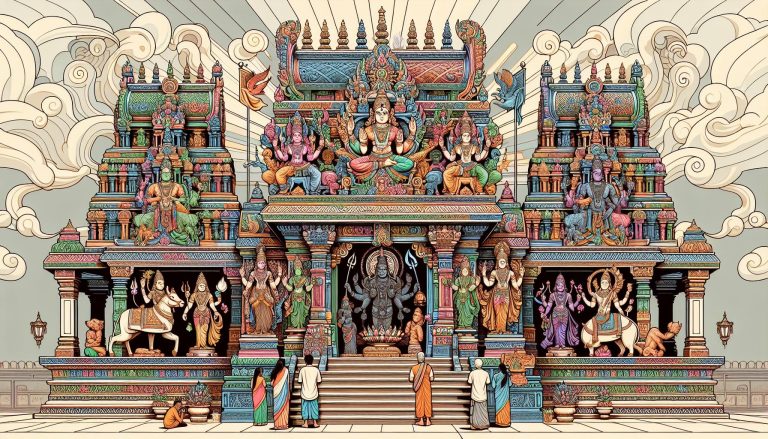
Cosmic Symbolism: The design of Hindu temples is codified in the Shilpa-shastras, reflecting Vedic microcosmic symbolism. Temples, laid out geometrically, mirror the universe’s structure with four quarters and a celestial roof.
Performing Arts
Dance and Theater: Hindu dance and theater are essential for expressing myths. Performances often use intricate gestures, costumes, and narratives to bring mythological stories to life, engaging the audience and preserving cultural heritage.
Common Symbols in Hindu Mythology

Symbolism in Hindu mythology is vast and intricate, playing a pivotal role in the religion’s cultural and spiritual practices. Below are some common symbols categorized into sacred animals, plants and trees, and celestial bodies.
Sacred Animals
Cow: The cow stands as the most sacred animal in Hinduism. It symbolizes good nature, purity, motherhood, and prosperity. Cows are closely associated with Lord Krishna – An Incarnation of Vishnu and often appear in his depictions.
Peacock: The peacock is linked to good luck and prosperity in Hinduism. This splendid bird is associated with Lord Krishna, who adorns a peacock feather in his crown. Created from a feather of Garuda, the peacock signifies its divine origin and connection with Lord Vishnu.
Naga: Represented as a half-human, half-snake deity, the naga is a prominent symbol in Hindu mythology. Nagas are revered for their protective powers and often appear in iconography connected to Shiva and Vishnu.
Plants and Trees
Hindu mythology also reveres various plants and trees for their spiritual significance.
Tulsi: The holy basil plant, Tulsi, holds immense religious significance. It’s considered a manifestation of the goddess Lakshmi and is believed to cleanse the body and mind.
Banyan Tree: Symbolizing longevity and immortality, the banyan tree represents Brahma, the creator god. It’s also linked to Lord Shiva, who meditates under it, reflecting the tree’s role in fostering deep meditation and spiritual growth.
Celestial Bodies
Celestial bodies play a crucial role in Hindu symbolism, linking the cosmos to divine elements.
Sun: The Sun God, Surya, represents vitality, light, and knowledge. Depictions often show him riding a chariot driven by seven horses, symbolizing the days of the week and the divine light illuminating the world.
Moon: The moon, associated with Lord Shiva and Chandra – The Moon, signifies emotions, the mind, and tranquility. It affects human moods and is vital in Hindu rituals and timing.
These elements stand as a testament to Hinduism’s profound connection with nature and the cosmos, offering intricate symbols that guide spiritual and cultural understanding.
Representations of Deities
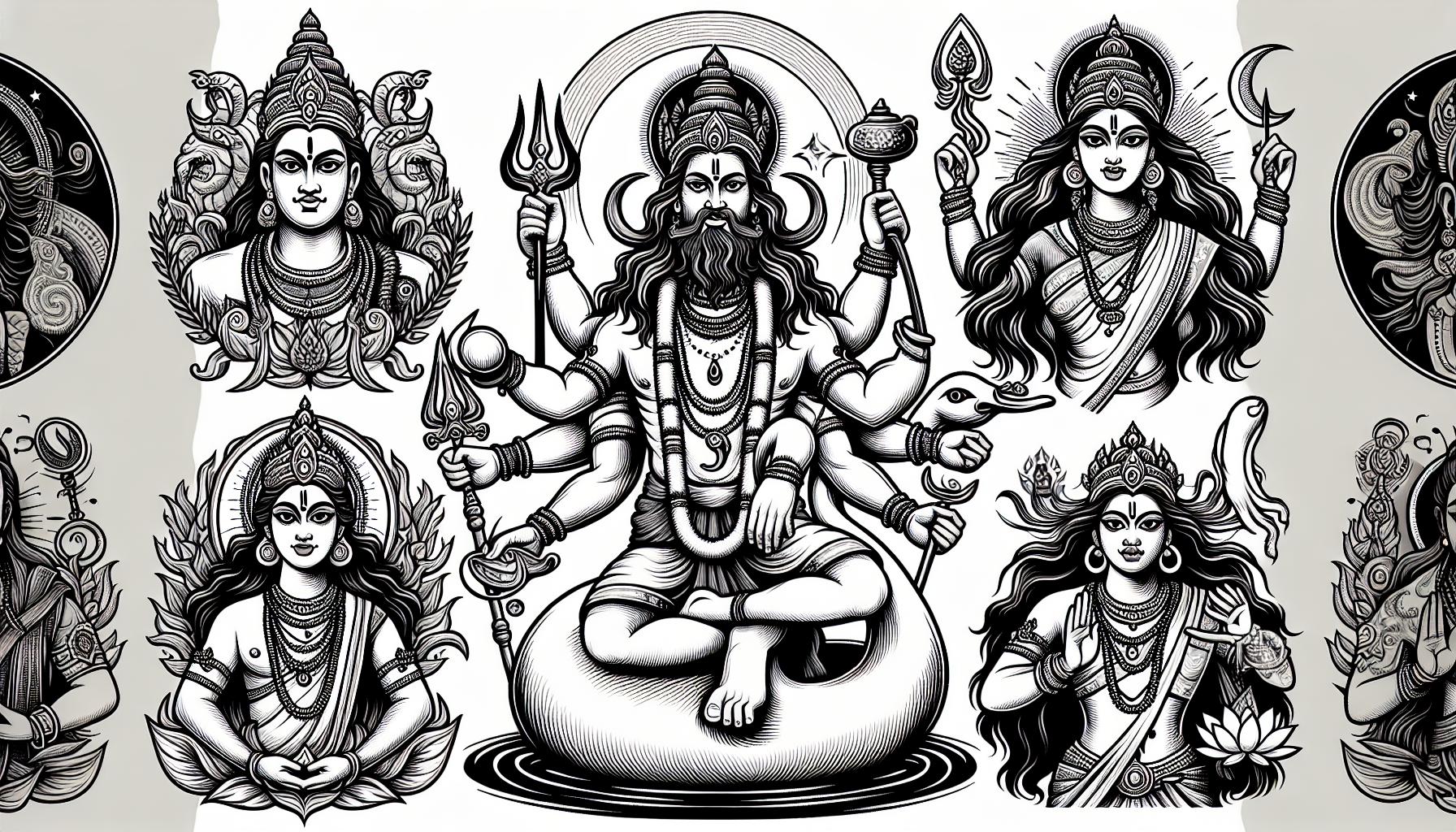
In Hindu mythology, deities’ representations carry profound meanings, reflecting their roles and attributes. These depictions serve as a bridge, connecting devotees to the divine.
Iconography of Major Deities
The iconography of Hindu deities uses detailed elements to symbolize their divine functions and stories.
- Brahma:
- Brahma, the god of creation, is depicted with four heads. These heads represent the four Vedas—Rigveda, Samaveda, Yajurveda, and Atharvaveda—emphasizing his role in the creation and spread of knowledge.
- Brahma’s association with a swan symbolizes wisdom and discernment, qualities crucial for creation.
- Vishnu:
- Vishnu, the preserver of the universe, commonly appears with four arms. Each arm holds a symbolic object: a conch shell (Shankha) signifying the primordial sound, a discus (Chakra) representing the mind, a mace (Gada) symbolizing strength, and a lotus flower (Padma) indicating purity and enlightenment.
- His avatars, including Rama (hero of the Ramayana – Epic of Hinduism) and Krishna (central figure in the Mahabharata – The Great Epic), are revered for their roles in restoring cosmic order.
- Shiva:
- Shiva, the destroyer and transformer, is recognized by his third eye, an emblem of his destructive power and insight. His depiction often includes the crescent moon on his head, the river Ganges flowing from his hair, and the serpent around his neck, each element portraying different aspects of his attributes.
- Associated with Nandi, the bull, which symbolizes strength and virility, Shiva is seen as the force that maintains cosmic balance through destruction.
- Shakti:
- Shakti, the supreme Goddess representing feminine power, manifests in multiple forms, including Durga, Parvati, Sati, and Kali. Each form highlights different energies and aspects of the divine feminine.
- Durga, armed with multiple weapons, signifies protection and power against evil. Parvati, as a nurturing mother, embodies love and devotion. Kali, with her fierce appearance, represents the destruction of the ego and illusions.
Attributes and Symbols
Different attributes and symbols uniquely identify Hindu deities, enhancing the understanding of their cosmic roles.
- Brahma: The four heads of Brahma each face a cardinal direction, symbolizing his omnipresence and omniscience.
- Vishnu: Vishnu’s objects (conch shell, discus, mace, lotus) highlight his roles in protection, strength, mental focus, and purity.
- Shiva: Shiva’s third eye, crescent moon, river Ganges, trident, and serpent all depict elements of his governance over time, cycles of creation and destruction, and mastery over death.
- Shakti: Shakti’s various weapons, attire, and mounts in her forms (like Durga’s lion) articulate her dynamic and multifaceted divine nature.
The distinct iconographic details and symbols of these deities form a complex and rich world, reflecting Hinduism’s deep spiritual and cultural heritage.
Mythological Stories and Their Symbolism
Hindu mythology is a vast collection of symbolic narratives, each bearing significant philosophical and moral lessons. The stories convey deeper meanings through symbolic representations.
Creation Myths
Hindu creation myths, found in texts like the Vedas and Puranas, explain the universe’s origins and the creation of humans. The story of Brahma, the creator god, is central. Brahma emerges from a golden egg called Hiranyagarbha, symbolizing the cyclical nature of creation and destruction. This myth underscores the concept of rebirth, with Brahma creating and then destroying the universe in perpetual cycles.
Epics and Puranas
The epics Ramayana and Mahabharata, along with various Puranas such as Vishnu Purana and Shiva Purana, hold a significant place in Hindu mythology. The Ramayana recounts the journey of Prince Rama and emphasizes dharma (duty/righteousness). The Mahabharata contains the Bhagavad Gita, where Lord Krishna imparts spiritual wisdom to Arjuna. These stories not only entertain but also impart moral and ethical lessons, highlighting virtues like loyalty, bravery, and selflessness. The Puranas elaborate on these themes, providing additional context and detailed narratives about the gods and the universe’s workings.
Symbolism in Rituals and Practices
In Hinduism, symbolic representations imbue rituals and practices with deeper spiritual meanings. These symbols shape the way adherents connect with the divine, enhancing the overall religious experience.
Festivals
Festivals in Hinduism are rich with symbolism, reflecting myths and divine stories. Diwali, the Festival of Lights, symbolizes the victory of light over darkness and good over evil. Houses are lit with oil lamps (diyas) and candles, representing the inner light that protects from spiritual darkness. During Holi, the Festival of Colors, people throw colored powders, signifying the arrival of spring and the triumph of good over evil. The colors represent humanity, the vibrancy of life, and the joyousness of the changing seasons.
Daily Worship
Daily worship (puja) in Hindu households includes symbolic rituals that represent universal truths. The lighting of a lamp signifies the dispelling of ignorance and welcoming of divine light. Offering flowers symbolizes devotion and the desire to please the deity, while incense sticks represent the fragrance of virtue and moral excellence. Using water in rituals purifies the mind and soul, preparing an individual for spiritual activities. Hindus often place murtis (icons) in their homes, which serve as a focus for prayer and meditation, believed to house the divine presence.
Conclusion
Hindu mythology’s rich symbolic representations offer profound insights into its philosophical and cultural fabric. Through art, rituals, and narratives, these symbols convey timeless truths and moral lessons. They enhance our understanding of the divine and the cosmos, making Hindu mythology a deeply spiritual and culturally enriching experience. By appreciating these symbols, we can connect more deeply with the values and wisdom that have shaped Hindu traditions for millennia.
Sources & further reading
These themes are explored in greater depth across the following authoritative resources:
- Internet Sacred Text Archive, Rig Veda (Griffith translation)
- Internet Sacred Text Archive, Upanishads
- Britannica, Veda
- Britannica, Upanishad
- Patrick Olivelle, The Early Upanishads (Oxford University Press, 1998)
External resources for further reading. Apam Napat is not affiliated with these publishers; citation does not imply endorsement.
Frequently asked questions
What is a murti in Hindu sculpture?
How are Hindu temples symbolically designed?
What do multi-armed deities symbolize?
What are sacred animals in Hindu mythology?
Based on the classical texts of Hindu mythology, see our sources.