

The Bhagavad Gita isn’t just a spiritual guide; it’s a practical manual for living a life of purpose and enlightenment. Through its verses, Lord Krishna – An Incarnation of Vishnu imparts wisdom that helps us understand our true nature and the path to spiritual freedom. Join me as we explore how the Gita’s timeless lessons can lead us toward Moksha, unraveling the mysteries of existence and the ultimate journey of the soul.
Understanding Moksha
Moksha, a key concept in Hinduism, signifies the liberation of the soul from the cycle of birth, death, and rebirth (samsara). This state of emancipation is achieved through the realization of the self’s true nature and the universe. Once attained, moksha leads to eternal bliss and unity with the Supreme Being. Understanding this profound concept involves delving into the teachings and paths outlined in sacred texts.
Paths to Moksha in the Bhagavad Gita
The Bhagavad Gita, a cornerstone of Hindu philosophy, offers three distinct paths to achieve moksha. These paths emphasize different approaches to spiritual enlightenment.
- Path of Duty (Karma-Marga):
Karma-Marga focuses on performing one’s duties without attachment to the results. This path underscores the significance of fulfilling one’s dharma (moral duty) and contributing to the greater good through selfless action. For instance, Arjuna – The Peerless Archer’s commitment to his role as a warrior, even though his personal dilemmas, exemplifies karma-marga. - Path of Knowledge (Jnana-Marga):
Jnana-Marga emphasizes pursuing spiritual knowledge and self-realization. This path involves deep contemplation and disciplined study to understand the nature of the self and the universe. Through discernment and insight, one can achieve liberation. Examples include rigorous practices of meditation and philosophical inquiry undertaken by sages. - Path of Devotion (Bhakti-Marga):
Bhakti-Marga emphasizes devotion and love towards a personal deity. This path engenders surrender to the divine, fostering a deep connection with the Supreme Being. Practitioners express their devotion through rituals, prayers, and unwavering dedication. Mirabai’s poetic devotion to Krishna is a notable example of bhakti-marga.
By understanding these paths, adherents can navigate their spiritual journey, aiming to transcend the cycle of samsara and reach the exalted state of moksha.
The Role of the Bhagavad Gita
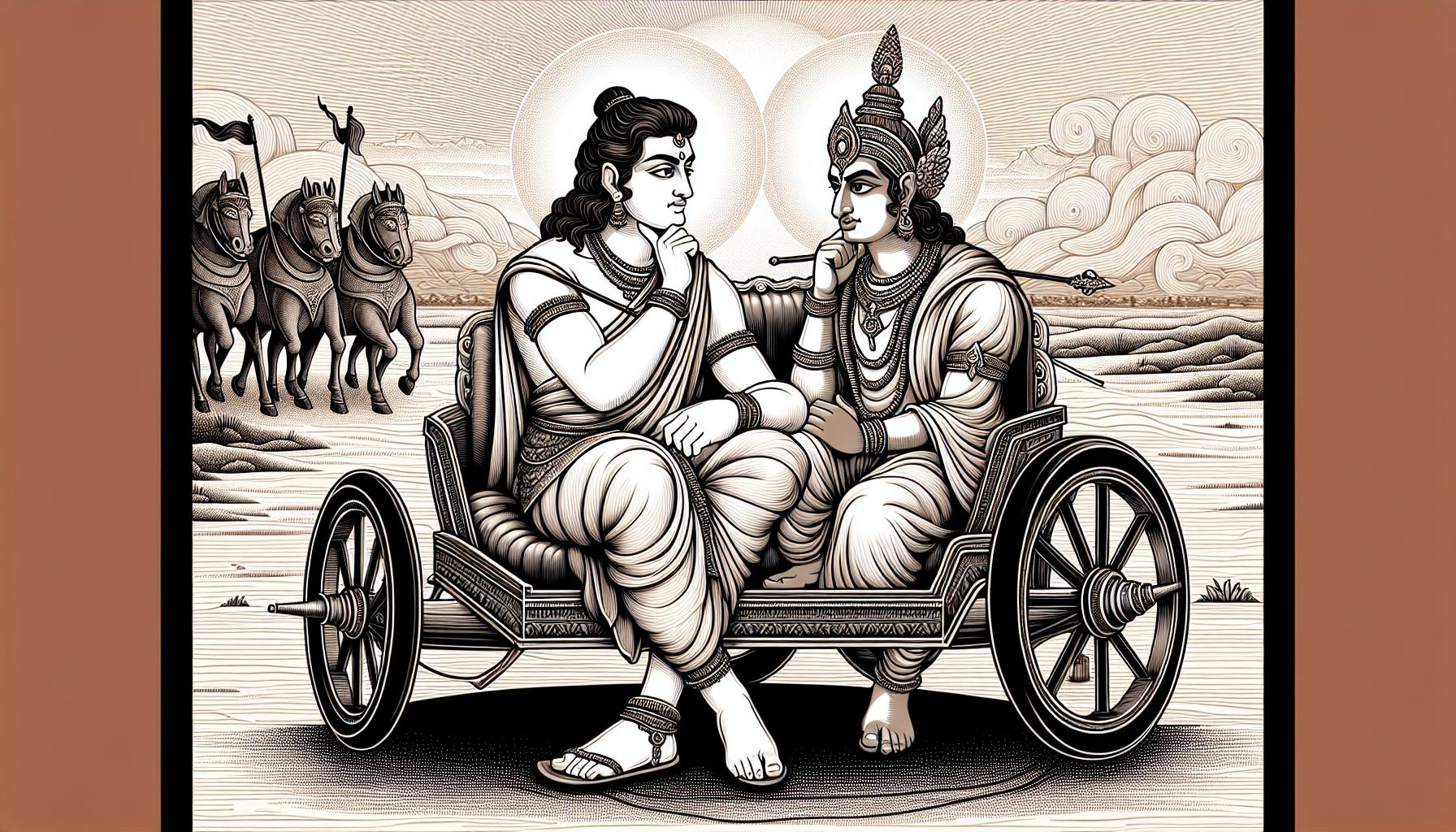
The Bhagavad Gita holds a crucial place in understanding Moksha within Hindu philosophy. This sacred text serves as a spiritual guide for Hindus seeking liberation from the cycle of birth and rebirth.
Historical Context
Believed to have been composed in the 1st or 2nd century CE, the Bhagavad Gita is part of the Mahabharata – The Great Epic. The Gita occupies chapters 23 to 40 of Book VI in this epic poem. It unfolds as a dialogue between Prince Arjuna and Krishna, an avatar of the god Vishnu – The Protector, discussing the nature of duty, righteousness, and the path to spiritual freedom.
Importance in Hindu Philosophy
The Bhagavad Gita is celebrated for its spiritual insights and comprehensive coverage of Hinduism’s core beliefs. It illuminates the distinctions between the transient physical body and the eternal self. The text also elaborates on the concept of transmigration of the soul and offers profound teachings on achieving Moksha, the ultimate spiritual goal. By following guidance from the Gita, individuals can understand the paths of Karma-Marga (duty and selfless action), Jnana-Marga (knowledge and self-realization), and Bhakti-Marga (devotion and love towards a deity) to attain liberation.
This sacred scripture embodies the essence of Hindu philosophy and provides a roadmap for those on a spiritual journey towards Moksha.
Key Teachings on Moksha in the Bhagavad Gita

The Bhagavad Gita outlines Moksha as the ultimate goal, where the soul attains eternal peace and unity with the divine. Key teachings divided into three primary paths guide this journey.
The Path of Knowledge (Jnana Yoga)
Jnana Yoga, the path of knowledge, focuses on self-realization. This intellectual path involves deep contemplation and understanding of one’s true nature as part of the cosmic whole. By transcending the ego and recognizing the self’s unity with Brahman – The Supreme Truth, individuals navigate their way to Moksha.
The Path of Devotion (Bhakti Yoga)
Bhakti Yoga emphasizes devotion and love towards a deity. This emotional and heartfelt path involves surrendering oneself to a higher power, fostering a deep, personal connection with the divine. Through prayer, rituals, and constant remembrance, devotees aim to dissolve the ego and attain liberation.
The Path of Action (Karma Yoga)
Karma Yoga highlights the importance of selfless action. By performing one’s duty without attachment to outcomes, individuals purify their mind and align their actions with the greater good. This path encourages dedication to righteous deeds as a means to transcend the cycle of birth and rebirth.
These three paths, detailed in the Bhagavad Gita, offer comprehensive guidance for individuals seeking Moksha.
Practical Applications of Moksha in Modern Life
Moksha isn’t just a distant spiritual goal; it can transform daily life in meaningful ways. The Bhagavad Gita provides actionable insights, applicable even in today’s context, to help the pursuit of moksha.
Reducing Stress Through Detachment
Adopting the principle of detachment from outcomes can significantly reduce stress. By focusing on efforts rather than results, there’s less pressure and anxiety. For instance, in a high-stakes career, concentrating on performing duties well without obsessing over promotions or rewards can improve mental well-being.
Enhancing Relationships Through Selflessness
Selfless action fosters healthier relationships. When I perform duties in personal or work relationships without expecting reciprocation, it strengthens bonds. Acts of kindness or assistance, when done without expectation, often result in deeper connections and mutual respect.
Fostering Focus on Personal Growth
Moksha encourages continual self-improvement. The Bhagavad Gita’s teachings on self-realization push me to understand my true nature, leading me to pursue knowledge and personal growth. This can take the form of educational endeavors, spiritual practices, or even simply reflective thinking.
Cultivating Inner Peace Through Devotion
Practicing Bhakti Yoga, or the path of devotion, helps cultivate inner peace. Devotion to a higher power or purpose can provide comfort and a sense of belonging. For many, daily routines such as prayers, meditation, or service activities bring solace and a tranquil mind.
Building Resilience Through Knowledge
Knowledge allows for resilience in the face of life’s challenges. The Bhagavad Gita emphasizes understanding the eternal nature of the soul, which brings a profound sense of peace and fortitude. When faced with setbacks, this perspective can foster resilience and a positive outlook.
The Bhagavad Gita’s teachings on moksha so provide practical methods to improve contemporary life by focusing on duty, selflessness, personal growth, devotion, and knowledge.
Criticisms and Contrasting Views
Monistic and Dualistic Interpretations
Adi Shankara interprets the Bhagavad Gita in the monistic tradition of Advaita Vedanta, highlighting the non-dualism of Atman – The Soul (soul) and Brahman (ultimate reality). According to him, realizing the oneness of Atman and Brahman leads to moksha. By contrast, Ramanuja offers a dualistic and qualified monism perspective through Vishishtadvaita. He believes that while the soul is distinct from Brahman, it remains intimately connected and dependent on it. These divergent views reflect rich philosophical debates.
Gender and Moksha
The Bhagavad Gita emphasizes gender equality in attaining moksha. It asserts that both men and women have the same capacity to achieve spiritual liberation. The text describes yogic practices such as meditation, ethical living, and devotion (e.g., chanting, rituals) that work equally for all. This approach challenges traditional gender roles and underscores universal accessibility to spiritual paths.
Conclusion
The Bhagavad Gita offers profound insights into achieving Moksha, making it relevant even in today’s rapid world. By embracing the teachings of Karma, Jnana, and Bhakti, we can navigate life’s challenges with greater ease and purpose. The dialogue between Arjuna and Krishna serves as a timeless guide for personal and spiritual growth.
Understanding the diverse interpretations of Moksha, including those from Advaita Vedanta and Vishishtadvaita, enriches our spiritual journey. The Gita’s emphasis on gender equality further underscores its universal appeal. By applying these principles, we can cultivate inner peace, resilience, and a deeper sense of fulfillment in our daily lives.
Sources & further reading
These themes are explored in greater depth across the following authoritative resources:
- Stanford Encyclopedia of Philosophy, Hindu Philosophy
- Britannica, Moksha
- Britannica, Brahman
- Internet Sacred Text Archive, Upanishads
- Sarvepalli Radhakrishnan, Indian Philosophy (2 vols., Oxford University Press, 1923)
External resources for further reading. Apam Napat is not affiliated with these publishers; citation does not imply endorsement.
Frequently asked questions
How does the Bhagavad Gita describe moksha?
What are the paths to moksha in the Gita?
Why is the Bhagavad Gita important for spiritual seekers?
Who teaches moksha in the Bhagavad Gita?
Based on the classical texts of Hindu mythology, see our sources.