
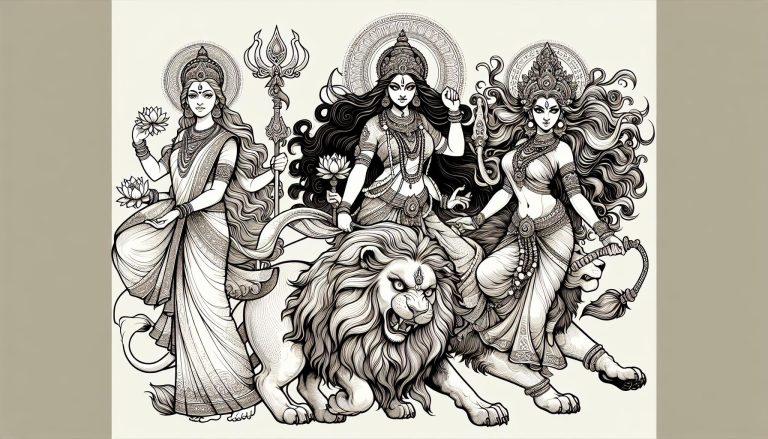
I find it fascinating how these goddesses, though distinct in their attributes, are interconnected and often seen as different manifestations of the same divine energy. Parvati represents love and devotion, Durga embodies strength and justice, while Kali is the fierce destroyer of evil. Understanding their roles not only enriches our knowledge of Hindu mythology but also offers timeless wisdom relevant to our everyday lives.
Overview of Parvati, Durga, and Kali
Parvati
Parvati embodies the goddess of marriage and childbirth, representing the nurturing aspect of the feminine divine. As the consort of Lord Shiva – The Destroyer, she goes by various names, including Uma, Gauri, and Lalitha. She showcases multiple forms, such as Durga and Kali, to combat evil forces and maintain cosmic balance.
Durga
Durga stands as a formidable warrior goddess, often depicted riding a lion or tiger. She is a manifestation of Parvati, specifically embodying the fierce and protective aspects. In the Devi Mahatmya, Durga’s epic battle against the demon Rakthabija illustrates her strength and determination. During this battle, she summons Kali from her being to vanquish the demons more effectively.
Kali
Kali, another powerful form of Parvati, symbolizes the ultimate destroyer of evil. She emerges from Durga during critical battles, wielding immense power and ferocity. Kali represents the transformative force essential for eradicating negativity and fostering regeneration in the cosmos.
Parvati: The Gentle Mother

Parvati, known as the nurturing and protective mother goddess, embodies the gentle aspect of the divine feminine. Her character in Hindu mythology is rich with compassionate and loving qualities that provide a balanced view of feminine divinity.
Mythological Background
Parvati, daughter of the Himalayan king Himavan and queen Maināvati, is a pivotal figure in Hindu lore. As the consort of Shiva, her narrative weaves closely with his, establishing a dynamic interplay between feminine and masculine energies. Parvati’s children, Ganesha and Kartikeya, further signify her role in family lore, reinforcing her status as the goddess of domestic bliss and motherhood.
Key Attributes and Symbolism
Parvati is revered as the goddess of marriage, family, beauty, fertility, and the arts. Symbols such as lotus flowers, tigers, elephants, and tridents are frequently linked to her. Lotus flowers represent purity and beauty, while tigers and elephants signify her connection to nature and inherent power. Tridents, often carried by Shiva, symbolize her shared energy and divine partnership with him.
Worship and Festivals
Devotees honor Parvati through various rituals and festivals, emphasizing her nurturing and maternal nature. One prominent festival includes Navratri, lasting nine nights to celebrate her different forms like Durga and Kali. Other celebrations, like Teej and Karva Chauth, focus on her role as a devoted wife and loving mother, drawing women particularly in worship and cultural reverence.
Durga: The Fierce Protector
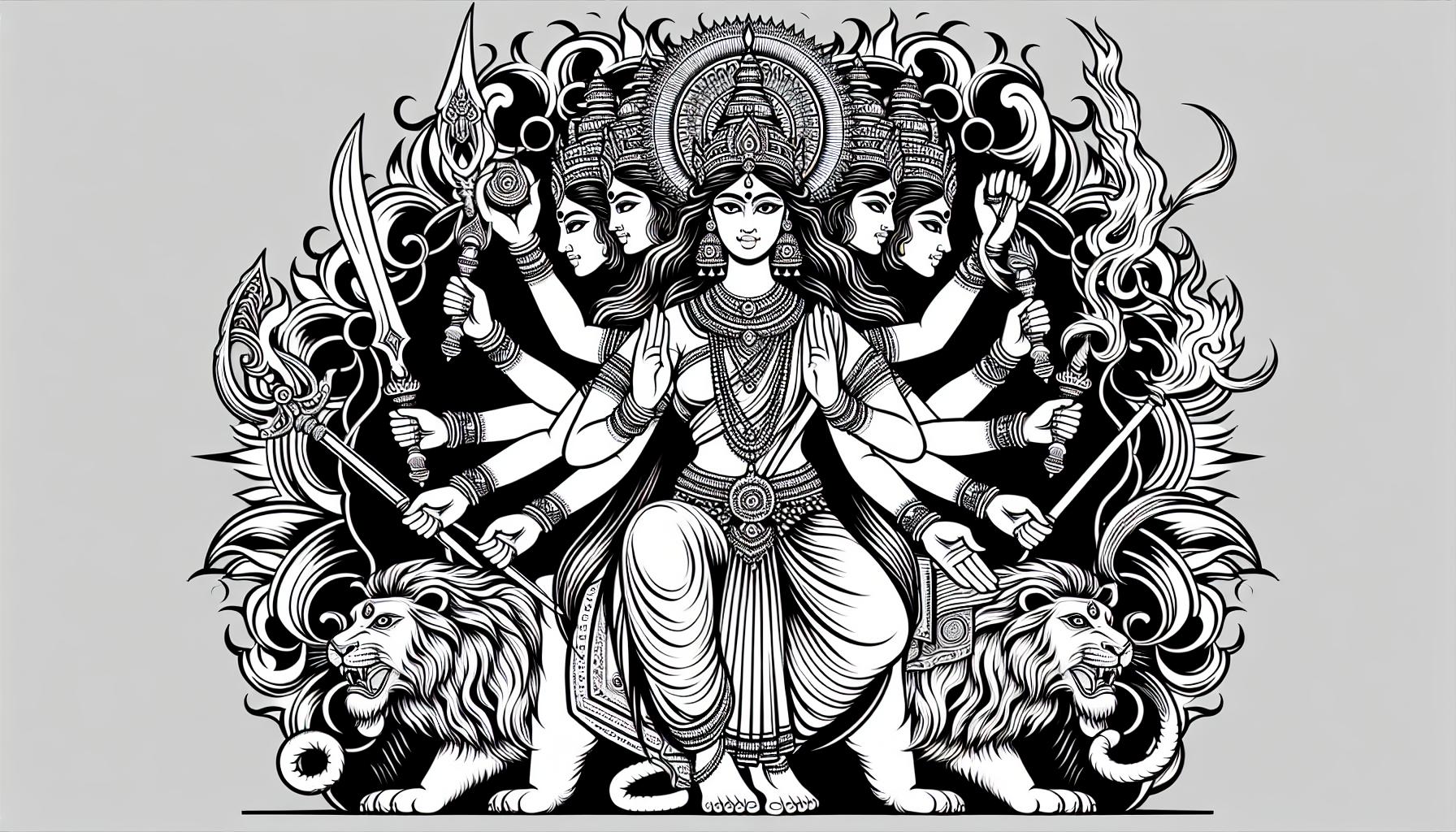
Durga, the fierce protector, embodies strength and resilience in Hindu mythology. She is a central figure who showcases divine power and courage.
Mythological Background
Durga’s mythological background highlights her role in defeating Mahishasura – Buffalo Demon. The demon Mahishasura received near immortality from Brahma – The Creator. To combat this threat, Durga emerged from the collective energy of the gods. Her mission: to slay Mahishasura. Durga’s battle lasted nine nights, ending in her victory. This victory inspires the festival Navaratri.
Key Attributes and Symbolism
Durga often appears as a beautiful woman riding a lion or tiger. She possesses multiple arms, each wielding a weapon. The name “Durga” means “impassable, invincible, or unassailable” in Sanskrit. Associated with protection and strength, Durga’s nine incarnations, the Navadurga, include Shailaputri, Brahmacharini, Chandraghanta, Kushmanda, Skandamata, Katyayini, Kaalratri, Mahagauri, and Siddhidatri.
Worship and Festivals
Devotees worship Durga with immense fervor during Navaratri, a nine-night festival celebrating her victory. Other significant festivals include Durga Puja in West Bengal and Dashain in Nepal. These events involve elaborate rituals, prayers, and communal gatherings, emphasizing her protective and nurturing nature.
Kali: The Powerful Destroyer
Kali is revered in Hindu mythology, especially in Goddess-centric traditions. Known for her fierce yet nurturing nature, she represents death, time, and destruction while symbolizing motherly love.
Mythological Background
Kali is an incarnation of Parvati, created during a battle against the buffalo demon Mahishasura. Emerging from Durga’s forehead, she went on a rampage, killing demons and stringing their heads on a chain. In a different story, Kali forms from Parvati’s shed dark skin. Both versions highlight her role in conquering evil. When she accidentally steps on Shiva, she calms down, illustrating her connection to balance and control.
Key Attributes And Symbolism
Kali’s powerful imagery includes a dark, wrathful visage with a necklace of demon heads and a skirt of arms. Four hands signify creation and destruction, holding a sword and a severed head while offering blessings and protection. Her tongue sticks out, symbolizing her ferocity and thirst for blood, showcasing her role in eliminating evil. She represents the cycle of life and death, embodying time’s inexorable flow.
Worship And Festivals
Devotees across South Asia, particularly in Bengal, Nepal, South India, and Assam, worship Kali fervently. Kali Puja, observed on Amavasya (new moon) in the Hindu month of Kartik (October-November), involves night-long vigils, rituals, and offerings. Celebrations include chanting, music, and dance to honor her and seek her protection. This festival underscores her importance and the enduring reverence for her power and maternal aspects.
Common Themes and Differences
Common Themes
- Feminine Power: The goddesses Parvati, Durga, and Kali all embody various forms of feminine power. Parvati represents gentle and nurturing power. In contrast, Durga and Kali display more aggressive forms of feminine strength. Together, they cover a spectrum of divine femininity.
- Association with Shiva: Each goddess is closely connected to Shiva. Parvati is Shiva’s consort. Durga and Kali are manifestations of Parvati. This connection ties them directly to one of Hinduism’s primary deities.
- Protection and Destruction: These goddesses offer both protection and the power of destruction. Durga is renowned for defeating the demon Mahishasura. Kali’s fierce form signifies her role in destruction to maintain cosmic order, while Parvati represents a more nurturing force but holds the potential for destruction within her various forms.
Parvati
- Gentle and Nurturing: Parvati embodies gentleness and nurturing qualities. She’s associated with aspects of love, marriage, and motherhood. Couples often invoke her blessings for a happy and prosperous married life.
- Multiple Names: Parvati goes by various names like Uma, Gauri, and Lalitha. Each name signifies different attributes, from beauty (Gauri) to simplicity (Uma).
Durga
- Warrior Goddess: Durga is known as a fierce warrior. She battles evil forces and protects her devotees from harm. Her most famous myth involves the battle with the buffalo demon Mahishasura, where she emerges victorious, symbolizing the triumph of good over evil.
- Festivals: Durga is celebrated during Navaratri, a nine-night festival dedicated to her. Enthusiasts worship her with great enthusiasm, celebrating her strength and protective nature through rituals, dances, and songs.
- Fierce and Protective: Kali is an aggressive form of Parvati. Her depiction with dark skin and a necklace of skulls represents her dominion over death and time. Despite her fearsome appearance, devotees worship her for protection and liberation from evil.
- Rituals: Worshippers honor Kali during Kali Puja, particularly in South Asia. They offer rituals and sacrifices, seeking her fierce protection and strength to overcome evil forces. Her myths often depict her in destructive roles to protect the universe from demonic influences.
These goddesses, through their unique attributes and common themes, illustrate diverse aspects of the divine feminine, balancing nurturing and warrior-like qualities, and contributing significantly to Hindu mythology and spirituality.
Conclusion
Exploring the rich tapestry of Parvati, Durga, and Kali reveals the multifaceted nature of the divine feminine in Hindu mythology. Each goddess, with her unique attributes and stories, offers profound insights into themes of love, protection, and transformation. Their roles and representations highlight the balance between nurturing and destructive forces, reminding us of the complexity and depth of feminine power. These goddesses not only enrich Hindu spirituality but also provide timeless lessons on strength, resilience, and the cyclical nature of life. Through their worship and stories, we gain a deeper understanding of the diverse aspects of divinity and the enduring significance of these revered figures.
Sources & further reading
These themes are explored in greater depth across the following authoritative resources:
- Encyclopaedia Britannica, Hindu Mythology
- Internet Sacred Text Archive, Hinduism
- Mythopedia, Hindu Mythology
- Harvard Pluralism Project, Hindu Tradition
- Wendy Doniger, The Hindus: An Alternative History (Penguin, 2009), ISBN 978-0143116691
External resources for further reading. Apam Napat is not affiliated with these publishers; citation does not imply endorsement.
Based on the classical texts of Hindu mythology, see our sources.