
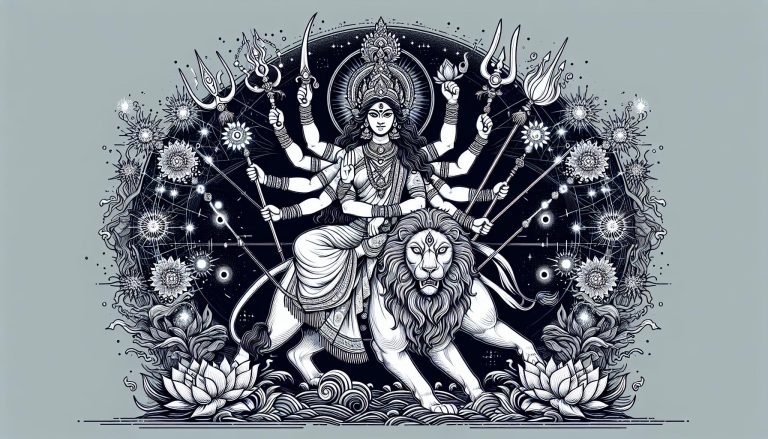
Durga’s spiritual symbolism goes beyond mere mythology; it offers valuable lessons for modern life. She teaches us about resilience, courage, and the importance of standing up for what’s right. Her story isn’t just an ancient tale; it’s a timeless guide for navigating the complexities of our own journeys.
Overview Of Durga
Durga is a powerful and multifaceted goddess in Hinduism, embodying both derivative and original aspects of the divine feminine. She represents the convergence of the collective energy (shakti) of male divinities like Brahma – The Creator, Vishnu – The Protector, and Shiva – The Destroyer. Depictions often show her with multiple arms, each bearing a weapon, underlining her role as a warrior goddess.
The Great Mother Goddess
Revered as the Great Mother Goddess, Durga represents the feminine aspect of the divine. She embodies the collective energy (shakti) of male gods. Many depictions show her as a warrior goddess with multiple arms and weapons, highlighting her martial prowess and nurturing nature.
Protector and Savior
Known for her protective nature, Durga symbolizes the divine energy safeguarding souls from duality, adversity, and opposition. She provides the strength to overcome challenges, illustrating her role as both protector and savior.
Power and Strength
Durga’s name translates to “the invincible, unconquerable, and unassailable one,” reflecting her immense power and strength. Often depicted riding a lion or tiger, she embodies martial and regal aspects, showcasing her unparalleled potency in defeating evil.
The Mythological Origin
Durga’s spiritual symbolism is deeply anchored in Hindu mythology. As Devi and Shakti, she embodies the divine feminine energy and is revered during Navratri, celebrating her triumph over Mahishasura – Buffalo Demon.
The Birth Of Durga
Durga’s birth stems from the power of Agni, representing the inner flame of immortal life. This awakening power motivates us to seek the highest bliss. Durga was created by the combined energies (shakti) of Brahma, Vishnu, Shiva, and lesser gods, who were unable to defeat Mahishasura on their own.
Her Role In Different Yugas
Durga’s role varies across the yugas (ages) in Hindu cosmology. In Satya Yuga, she embodies truth and virtue, defending righteousness. In Treta Yuga, she aids deities in their battles against demonic forces. During Dvapara Yuga, she continues to protect the cosmic order, showing adaptability against rising evils. In Kali Yuga, she becomes a key figure symbolizing the persistent fight against pervasive darkness and corruption.
The Symbols Associated With Durga
Durga’s various symbols hold deep spiritual meanings, each revealing a facet of her divine nature. Let’s delve into the significance of her key symbols.
The Sword: Significance Of Power And Purity
Durga’s sword signifies sharp intellect and wisdom, both critical in overcoming negativity. Given to her by Lord Ganesh, this weapon represents the blend of intelligence and comprehension. The blade’s brilliance reflects the light of knowledge, and its sharpness epitomizes wisdom. For instance, the sword teaches that pure knowledge cuts through ignorance and darkness.
The Trident: Representation Of Creation, Preservation, And Destruction
Durga’s trident, or Trishul, encapsulates the three primal qualities of existence: Tamas (calmness), Rajas (energy), and Sattva (purity). Lord Shiva gifted her this weapon, illustrating the balance required within the human soul. The trident’s prongs symbolize the Trinity – Shiva, Vishnu and Brahma of creation, preservation, and destruction. Different aspects harmonized within the human experience reflect spiritual balance.
The Lotus: Symbol Of Spiritual Awakening
The lotus in Durga’s hand signifies spiritual awakening and purity. Steering above the mud, the lotus blooms beautifully, symbolizing transcending worldly attachments. This represents rising above materialistic concerns and attaining higher consciousness. For example, the lotus reminds us to stay unattached and pure while engaging in the world.
These symbols capture Durga’s essence, embodying diverse spiritual virtues.
The Spiritual Significance Of Durga’s Vahana
Durga’s vahana, the lion, holds deep symbolic meaning in Hindu mythology. It’s not just a mere mount; it represents strength, fearlessness, and divine power.
The Lion: Strength And Fearlessness
The lion showcases qualities like strength, courage, and fearlessness. As Durga’s mount, it highlights her ability to overcome obstacles and protect devotees from harm. This association serves as a powerful visual cue for Durga’s unmatched prowess in battling evil.
Symbolic Interpretations In Various Scriptures
In various scriptures, the lion symbolizes the solar force, representing the sun’s power that dispels darkness. Often depicted as golden-skinned, the lion embodies Shakti, the divine energy that Durga personifies. In Shakta iconography, the lion signifies the feminine side of the divine, further emphasizing Durga’s role as the ultimate feminine power.
The Nine Forms Of Durga
Durga’s nine forms, known as Navadurga, embody different aspects of her divine energy. Each form symbolizes unique qualities and is worshipped during the festival of Navratri.
Shailaputri: The Embodiment Of Mahakali
Shailaputri, the first form of Durga, represents Mahakali’s power. She holds a trident and a lotus flower in her two hands and rides a bull. Shailaputri signifies strength and protection, symbolizing the mountain. Worship on the first day of Navratri, she represents the feminine power of the universe and is considered the daughter of the mountain.
Brahmacharini: The Epitome Of Devotion
Brahmacharini, the second form, represents the essence of devotion. Depicted as a female ascetic, she carries a rosary bead and a water pot. Brahmacharini embodies penance and self-control, and worshippers seek peace and harmony on the second day of Navratri. Her representation emphasizes the significance of devotion in spiritual practice.
Chandraghanta: The Warrior Form
Chandraghanta, the third form of Durga, is known for her warrior spirit. Although the initial context does not provide specific details about Chandraghanta, she is typically depicted with ten arms, carrying weapons, and riding a tiger. This form signifies courage and combativeness, showcasing Durga’s power to fight against adversities. Worship on the third day of Navratri, devotees celebrate her warrior prowess.
The Role Of Durga In Modern Spiritual Practices
Durga’s spiritual symbolism extends beyond ancient mythology, playing a significant role in contemporary spiritual practices. Her influence is evident in meditation, mindfulness, and the widely celebrated festival of Durga Puja.
Durga’s Influence On Meditation And Mindfulness
Durga embodies divine energy that aids in meditation and mindfulness. Her presence helps individuals focus, providing protection from negative influences and distractions. By invoking Durga during meditation, practitioners can enhance their concentration and attain a peaceful state of mind. Her symbolism of strength and justice also encourages facing internal challenges with resilience and courage. This enables a deep connection with one’s inner self.
Durga Puja: A Festival Of Inner Strength And Empowerment
Durga Puja, an important Hindu festival, celebrates Durga’s victory over Mahishasura, symbolizing the triumph of good over evil. This festival is not just a religious observance but a period of spiritual rejuvenation. During Durga Puja, devotees engage in rituals and prayers that empower them with inner strength and resilience. The celebration of Durga’s multiple arms and weapons reminds individuals of their own ability to overcome life’s battles. The festival’s practices enhance community bonding and foster a collective sense of empowerment and protection, reflecting Durga’s spiritual influence on modern life.
Conclusion
Durga’s spiritual symbolism transcends time and remains deeply relevant in modern spiritual practices. Her embodiment of divine feminine energy offers profound lessons on resilience, courage, and righteousness. Each of her nine forms, Navadurga, presents unique qualities that inspire strength and devotion.
Through meditation and mindfulness, Durga’s energy enhances concentration and inner peace, empowering us to face life’s challenges with unwavering courage. Durga Puja stands as a testament to her enduring influence, celebrating the triumph of good over evil and fostering community bonding.
Durga’s legacy as the Great Mother Goddess continues to inspire and uplift, reminding us of the powerful virtues she embodies.
Sources & further reading
These themes are explored in greater depth across the following authoritative resources:
- Encyclopaedia Britannica, Hindu Mythology
- Internet Sacred Text Archive, Hinduism
- Mythopedia, Hindu Mythology
- Harvard Pluralism Project, Hindu Tradition
- Wendy Doniger, The Hindus: An Alternative History (Penguin, 2009), ISBN 978-0143116691
External resources for further reading. Apam Napat is not affiliated with these publishers; citation does not imply endorsement.
Based on the classical texts of Hindu mythology, see our sources.