
Exploring Vedic knowledge sources isn’t just an academic pursuit; it’s a journey into the very essence of human understanding and consciousness. Whether you’re curious about the Rigveda, the Yajurveda, the Samaveda, or the Atharvaveda, each text holds a unique key to unlocking profound truths about the universe and our place in it.
Overview Of Vedic Knowledge Sources
Vedic knowledge stems from four primary texts known as the Vedas: Rigveda, Yajurveda, Samaveda, and Atharvaveda. These ancient scriptures form the foundation of Indian spiritual and philosophical traditions.
Rigveda
The Rigveda, considered the oldest of the four Vedas, contains hymns and praises dedicated to various deities. Comprising over 10,000 verses, it provides insights into early Vedic religion and social practices. Scholars often refer to it for its linguistic and historical significance.
Yajurveda
The Yajurveda serves as a manual for rituals and sacrifices. Consisting of both prose and verse, it guides the execution of ceremonies central to Vedic worship. Divided into the White (Shukla) and Black (Krishna) Yajurveda, this text outlines different methods for performing rituals.
Samaveda
The Samaveda primarily focuses on musical chants and melodies. It contains around 1,900 verses, most of which are borrowed from the Rigveda. The text’s emphasis on musical recitation shows its unique role in Vedic liturgy.
Atharvaveda
The Atharvaveda differs from the other Vedas by including hymns used in everyday rituals and practices. Its contents cover a broad spectrum, from healing and spells to philosophical discourses. This Veda provides a comprehensive view of practical and mystical aspects of Vedic life.
Each Veda contributes uniquely to understanding Vedic traditions and practices. Together, they offer a profound exploration of ancient Indian wisdom.
The Four Vedas
The Four Vedas are the oldest and most revered sacred texts in Hinduism, offering comprehensive insights into early Indian wisdom and practices. These texts are central to understanding Vedic knowledge.
Rig Veda
Rig Veda is the oldest of the Vedas. It contains over 1,000 hymns dedicated to various deities. These hymns provide significant insights into early Vedic rituals, religious practices, and cosmology. Rig Veda showcases the profound spiritual and philosophical thought of its time.
Sama Veda
Sama Veda, often termed the “Veda of Chants,” focuses on musical rituals. It comprises hymns from the Rig Veda, arranged for chanting. Sama Veda emphasizes the importance of sound and melody in Vedic ceremonies, highlighting the role of music in spiritual practice.
Yajur Veda
Yajur Veda serves as a manual for conducting rituals. It contains prose mantras for ceremonial purposes. Unlike the Rig Veda and Sama Veda, Yajur Veda includes detailed instructions for performing rituals, making it a practical guide for priests.
Atharva Veda
Atharva Veda encompasses hymns for everyday life and philosophical discourses. It addresses issues related to health, love, and prosperity and provides charms and spells for various purposes. Atharva Veda offers a glimpse into the daily life and beliefs of the Vedic people.
The Upanishads
The Upanishads form the cornerstone of Vedic knowledge and Hindu philosophy. They mark a shift from Vedic rituals to deeper philosophical inquiries into ultimate reality.
Major Upanishads
The major Upanishads are the most important in understanding Vedic knowledge:
- Brhadaranyaka Upanishad: This is the oldest and is part of the Yajur Veda. It explores Atman (Higher Self), the immortality of the soul, and the essential unity of all reality.
- Chandogya Upanishad: Found in the Samaveda, it discusses Brahman (Supreme Reality) and the relationship between the individual self (Atman) and Brahman.
Philosophical Themes
The Upanishads cover key philosophical themes:
- Atman and Brahman: These texts examine the concepts of the individual soul (Atman) and the universal soul (Brahman), emphasizing their unity.
- Moksha: The notion of liberation from the cycle of birth and rebirth (samsara) is a central theme.
- Knowledge and Ignorance: They juxtapose true knowledge (vidya) with ignorance (avidya), stressing that enlightenment leads to liberation.
- Karma: The principle of action and its consequences plays a critical role in understanding human existence and spiritual growth.
These elements collectively contribute to a comprehensive understanding of Vedic knowledge, urging readers to delve deeper into the nature of existence and ultimate reality.
The Brahmanas
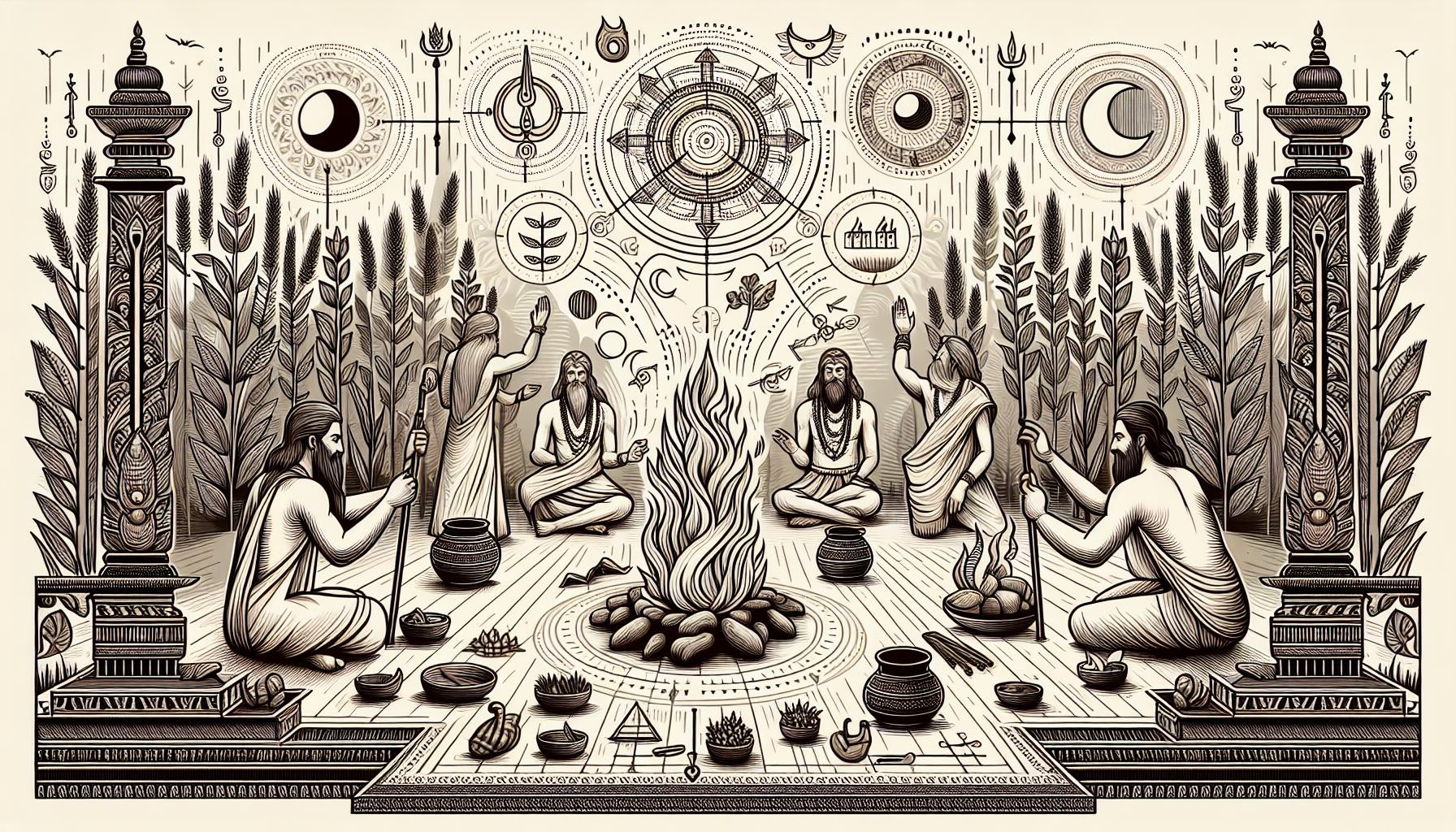
The Brahmanas offer an extensive prose commentary on the Vedas, focusing on the significance of rituals and hymns in early Hinduism. These texts, dating from 900–700 BCE, illustrate Vedic rituals and the deeper meanings behind them.
Rituals and Hymns
The Brahmanas emphasize rituals, providing detailed descriptions and instructions. Key rituals include:
- The “Going of the Cows” (Gavamayana): This ceremony relates to seasonal transitions and agricultural prosperity.
- The 12 Days’ Rites (Dvadashaha): A complex series of sacrifices performed over 12 days, symbolizing cosmic cycles.
- Daily Morning and Evening Sacrifices (Agnihotra): These involve offerings to the sacred fire, maintaining a link between humans and deities.
- Setting Up of the Sacrificial Fire (Agnyadhana): Initiates the sacrificial space, essential for all subsequent rituals.
- New- and Full-Moon Rites: These are conducted to honor lunar cycles and their impact on life.
- Four Months’ Rites: Seasonal rituals marking the agricultural calendar.
- Rites for the Installation of Kings: Ceremonies that legitimize a king’s rule, ensuring divine favor.
Cultural Significance
The Brahmanas hold immense cultural value, representing the oldest sources on Indian ritual practice. They reveal the integration of mythology, legend, and symbolism into religious ceremonies, impacting Indian culture profoundly. Priests’ actions and the hidden meanings behind them are meticulously documented, reflecting the importance of precise ritual in maintaining cosmic order and social structure.
The Aranyakas
The Aranyakas represent a key source of Vedic knowledge, offering symbolic and philosophical interpretations of Vedic rituals. They bridge the ritualistic Brahmanas and the speculative Upanishads, providing deeper insights into the Vedic tradition.
Meditative Practices
Aranyakas delve into meditative practices by interpreting rituals symbolically. Instead of external sacrifices, they emphasize inner spiritual exercises. These texts guide practitioners to focus on mental and spiritual development, promoting contemplation and meditation. For instance, the Brihadaranyaka Aranyaka discusses the significance of inner peace and mental clarity.
Interpretative Texts
The Aranyakas serve as interpretative texts, transforming literal rituals into symbolic acts. They offer philosophical insights on the nature of the universe and humanity’s place within it. These writings, embedded in each Veda, address profound themes through dialogue and narrative. For example, the Aitareya Aranyaka explores the symbolic meaning of rituals, connecting them to universal truths and human experiences.
Conclusion
Exploring Vedic knowledge sources has been an enlightening journey through ancient wisdom. The Four Vedas lay the groundwork with their hymns and rituals, while the Brahmanas provide a deeper understanding of these practices. The Aranyakas then bridge the gap between ritual and philosophy, offering symbolic interpretations that enrich our spiritual perspectives. These texts collectively reveal a sophisticated system of thought that continues to influence Hinduism and offers timeless insights into the human experience. Understanding these sources enhances our appreciation for the intricate tapestry of rituals, mythology, and philosophy that define Vedic tradition.
Sources & further reading
These themes are explored in greater depth across the following authoritative resources:
- Stanford Encyclopedia of Philosophy, Hindu Philosophy
- Mythopedia, Hindu Mythology
- Britannica, Hindu Mythology
- Sheldon Pollock, The Language of the Gods in the World of Men (University of California Press, 2006)
- A. K. Ramanujan, The Collected Essays (Oxford University Press, 1999)
External resources for further reading. Apam Napat is not affiliated with these publishers; citation does not imply endorsement.
Based on the classical texts of Hindu mythology, see our sources.