

I’ve always been intrigued by how these ancient narratives align with contemporary scientific theories. From the cyclical nature of time to the concept of multiple universes, Hindu cosmology presents ideas that are both profound and surprisingly relevant today. Let’s jump into these interpretations and explore their timeless wisdom.
Overview Of Hindu Cosmology
Hindu cosmology presents a multifaceted view of the universe, drawing from various ancient texts. The Vedas and Puranas describe the cosmos as cyclic, with endless creation, preservation, and destruction phases. This cyclical nature is central to Hindu thought.
Key Elements:
- Brahmanda (Cosmic Egg): The universe is often described as a cosmic egg, known as Brahmanda. This egg contains all existence, including gods, demons, and humans. The concept aligns with the modern idea of an expanding universe (source: Vedas).
- Kalpas (Ages): Time is divided into vast periods called Kalpas. Each Kalpa spans 4.32 billion years and consists of four Yugas: Satya, Treta, Dvapara, and Kali. These cycles repeat endlessly.
- Lokas (Worlds): The cosmos has several realms or Lokas. There are 14 such worlds, including seven higher Lokas like Svarga (heaven) and seven lower ones like Patala (underworld). Each Loka hosts different beings and life forms.
- Trimurti (Three Forms): The Hindu Trinity – Shiva, Vishnu and Brahma, or Trimurti, plays a crucial role. Brahma – The Creator creates, Vishnu preserves, and Shiva destroys. Their continuous interaction symbolizes the universe’s dynamic balance.
- Maya (Illusion): The concept of Maya signifies the deceptive nature of the material world. Believers see it as a tool to understand the reality beyond physical existence. Maya influences perceptions and actions, shaping the human experience.
| Element | Description |
|---|---|
| Brahmanda | Universe as a cosmic egg |
| Kalpas | Ages lasting 4.32 billion years each |
| Lokas | 14 realms including heavens and underworlds |
| Trimurti | Brahma (creator), Vishnu (preserver), Shiva (destroyer) |
| Maya | Concept of illusion influencing reality |
These elements provide a complex and intriguing framework that has influenced thinkers and scientists. The cyclical nature of Hindu cosmology aligns with certain modern scientific theories, reflecting timeless insights into the universe’s structure and behavior.
Key Texts And Scriptures
Exploring Hindu cosmology requires understanding its foundational texts. These scriptures provide essential insights into the universe’s creation and structure.
Vedas
The Vedas comprise four main texts: Rigveda, Samaveda, Yajurveda, and Atharvaveda. These ancient scriptures, dated to around 1500–500 BCE, contain hymns, mantras, and rituals central to Hindu thought. Among them, the Rigveda stands out for its cosmic hymns. The Nasadiya Sukta (Hymn of Creation) from the Rigveda delves into the origins of the universe, questioning the existence before creation began. It conveys the idea of a primordial state that predates the cosmos, reflecting the cyclical nature of existence.
Upanishads
The Upanishads, composed between 800–200 BCE, explore philosophical aspects of Hindu cosmology. These texts emphasize the concept of Brahman – The Supreme Truth, the ultimate reality, and Atman, the individual soul. The Chandogya Upanishad discusses the notion of the universe emanating from a single, unified source, while the Brihadaranyaka Upanishad presents an intricate view of the cosmic cycle through metaphors and dialogues. These scriptures underscore the interconnectedness of all existence, providing a deeper understanding of cosmic principles.
Major Concepts In Hindu Cosmology
Hindu cosmology encapsulates profound ideas about the universe’s nature, focusing on foundational elements found in sacred texts. These concepts revolve around Brahman, Atman, and Maya.
Brahman
Brahman signifies the ultimate reality in Hindu cosmology. Described as formless and infinite, it’s considered the source of all creation. The Upanishads present Brahman as the unchanging truth beneath the universe’s apparent diversity. Brahman encapsulates both the immanent and transcendent aspects of divinity, echoing the concept of a monistic universe where everything originates from and returns to a singular reality.
Atman
Atman refers to the inner self or soul. This concept posits that individual consciousness is a distinct reflection of the eternal Brahman. The Upanishads argue that realizing the unity of Atman and Brahman leads to moksha, or liberation from the cycle of rebirth. By understanding Atman, beings align their lives with the cosmic order, recognizing their essence as part of a larger whole.
Maya
Maya represents the illusion that veils the true nature of reality. According to Hindu cosmology, Maya causes individuals to perceive the world as distinct from Brahman. It’s a pivotal idea that explains the mistaken understanding of individuality and separateness. By overcoming Maya through spiritual practice and knowledge, one can see through the illusion and grasp the underlying unity of the universe.
Hindu Cosmological Cycles
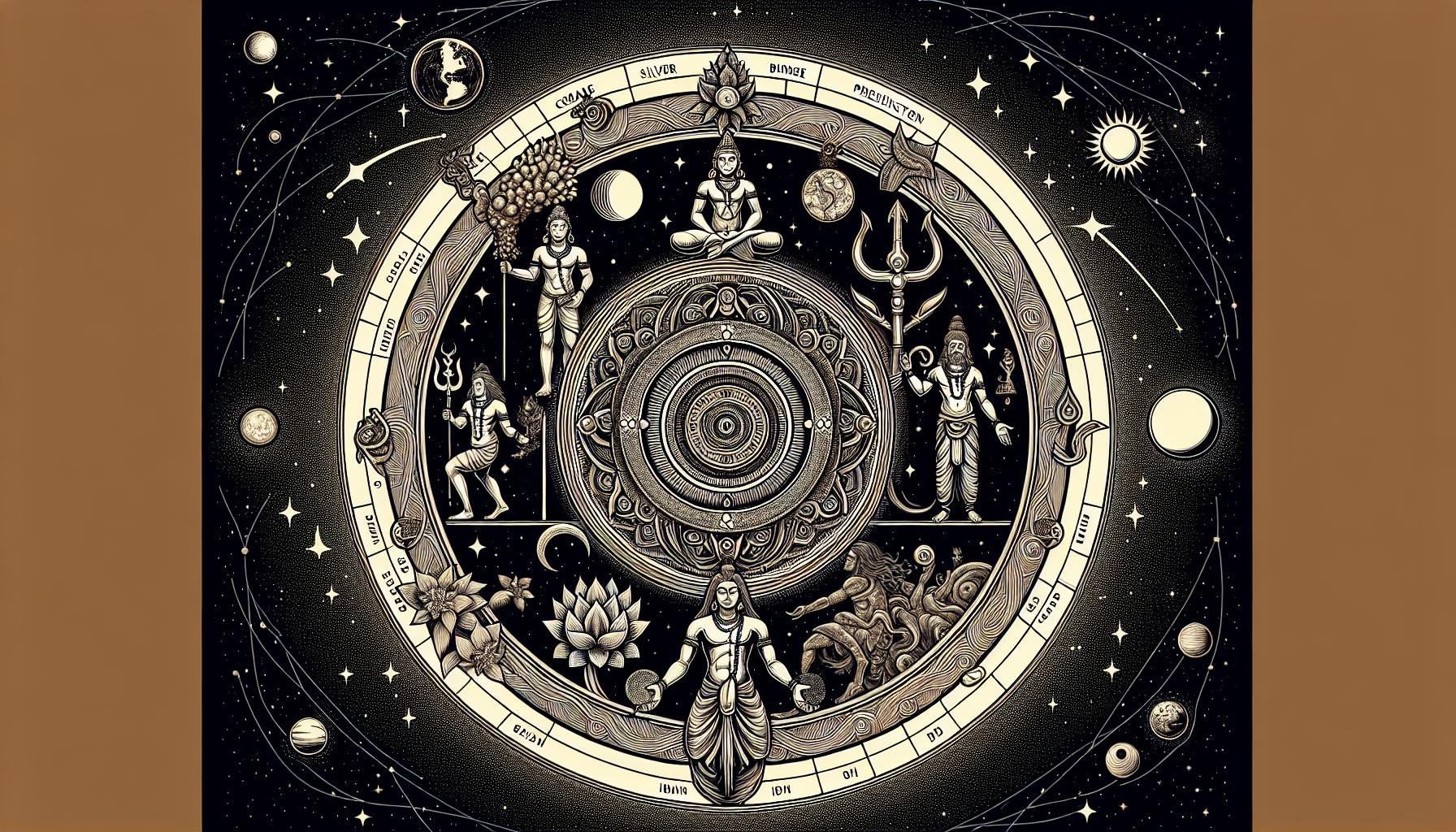
Hindu cosmology outlines intricate cycles within the universe, mapping vast periods through Yugas and charting the cosmos’s creation and destruction. These cycles offer profound insights into time’s nature and the universe’s perpetual rhythm.
Yugas
The universe progresses through four Yugas, or ages, each representing different stages of moral and physical decline. They are:
- Satya Yuga – Known as the “Golden Age”, this era spans 1,728,000 years, characterized by righteousness and truth.
- Treta Yuga – Translating to the “Silver Age”, it lasts 1,296,000 years, featuring a gradual decline in virtue.
- Dvapara Yuga – In the “Bronze Age”, 864,000 years, moral decay becomes more pronounced.
- Kali Yuga – The “Iron Age” spans 432,000 years, marking significant moral and spiritual decline. We’re currently in this Yuga.
Cosmos Creation And Destruction
In Hindu cosmology, creation and destruction follow a cyclical pattern known as Kalpa. A Kalpa spans 4.32 billion years, aligning with modern astronomical estimates.
- Srishti (Creation) – The universe begins anew, driven by Brahma’s divine actions. Creatures and the world manifest during this time.
- Sthiti (Maintenance) – This phase sustains created life. Vishnu preserves balance and order.
- Samhara (Destruction) – Shiva eventually dissolves the universe, paving the way for renewal.
Each creation phase follows one of Brahma’s days, with dissolution occurring at night. The cycle repeats indefinitely, emphasizing eternal time.
These concepts illustrate how Hindu cosmology interweaves cosmic rhythms with spiritual evolution.
Interpretations By Scholars
Hindu cosmology interpretations vary widely among scholars. These interpretations offer insights that bridge ancient sacred texts with modern understandings.
Traditional Views
Traditional scholars derive their interpretations from ancient texts such as the Vedas, Upanishads, Bhagavad Gita, and Puranas. Adi Shankaracharya, an 8th-century philosopher, emphasized non-dualism (Advaita Vedanta), viewing Brahman as the sole unchanging reality. He argued that Maya creates the illusion of the physical world, veiling Brahman from human perception.
Ramanuja, a 12th-century scholar, proposed Vishishtadvaita (qualified non-dualism), suggesting that while Brahman is the ultimate reality, the physical world and souls are real yet dependent on Brahman. He viewed God, souls, and matter as distinct but interconnected.
Swami Vivekananda, a 19th-century philosopher, integrated these ancient views with contemporary thought. He highlighted the cyclical nature of the universe and the belief in karma and rebirth, proposing that these principles align with modern ideas of evolutionary cycles.
Modern Scientific Perspectives
Modern scholars explore compatibility between Hindu cosmology and contemporary science. Fritjof Capra, a physicist, noted parallels between the cyclical patterns in Hindu cosmology and modern theories of cycles in nature. Capra referenced quantum physics concepts, aligning them with ancient Hindu ideas of interconnectedness and unity.
Carl Sagan, an astrophysicist, remarked on the striking similarities between Hindu ideas of the universe’s age and contemporary scientific estimates. Hindu texts suggest the universe is several billion years old, close to modern scientific calculations of 13.8 billion years.
Subhash Kak, a computer scientist, examines how ancient Hindu cosmology anticipates modern scientific discoveries. He links the concept of cosmic cycles (Yugas) to theories in thermodynamics and entropy, suggesting a sophisticated understanding of cosmic processes.
These varied interpretations by scholars show how Hindu cosmology remains a rich field for ongoing exploration and dialogue, bridging ancient wisdom and contemporary thought.
Implications For Modern Life
Hindu cosmology influences contemporary life by shaping how individuals perceive their existence and ethical duties. This philosophy, which revolves around the cyclic nature of time, underscores the significance of the Purusharthas.
Cyclical Nature of Time
In Hindu cosmology, time is cyclical rather than linear. The concept of Yugas represents stages of moral and physical decline, emphasizing the eternal cycle of creation and destruction. This understanding encourages a balanced view of progress and decay, reminding individuals of life’s transient nature. Accepting this cyclical pattern can foster resilience and adaptability in daily life.
- Dharma (Duty and Righteousness)
Placing importance on ethical living and social responsibilities, dharma encourages individuals to act virtuously. By adhering to dharma, one contributes to societal harmony and personal integrity. - Kama (Pleasure and Desire)
Pursuing kama involves seeking joy and affection in life. Valuing kama helps in recognizing the importance of fulfilling personal desires within ethical boundaries, leading to a well-rounded, satisfying life. - Artha (Prosperity and Wealth)
Striving for artha, or material success, supports personal and communal well-being. By achieving artha, one can provide for oneself and others, fostering a stable and prosperous society. - Moksha (Liberation and Salvation)
Seeking moksha inspires individuals to transcend the material world and attain spiritual freedom. This aim encourages a deeper connection to the universe and a pursuit of meaningful existence beyond temporary gains.
Recognizing these aims assists individuals in making ethical choices and striving for a balanced, fulfilling life. Hindu cosmology, by integrating the ideals of dharma, kama, artha, and moksha, provides a comprehensive framework for understanding life’s purpose and exploring its complexities.
Conclusion
Hindu cosmology offers profound insights into the nature of the universe and our place within it. By embracing the cyclical concept of time and the guiding principles of Purusharthas we can navigate life with a greater sense of purpose and balance. The wisdom from ancient sages and modern scholars alike enriches our understanding and helps us lead lives that are both ethically sound and spiritually fulfilling. Hindu cosmology isn’t just an abstract philosophy; it’s a practical guide for living a meaningful and harmonious life.
Sources & further reading
These themes are explored in greater depth across the following authoritative resources:
- Stanford Encyclopedia of Philosophy, Hindu Philosophy
- Mythopedia, Hindu Mythology
- Britannica, Hindu Mythology
- Sheldon Pollock, The Language of the Gods in the World of Men (University of California Press, 2006)
- A. K. Ramanujan, The Collected Essays (Oxford University Press, 1999)
External resources for further reading. Apam Napat is not affiliated with these publishers; citation does not imply endorsement.
Frequently asked questions
What is Hindu cosmology?
What is Brahmanda in Hindu cosmology?
How is time divided in Hindu cosmology?
What are the Lokas in Hindu cosmology?
What roles do the Trimurti play in Hindu cosmology?
Based on the classical texts of Hindu mythology, see our sources.