

I’ve always been fascinated by how these divine manifestations adapt to the needs of the time, addressing specific challenges and guiding humanity. Understanding the roles of Vishnu’s avatars not only enriches our knowledge of Hindu mythology but also offers timeless wisdom that can be applied to our lives today. Let’s explore the significance of these avatars and the profound impact they’ve had on the spiritual and cultural fabric of the world.
The Concept of Avatars in Hinduism
Avatars in Hinduism represent the divine manifestations of deities in physical forms. Vishnu’s avatars, specifically, descend to earth to restore Dharma whenever it’s threatened. These divine forms take shape to empower the good and counteract evil forces. Each avatar embodies unique characteristics and missions, tailored to address specific cosmic imbalances.
There are different types of avatars, including full avatars (purna avatars) and partial avatars (ansha avatars). Full avatars like Krishna, Rama, and Narasimha play complete roles in the narratives, offering comprehensive lessons and guidance. Partial avatars perform more specific tasks within the grand scheme.
The Dashavatara, or ten principal avatars of Vishnu, illustrate the broad range of forms Vishnu takes. These include Matsya (fish), Kurma (tortoise), Varaha (boar), Narasimha (man-lion), Vamana (dwarf), Parasurama, Rama, Krishna, Buddha, and Kalki (prophesied). Each of these forms appears during critical epochs to re-establish cosmic balance and righteousness.
This profound concept underscores the flexibility and adaptability of divinity in Hindu theology, demonstrating that the divine is ever-present, ready to intervene and guide humanity through moral and spiritual crises.
| Avatar | Form | Key Role |
|---|---|---|
| Matsya | Fish | Saves Vedas and the Saptarishi from the flood. |
| Kurma | Tortoise | Supports Mount Mandara during the churning of the ocean. |
| Varaha | Boar | Rescues Earth from the demon Hiranyaksha. |
| Narasimha | Man-Lion | Protects Prahlada and destroys the demon Hiranyakashipu. |
| Vamana | Dwarf | Restrains the demon king Bali. |
| Parasurama | Warrior | Destroys corrupt Kshatriya rulers. |
| Rama | Prince | Defeats the demon king Ravana. |
| Krishna | Cowherd/Prince | Plays a pivotal role in the Mahabharata – The Great Epic, imparts the Bhagavad Gita. |
| Buddha | Sage | Propagates the path of enlightenment and non-violence. |
| Kalki | Future Warrior | Expected to end the current age of darkness and restore righteousness. |
Overview of Vishnu’s Avatars
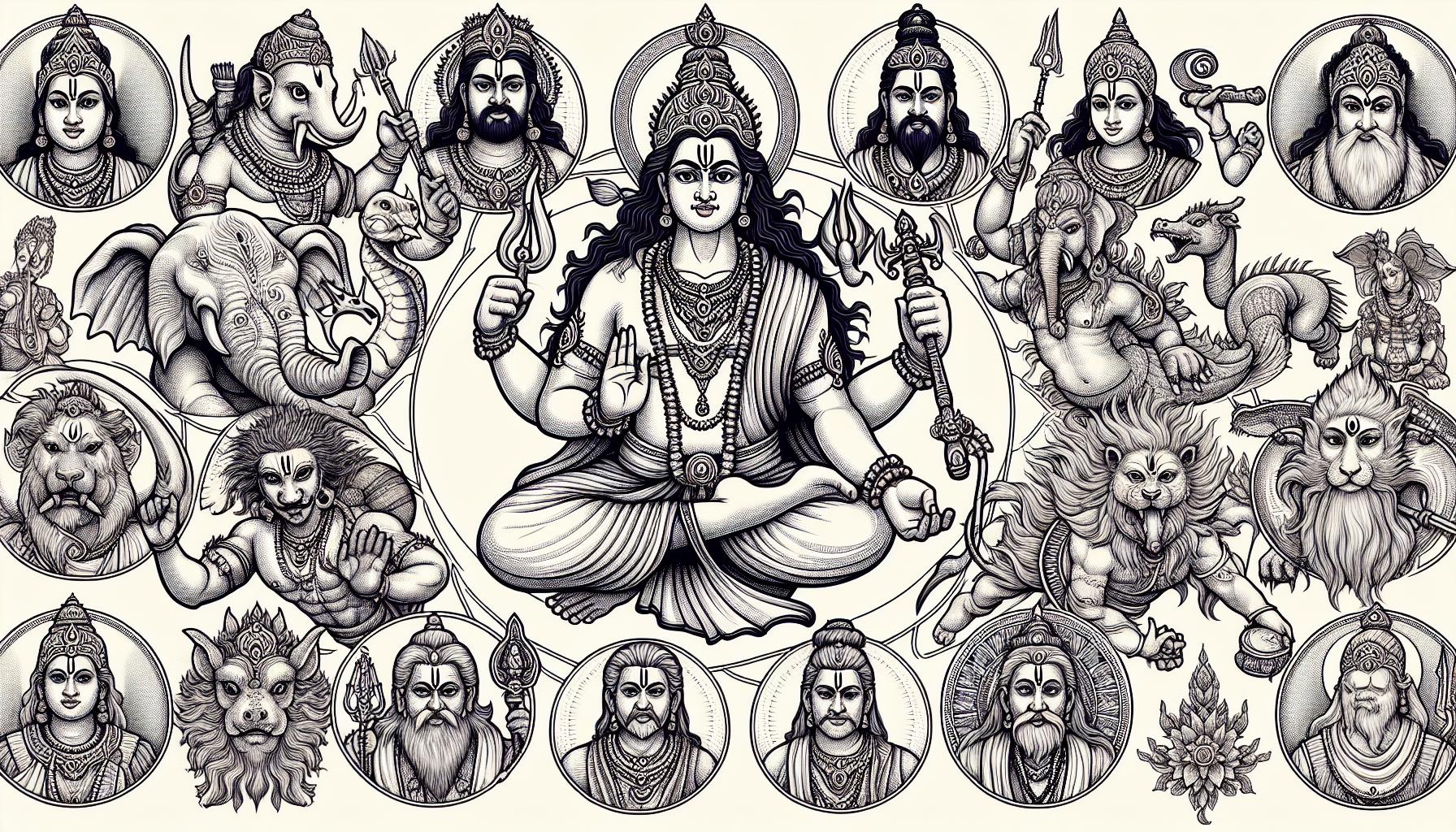
Vishnu, central in Hinduism, preserves cosmic balance by descending as avatars whenever dharma declines. Each avatar serves distinct purposes to restore order.
The Ten Primary Avatars (Dashavatara)
The Dashavatara are Vishnu’s ten primary avatars:
- Matsya (Fish): Saved the Vedas from demons.
- Kurma (Tortoise): Supported the churning of the ocean of milk.
- Varaha (Boar): Killed the demon Hiranyaksha.
- Narasimha (Half-man, Half-lion): Killed the demon Hiranyakashipu.
- Vamana (Dwarf): Defeated the demon king Bali.
- Parashurama – Rama of the Axe (Rama with the Axe): Liberated Brahmins from the Kshatriyas.
- Rama (Prince of Ayodhya): Killed the demon king Ravana.
- Krishna (Prince of the Yadava Clan): Taught spiritual knowledge and killed various demons.
- Buddha (The Enlightened One): Taught spiritual knowledge and non-violence.
- Kalki (Future Warrior): Prophesied to destroy adharma at the end of the current age.
Lesser-known Avatars
Lesser-known avatars convey special roles and tasks:
- Hayagriva: Restored Vedas to Brahma.
- Dhanvantari: Brought medical knowledge to humanity.
- Mohini: Appeared in a female form to distribute the nectar of immortality.
These avatars, while not part of the Dashavatara, highlight Vishnu’s flexibility in addressing various cosmic needs.
Matsya: The Fish
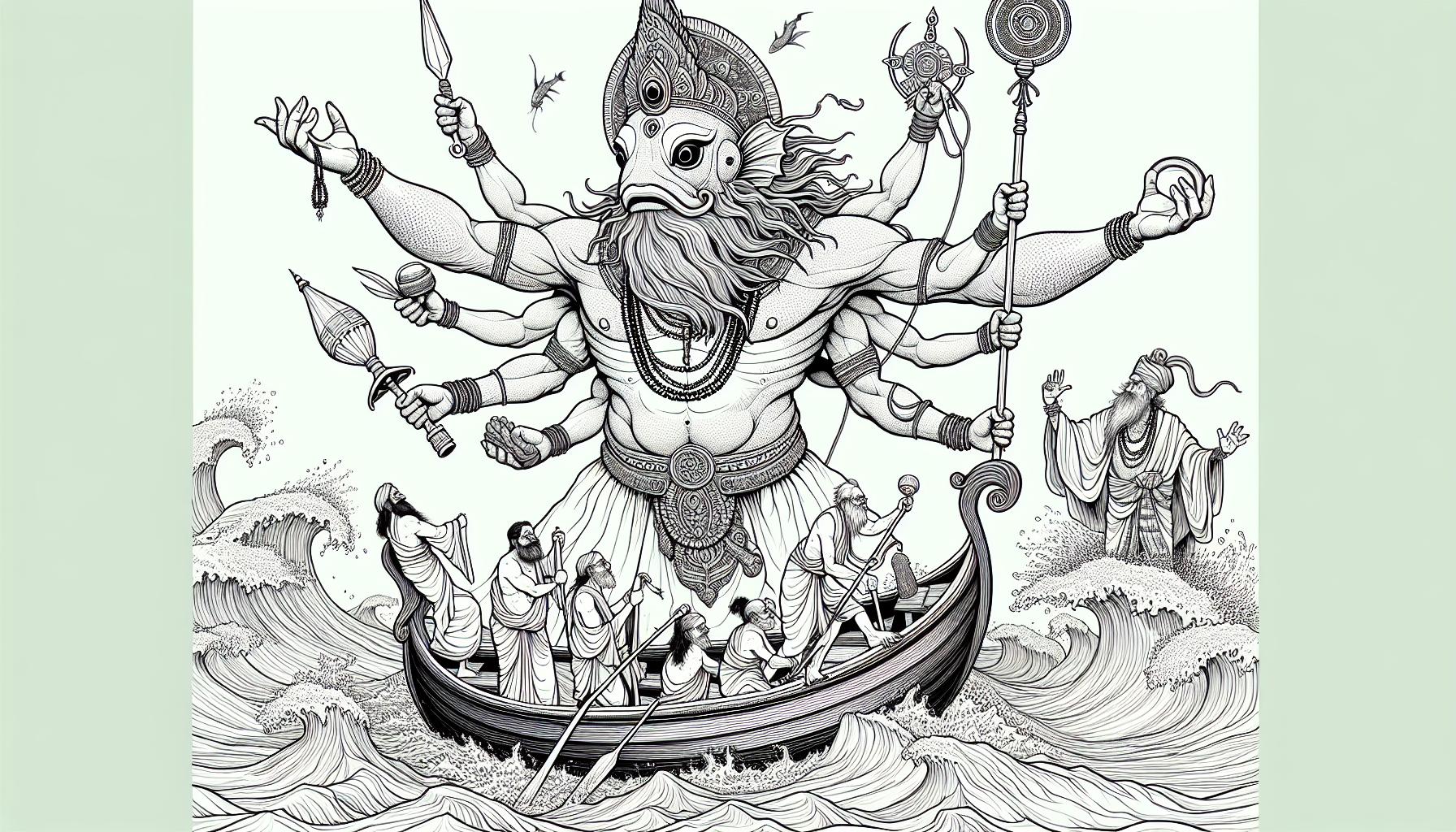
Matsya, Vishnu’s first primary avatar, emerges during a critical cosmic event. This avatar plays a pivotal role in rescuing Vaivasvata Manu and seven sages during a devastating flood. I’ve found Matsya’s mission of guiding them onto a boat to save them from the floodwaters particularly remarkable.
Matsya’s appearance adds to his mystical aura. In depictions, Matsya can appear as a giant fish or in an anthropomorphic form, combining a human torso with a fish’s tail. In this hybrid form, Matsya typically possesses four arms, holding the Sudarshana – Ancestor of Rama Chakra and a conch while gesturing varadamudra and abhayamudra.
Matsya’s role extends beyond just the rescue mission. He also slays the demon Hayagriva, who steals the Vedas. By restoring these sacred texts, Matsya helps to preserve vital spiritual knowledge. His actions emphasize the theme of salvation and preservation prevalent in Hindu mythology.
Kurma: The Tortoise

Kurma, the second avatar of Vishnu, plays a crucial role in Hindu mythology. In this form, Vishnu transforms into a tortoise to support Mount Mandara on his back during the churning of the ocean of milk. This myth illustrates Vishnu’s commitment to maintaining cosmic order.
The churning of the ocean, a joint effort by gods and demons, aimed to extract the elixir of immortality, amrita. Kurma’s role as the stable base prevents the mountain from sinking, enabling the extraction of the elixir. This act underscores Vishnu’s importance in ensuring divine success.
Kurma’s depiction often combines human and tortoise elements. The human part wears Vishnu’s ornaments and wields his weapons, while the tortoise half symbolizes the stabilizing force. This hybrid form highlights the avatar’s unique function in cosmic events.
Vishnu, through Kurma, not only aids in the procurement of amrita but also exemplifies the significance of balance. By providing a stable foundation, Kurma embodies Vishnu’s role in sustaining the universe and facilitating the gods’ access to immortality.
Varaha: The Boar
Varaha, the third avatar of Vishnu, plays a critical role in Hindu mythology by rescuing the earth from the cosmic ocean. This avatar, depicted as a boar or in an anthropomorphic form with a boar’s head and a human body, demonstrates Vishnu’s power and dedication to restoring cosmic order.
The legend begins with the asura Hiranyaksha stealing the earth and hiding her in the primordial waters. Vishnu, seeing the earth’s peril, incarnates as Varaha to rescue her. With immense strength, Varaha battles and kills Hiranyaksha, retrieving the earth from the depths of the ocean. Varaha lifts the earth on his tusks, symbolically restoring Bhumi to her rightful place in the universe.
Varaha’s form, combining human and boar attributes, highlights the divine intervention necessary to combat chaos and restore balance. This avatar underscores Vishnu’s commitment to preserving the world and maintaining order against disruptive forces.
Narasimha: The Man-Lion
Narasimha, the fourth avatar of Vishnu, is a distinctive man-lion form. Vishnu assumed this form to save his devotee Prahlada from his tyrannical father, Hiranyakashipu. This avatar emphasizes several key aspects of Vishnu’s role in Hindu mythology.
Protection of Devotees: Narasimha’s primary objective was to shield Prahlada, demonstrating Vishnu’s unwavering commitment to his devotees. Prahlada’s unflinching devotion to Vishnu, despite his father’s persecution, highlights the deity’s protective nature.
Restoration of Dharma: The actions of Narasimha aimed at restoring dharma (righteousness) on earth. By killing Hiranyakashipu, Narasimha ended the demon’s reign of terror. This act reestablished the natural order and reminded others of the importance of righteousness.
Overcoming Boons: Narasimha’s form allowed him to circumvent the powerful boon granted to Hiranyakashipu by Brahma. The boon made the demon invulnerable to death by man or beast, inside or outside, and during day or night. Narasimha’s half-man, half-lion form enabled him to bypass these constraints. He killed Hiranyakashipu at twilight, on a porch, showcasing Vishnu’s ingenuity in overcoming seemingly insurmountable obstacles.
Narasimha’s role extends beyond protecting an individual; it underscores a broader cosmic duty. Vishnu’s avatars often appeared to address specific threats and restore balance, and Narasimha’s mission is a prime example of this divine responsibility.
Vamana: The Dwarf
Vamana, the fifth avatar of Lord Vishnu, is known for restoring cosmic order. His primary purpose was to regain control of the heavens for Indra, which had been lost to the demon king Bali.
Appearance
Vamana appeared as a dwarf Brahmin. Depictions often show him as a small, deformed dwarf or a brahmacharin dressed in traditional attire.
Story
During a yajna performed by King Bali, Vamana asked for three paces of land. Bali granted the request. Vamana then grew to gigantic proportions. He covered the earth and the heavens with his first two strides. For the third stride, Bali offered his head. Vamana granted him immortality and rulership over the netherworld.
Symbolism
Vamana’s story symbolizes restoring cosmic order and the triumph of good over evil. It highlights balancing power dynamics and showcasing the ultimate victory of righteousness.
Parashurama: The Warrior with an Axe
Parashurama, the sixth avatar of Vishnu, played a crucial role as a warrior. Known for wielding an axe, he restored cosmic equilibrium by confronting the Kshatriya class. Parashurama’s parents, Jamadagni and Renuka, hailed from Brahmin and Kshatriya classes, respectively, highlighting his unique lineage. He had several siblings, including Ṛumaṇvān, Suhotra, Vasu, and Viśvāvasu.
Parashurama gained fame by destroying Kshatriya warriors twenty-one times. This action addressed their abuse of power and tyranny, showcasing his dedication to justice. His axe, Vidyudabhi (Parashu), symbolizes his strength and commitment to righteousness.
In the Ramayana, Parashurama’s encounter with Rama, another avatar, adds to his legacy. After Rama won Shiva’s bow from Parashurama’s father-in-law, Parashurama challenged Rama to a fight. Rama’s victory in this encounter underlines the intricate connections between Vishnu’s avatars and their roles in upholding dharma.
Rama: The Prince of Ayodhya
Rama, the seventh avatar of Vishnu, stands as a beacon of virtue and righteousness in Hindu mythology. As the central character in the Ramayana, he exemplifies moral values and upholds dharma through his actions.
Key Traits
- Righteousness: Rama embodies unwavering adherence to justice and duty. His actions reflect his commitment to righteousness, making him a paragon of moral integrity.
- Compassion: He shows profound compassion, treating everyone equally regardless of their status. For instance, he respects sages and commoners alike, showcasing his egalitarian nature.
- Courage: Renowned for his bravery, Rama faces numerous adversaries with valor. His battles against formidable demons, notably his triumph over Ravana, highlight his courageous spirit.
- Obedience: Rama’s obedience to his father, King Dasharatha, showcases his respect for parental authority. This trait is evident when he accepts 14 years of exile without hesitation.
- Exile: Rama’s exile from Ayodhya, driven by his stepmother Kaikeyi’s boon, sets off a chain of profound events. This period in the forest symbolizes his resilience and adherence to dharma despite personal loss.
- Battle Against Ravana: During the exile, the abduction of his wife, Sita, by Ravana, the demon king of Lanka, becomes a pivotal moment. Rama’s journey to rescue Sita, involving alliances and battles, culminates in Ravana’s defeat, signifying the triumph of good over evil.
Krishna: The Divine Statesman
Krishna, Vishnu’s eighth avatar, stands out in Hinduism for his complex character and influential roles. Known as a divine statesman, Krishna’s life reflects wisdom, strategy, and philosophy.
Key Traits
- Divine Statesman: Krishna’s leadership and strategic acumen in both diplomacy and warfare are well-documented. His counsel significantly shaped key events in Hindu texts.
- Cowherd: During his early years as a cowherd, Krishna exhibited a playful, mischievous demeanor. This period symbolizes his connection to nature and simplicity.
- Philosopher: Krishna’s teachings in the Bhagavad Gita, part of the Mahabharata, highlight his role as a philosopher. He imparted profound spiritual wisdom and life guidance.
- Charioteer: Krishna’s pivotal role as Arjuna’s charioteer in the Kurukshetra War stands out. He provided strategic advice and divine insight to guide Arjuna through the conflict.
- Refusal to Fight: Krishna maintained a vow of non-participation in direct combat. His stance emphasized adherence to promises and a focus on guiding others to their destinies.
Buddha: The Enlightened One
The Buddha is considered the ninth avatar of Vishnu in Hinduism, particularly in the Vaishnava tradition. This incorporation of the Buddha into Vaishnavism is detailed in various Vaishnava Puranas. In Hindu mythology, Vishnu assumed this incarnation to restore natural order on earth.
Purpose of the Avatar
According to the Agni Purana, Vishnu took the form of the Buddha to delude the asuras (demons) and lead them away from the path set by the Vedas. This act caused the asuras to abandon dharma, leading to their eventual downfall. The Buddha’s teachings served as a tool for restoring balance and order in the world.
Symbolism and Impact
The Buddha’s role as an avatar of Vishnu symbolizes a strategic effort to maintain cosmic balance. By guiding the asuras away from spiritual truth, Vishnu ensured the triumph of good over evil. This avatar uniquely combines elements of compassion and cunning, emphasizing the multifaceted nature of divine intervention.
Kalki: The Future Warrior
Kalki, the tenth and final avatar of Vishnu, is characterized as a warrior king who will bring an end to the Kali Yuga, a period defined by chaos and destruction. He emerges as an uncompromising leader who shows no mercy to those who threaten the world’s order.
Key Attributes and Roles
Warrior King: Born into the priest caste in Samvala, Kalki is a skilled warrior destined to combat adharma (unrighteousness). His martial prowess sets the stage for his transformative impact on the cosmic cycle.
End of Kali Yuga: Kalki appears at the end of the Kali Yuga, tasked with eliminating the forces of adharma. His intervention marks the transition to the Satya Yuga, an era of peace and righteousness, effectively restoring cosmic order.
Riding a White Horse: Depicted riding a majestic white horse named Devadatta, a manifestation of Garuda, Kalki’s mount symbolizes divine speed and strength. This imagery underscores his expedited mission to eradicate evil.
Fiery Sword: Wielding the fiery sword Nandaka or Ratnamaru, Kalki vanquishes his adversaries with precision and might. This powerful weapon not only signifies destruction but also the purging of malevolence from the world.
Assisted by Immortals: Kalki receives guidance and support from the immortal Chiranjivis. These beings assist him at various stages, highlighting the collaborative effort necessary to overthrow oppressive forces and restore dharma.
Kalki’s role as the harbinger of a new era reflects the perpetual cycle of destruction and renewal inherent in Hindu cosmology. His dynamic attributes provide a compelling vision of divine intervention geared towards reestablishing universal harmony.
Conclusion
Understanding Vishnu’s avatars unveils the profound layers of Hindu mythology and its timeless messages. Each avatar, from Matsya to Kalki, plays a pivotal role in guiding humanity toward righteousness and balance. These divine interventions underscore the cyclical nature of the universe and the perpetual battle between good and evil. Vishnu’s avatars remind us of the importance of virtue, justice, and the ultimate triumph of good over chaos. Through these stories, we gain insights into the spiritual and moral framework that continues to inspire millions.
Sources & further reading
These themes are explored in greater depth across the following authoritative resources:
- Encyclopaedia Britannica, Hindu Mythology
- Internet Sacred Text Archive, Hinduism
- Mythopedia, Hindu Mythology
- Harvard Pluralism Project, Hindu Tradition
- Wendy Doniger, The Hindus: An Alternative History (Penguin, 2009), ISBN 978-0143116691
External resources for further reading. Apam Napat is not affiliated with these publishers; citation does not imply endorsement.
Frequently asked questions
What are Vishnu's avatars in Hinduism?
What are the Dashavatara?
What is the difference between full and partial avatars?
Why does Vishnu take different avatars?
What is the role of the Matsya avatar?
Based on the classical texts of Hindu mythology, see our sources.