
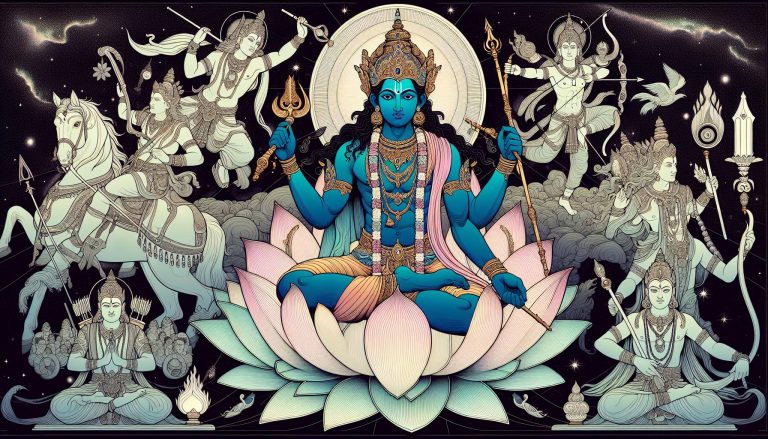
Exploring Vishnu’s forms isn’t just about understanding ancient tales; it’s about connecting with timeless principles that resonate even today. Each avatar embodies different virtues and challenges, reflecting the complexities of life and the eternal quest for harmony. Whether you’re a mythology enthusiast or a seeker of wisdom, delving into Vishnu’s avatars offers a profound glimpse into the spiritual fabric of Hinduism.
The Importance Of Vishnu In Hinduism
Vishnu holds a crucial place in Hinduism as a member of the Trimurti, which includes Brahma and Shiva. Known as the Preserver, Vishnu maintains the cosmic order (dharma). This role underscores the importance of balance and harmony in the universe.
As the central deity of Vaishnavism, the largest Hindu sect, Vishnu’s impact spans across various aspects of worship and culture. His depictions often include blue skin and riding Garuda, signifying his role as a divine protector. Worshippers find solace in his ability to preserve and protect, invoking his presence in times of trouble.
Vishnu’s ten avatars, known as Dashavatara, illustrate his dynamic forms. Each avatar, like Krishna and Rama, serves a specific purpose in the cosmic play. These avatars demonstrate Vishnu’s adaptability in addressing different needs and challenges. For instance, Krishna’s teachings in the Bhagavad Gita guide devotees towards righteous living, while Rama’s life in the Ramayana exemplifies ideal behavior.
His avatars also reveal key lessons in perseverance and justice. Parashurama – Rama of the Axe’s story emphasizes the importance of justice, while Narasimha’s form highlights the power of good over evil. These narratives continue to inspire and educate Hindus globally.
Vishnu’s role as the Preserver, his depiction in sacred texts, and his avatars’ lessons form the cornerstone of Hindu worship and ethos, proving his unparalleled significance in sustaining spiritual and cosmic balance.
Overview Of Vishnu’s Forms
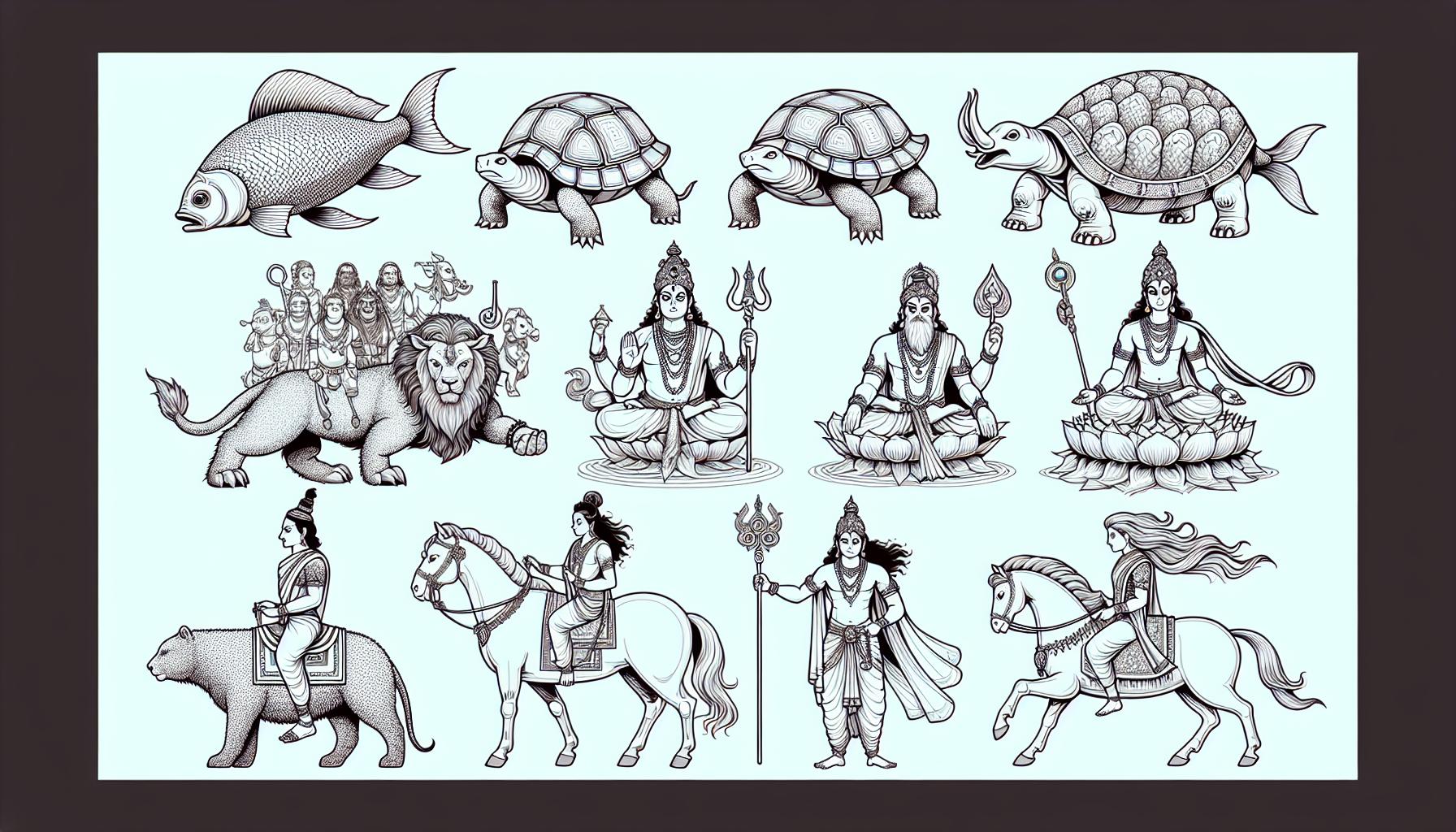
Vishnu, one of Hinduism’s principal deities, is known for his many forms and avatars. These diverse manifestations play crucial roles in creation, preservation, and destruction within Hindu mythology.
The Ten Avatars (Dashavatara)
The Dashavatara consists of Vishnu’s ten primary avatars, each with specific purposes:
- Matsya (Fish): Saved the sacred texts, Vedas, from demons and restored order.
- Kurma (Tortoise): Supported the churning of the ocean of milk, aiding in the quest for Amrita (nectar of immortality).
- Varaha (Boar): Defeated the demon Hiranyaksha and lifted the earth from the cosmic ocean.
- Narasimha (Half-man, Half-lion): Vanquished the demon Hiranyakashipu, defending his devotee.
- Vamana (Dwarf): Overpowered the demon king Bali, restoring cosmic balance.
- Parashurama (Rama with the Axe): Liberated the Brahmins from the oppressive Kshatriyas, wielding his powerful axe.
- Rama: Exemplified dharma (righteousness), defeating the demon king Ravana.
- Krishna: Taught the Bhagavad Gita, guiding Arjuna and reestablishing dharma.
- Buddha: Preached non-violence and compassion, promoting peaceful living.
- Kalki: Expected future avatar, prophesied to end the current age of darkness (Kali Yuga).
Other Significant Forms
Beyond the Dashavatara, Vishnu’s other forms hold substantial significance:
- Hayagriva: A horse-headed form that restored the stolen Vedas, symbolizing knowledge and wisdom.
- Dhanvantari: Emerged during the churning of the ocean, bringing the nectar of immortality and founding Ayurveda.
- Mohini: An enchantress form, distracted the demons to distribute the Amrita to the gods, maintaining cosmic balance.
Vishnu’s varied forms and avatars illustrate his role in upholding Dharma, each form tailored to address specific cosmic challenges and teach lasting spiritual wisdom.
Matsya: The Fish
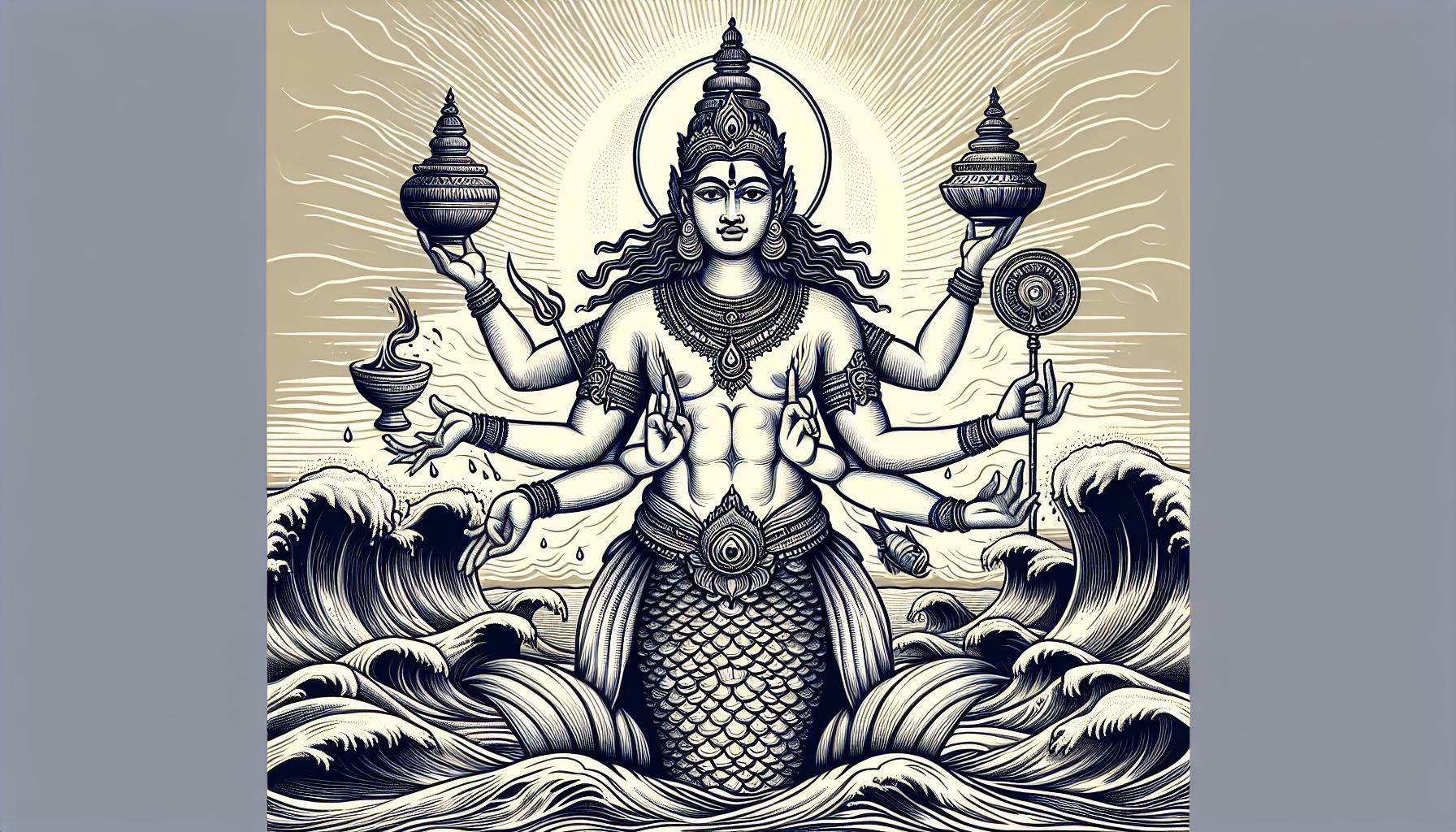
Matsya, the Fish, is one of Vishnu’s ten avatars, signifying immense historical and symbolic importance in Hinduism.
Historical Significance
Matsya represents the first of Vishnu’s avatars. In Hindu mythology, Matsya saved the world during a great flood. According to the myth, Manu, the first man, caught a small fish that kept growing until it became gigantic. As the flood approached, Manu tied his boat to a horn on Matsya’s head, which ensured his safety throughout the deluge.
Symbolism And Lessons
Matsya, often shown in either full animal form or as a combination of a man and a fish, holds deep symbolic meanings. Typically, Matsya is depicted with the upper half of a man and the lower half of a fish. In this form, Matsya has four hands, each holding significant objects: a conch shell and a discus (chakra), while the other two hands display the varada mudra (conferring a boon) and the abhaya mudra (granting protection).
The symbolism behind Matsya includes:
- Preservation in Chaos: Matsya’s intervention during the flood symbolizes Vishnu’s role in preserving life and order during cosmic disruptions.
- Spiritual Enlightenment: The fish symbolizes knowledge and wisdom, reflecting the idea of spiritual enlightenment emerging from chaos.
- Protection and Guidance: By guiding Manu to safety, Matsya embodies the principles of divine protection and guidance.
These teachings emphasize Vishnu’s role as the preserver and protector in Hinduism.
Kurma: The Tortoise
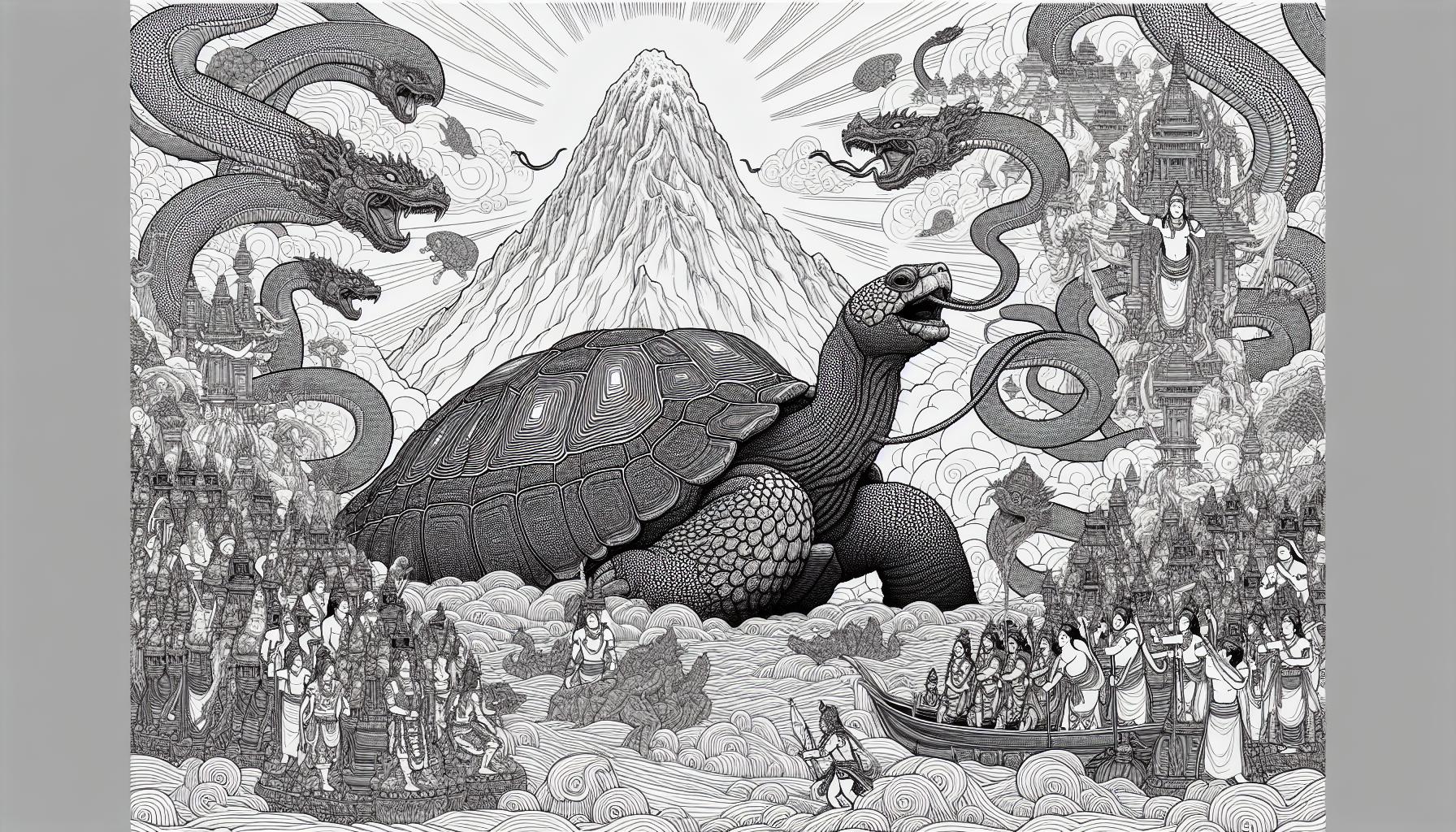
Kurma, Vishnu’s second avatar, holds a unique place in Hindu mythology. Kurma represents stability and support during chaos, embodying the critical role of balance in maintaining cosmic order.
Role in the Churning of the Ocean
The churning of the ocean of milk, known as Samudra Manthan, remains one of the most significant events in Hindu lore. In this tale, gods and demons joined forces to churn the ocean to obtain amrita, the elixir of immortality. They used the serpent Vasuki as a rope and Mount Mandara as the churning stick. Vishnu, in his Kurma avatar, provided essential support. He transformed into a giant tortoise to stabilize Mount Mandara on his back, ensuring the churning process continued smoothly. Without Kurma’s foundation, the mountain would’ve sunk, halting the quest for amrita.
Symbolic Meaning
Kurma’s symbolism extends beyond the literal transformation into a tortoise. The tortoise, known for its slow yet steady nature, signifies endurance, resilience, and steadfastness. Kurma reminds devotees of the importance of a solid foundation in any endeavor. Stories of Kurma depict how cooperation, balance, and support are necessary to achieve great outcomes, reinforcing the fundamental values of harmony and unity in Hinduism.
Varaha: The Boar
Varaha, the boar avatar of Vishnu, is the third of the ten incarnations of the Hindu god Vishnu. This form plays a crucial role in restoring cosmic order.
Mythological Tale
Varaha’s myth revolves around the demon Hiranyaksha. This demon dragged the earth to the sea’s bottom. To rescue the earth, Vishnu transformed into a boar. After a thousand-year battle, Varaha killed Hiranyaksha and lifted the earth from the water with his tusks.
Representation And Importance
Varaha appears in art and sculpture in various forms. He’s depicted either entirely as a boar or as a creature with a boar’s head and a man’s body. In the half-human, half-animal form, Varaha often stands with one leg bent, supporting the earth goddess Bhumidevi. Bhumidevi is personified as a dark-hued goddess clinging to one of his tusks. Varaha symbolizes wisdom, wealth, and power.
Narasimha: The Man-Lion
Narasimha, the fourth avatar of Vishnu, is a striking fusion of man and lion. This hybrid avatar emerged to defeat the demon Hiranyakashipu and restore dharma.
The Story of Narasimha
Hiranyakashipu, the twin brother of Hiranyaksha, had a boon from Brahma making him seemingly invincible. No human or animal could kill him; he couldn’t die inside or outside, by day or night, using any weapon. Empowered by this boon, he spread terror across heaven and earth. However, his son, Prahlada, remained a devout follower of Vishnu, driving Hiranyakashipu into a rage. He challenged Prahlada, insisting that Vishnu show his omnipresence, including in a stone pillar. From this pillar, Vishnu emerged as Narasimha, a being neither entirely human nor animal. At dusk, on a threshold, Narasimha used his claws to kill Hiranyakashipu, adhering to the boon’s constraints and re-establishing cosmic order.
Cosmic Symbolism
Narasimha represents the destruction of evil and the triumph of good. His unique form subverts conventional boundaries, illustrating that divine power transcends earthly constraints. The avatar emphasizes that dharma prevails even under seemingly insurmountable conditions. This symbolism reinforces Vishnu’s role as the Preserver within the Trimurti, showcasing his ability to adapt and ensure the universe remains balanced.
Vamana: The Dwarf
Vishnu’s fifth avatar, Vamana, known as the Dwarf Avatar, holds significant symbolic meaning. This form connects deeply with the tale of King Bali and various moral lessons.
The Tale Of King Bali
Vamana appeared as a young brahmin during King Bali’s grand sacrifice. He requested a small piece of land measured by three paces of his feet. Despite warnings from his guru, Shukracharya, King Bali granted the request. Vamana then expanded to his full size and covered the entire universe in three strides. This act reclaimed the heavens and the earth for the gods.
Lessons And Symbolic Meaning
Vamana’s small stature represents humility and simplicity. It shows that the divine can manifest in unassuming forms. His actions emphasize the importance of charity and fulfilling promises. King Bali’s generosity and commitment to his word exemplify dharma, or righteous living. This story teaches the value of humility, the power of divine presence in simple forms, and the virtue of keeping one’s promises.
Parashurama: The Warrior With An Axe
Parashurama, one of Vishnu’s avatars, embodies valor and justice. Possessing an axe gifted by Shiva, he stands out in Hindu mythology for his immense strength and warrior nature.
The Legend Of Parashurama
Parashurama, born to sage Jamadagni – Father of ParashuRama and Renuka, sought revenge for his father’s murder by a Kshatriya king. He decimated male Kshatriyas, doing so 21 times, filling five lakes with their blood. This act aimed to restore societal balance. Additionally, he is credited with creating Kerala by throwing his axe into the sea. The barren land was made fertile by the snake king Vasuki.
His Relevance In Modern Times
Parashurama’s tales emphasize justice, duty, and the fight against oppression. His determination and strength continue to inspire, symbolizing the unwavering pursuit of righteousness. Modern retellings often highlight his role in establishing order, making him a timeless figure in Hindu lore.
Rama: The Prince Of Ayodhya
Rama, the seventh incarnation of Vishnu, is a central figure in Hindu mythology. As the eldest son of King Dasharatha and Queen Kaushalya, his life story is detailed in the revered epic, the Ramayana.
The Story Of Ramayana
The Ramayana narrates Rama’s life journey, starting with his miraculous conception and birth in Ayodhya. Rama faces numerous challenges, including a lengthy exile and confrontations with formidable demons. A pivotal moment in the epic is the abduction of his wife, Sita, by Ravana, the demon king of Lanka. With the assistance of Hanuman and his monkey army, Rama successfully rescues Sita. Ultimately, Rama’s triumph over Ravana and his return to Ayodhya herald his rightful ascension to the throne. The Ramayana remains a sacred Hindu text, illustrating the triumph of good over evil.
Rama’s Virtues And Leadership
Rama embodies virtues like courage, honor, and unwavering commitment to dharma (righteousness). Known for his exemplary conduct, Rama’s leadership is marked by fairness, compassion, and devotion to duty. His adherence to dharma, even in the face of personal loss and hardship, sets a moral standard revered in Hinduism. His life highlights the importance of virtuous leadership, self-sacrifice, and the unyielding pursuit of justice.
Krishna: The Divine Statesman
Krishna, one of Vishnu’s most prominent avatars, exemplifies both playful charm and profound wisdom. Recognized as a divine statesman, his teachings and actions significantly impact Hindu philosophy.
Tales From Mahabharata – The Great Epic And Bhagavad Gita
In the Mahabharata, Krishna’s role transcends that of just a warrior. He serves as a charioteer to Arjuna, guiding him through the complexities of war and morality. His counsel is pivotal during the Kurukshetra War. The Bhagavad Gita, a 700-verse Hindu scripture that is part of the epic, captures his philosophical dialogues. In this dialogue, Krishna discusses the concepts of duty, righteousness, and devotion. He emphasizes the importance of following one’s Dharma or rightful duty, even in the face of personal turmoil.
The Teachings Of Krishna
Krishna’s teachings are cornerstones of Hindu philosophy. He advocates for Karma Yoga, the path of selfless action, and Bhakti Yoga, the path of devotion. By performing one’s duties without attachment to the results, one attains self-realization and inner peace. His emphasis on detachment and devotion has shaped many spiritual practices. Another critical teaching includes the concept of eternal soul, distinguishing between the temporary physical body and the everlasting soul. This belief helps followers transcend material concerns and focus on spiritual growth.
Buddha: The Enlightened One
Buddha, recognized in Hinduism as an avatar of Vishnu, holds a unique position in both Hindu and Buddhist traditions.
Connection To Buddhism
Buddha’s inclusion in the Dashavatara narrative occurred after his enlightenment, between 500–200 BCE and c. 300 CE. Consequently, many Hindus revere Buddha as the ninth avatar of Vishnu. This synthesis likely emerged due to interactions between Hinduism and Buddhism during this period. Recognizing Buddha as an avatar helped integrate Buddhist teachings into Hindu philosophy.
Symbolic Importance
Within Hindu mythology, Buddha’s avatar symbolizes compassion and non-violence. His teachings against animal sacrifice marked a significant shift from Vedic traditions. As Vishnu’s incarnation, Buddha’s role transcends religious boundaries, embodying enlightenment and spiritual transformation. His presence in the Dashavatara underscores the adaptability and inclusiveness of Hindu thought.
Kalki: The Future Warrior
Kalki, Vishnu’s tenth and final avatar, is integral to Hindu mythology. Prophesied to appear at the end of the Kali Yuga, Kalki serves as a beacon of hope, symbolizing the restoration of balance and righteousness.
Predictions And Prophecies
The prophecy of Kalki’s arrival marks the end of the Kali Yuga, the current age known for its darkness and chaos. Predicted to emerge as a warrior, Kalki will bring about a new era of peace and prosperity. This new period, the Satya Yuga, will reverse the moral decay and social unrighteousness pervasive in the Kali Yuga. Prophetic scriptures like the Puranas detail Kalki’s mission to stand against alignment with evil forces.
Symbolizing The End Of The Kaliyuga
Kalki’s representation as a warrior riding a white horse with a fiery sword is significant. He embodies the end of Kali Yuga’s darkest days and the commencement of a righteous era. With no mercy for enemies, Kalki’s fierce demeanor highlights his role in purifying the world. This visual is a powerful reminder of the cyclical nature of time in Hindu cosmology, where each Yuga represents a stage in the cosmic cycle. Through Kalki, Vishnu reaffirms his commitment to preserving cosmic balance and ensuring righteousness prevails.
Conclusion
Exploring Vishnu’s forms reveals the depth and richness of Hindu mythology. Each avatar, from Krishna to Kalki, embodies essential virtues and teachings. They serve as reminders of the cosmic balance Vishnu maintains and the moral values he upholds. This journey through Vishnu’s manifestations highlights the enduring relevance of these ancient stories and their impact on spiritual and moral life. Vishnu’s avatars not only preserve cosmic order but also inspire hope and righteousness in our lives.
Sources & further reading
These themes are explored in greater depth across the following authoritative resources:
- Encyclopaedia Britannica, Hindu Mythology
- Internet Sacred Text Archive, Hinduism
- Mythopedia, Hindu Mythology
- Harvard Pluralism Project, Hindu Tradition
- Wendy Doniger, The Hindus: An Alternative History (Penguin, 2009), ISBN 978-0143116691
External resources for further reading. Apam Napat is not affiliated with these publishers; citation does not imply endorsement.
Based on the classical texts of Hindu mythology, see our sources.