
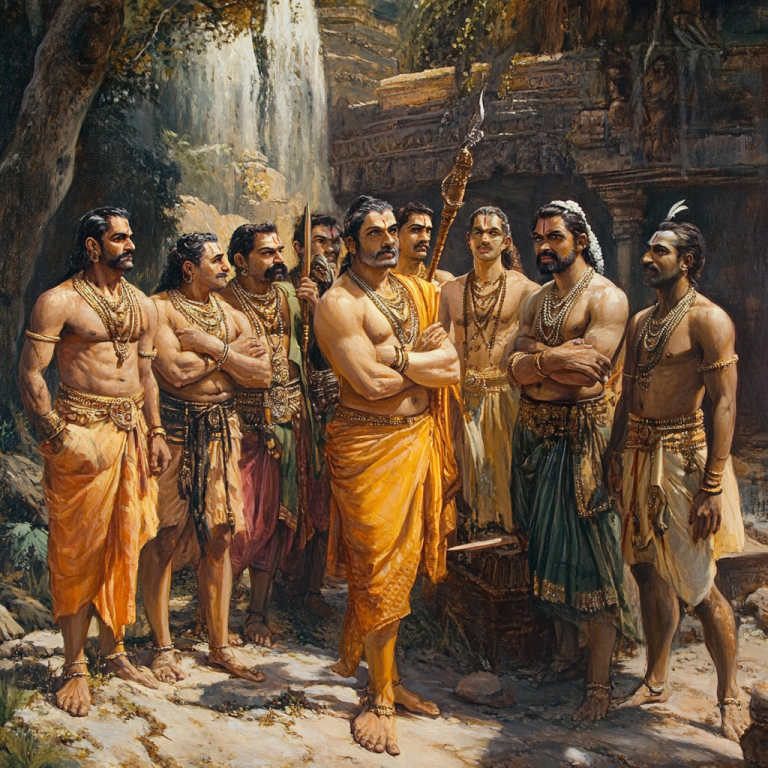
The Pandavas’ Exile to Varanavatha: A Tale of Betrayal and Survival
The End of Training and the Blessing of Brahmastra
After the public display of their prowess during the grand exhibition, the Pandava and Kaurava princes completed their training under Dronacharya. Among all his disciples, Drona recognized Arjuna as the most gifted and worthy of learning the Brahmastra, a weapon of immense destructive power.
Drona said, “This weapon is a double-edged sword. Its use can annihilate the world. Wield it only in the direst emergency, against supernatural foes or divine opponents. Never use it against mortals.”
Blessing his student, Drona declared, “You are now the greatest warrior on Earth, and only Krishna – An Incarnation of Vishnu, your cousin and divine ally, can match you. He will be your greatest friend, so no force shall defeat you. Promise me, however, that you will not shirk from battle, even if you face me or Bhishma – The Grand Old Man of The Kurus on the battlefield.”
Arjuna bowed low and pledged his obedience, unaware of how these words would one day come to haunt him in later battles chronicled in the epic Mahabharata Book 7, where the struggles for Dharma would reach their fiercest intensity.
The Crown Prince Yudhishthira
After consulting his ministers, Dhritarashtra announced the anointment of Yudhishthira as the Crown Prince. Though wise and justified, this decision sparked intense jealousy in Duryodhana, who considered the throne his birthright.
The people’s love for the Pandavas, coupled with Yudhishthira’s innate sense of Dharma, made the Kaurava princes insecure. The Pandavas, revered for their adherence to righteousness, stood as shining examples of virtue in an increasingly corrupted court.
Dhritarashtra, torn between his duty as king and his partiality toward Duryodhana, grew increasingly conflicted. Though he could not openly oppose Yudhishthira’s anointment, his inner desires leaned toward ensuring his son’s ascendancy.
Duryodhana and Shakuni’s Plot
Duryodhana, burning with envy, sought counsel from his maternal uncle Shakuni, a master manipulator. Together, they devised a sinister plan to eliminate the Pandavas under the guise of a diplomatic mission.
Shakuni advised, “The Pandavas must be sent away from Hastinapura, where they are beloved. Once isolated, we can ensure their demise, but it must appear as an accident. Let us exploit the festival at Varanavatha to set our plans in motion.”
Duryodhana presented this idea to Dhritarashtra. Reluctant at first, the blind king eventually yielded, swayed by his own subconscious desires for his son’s ascendancy.
The Pandavas’ Departure
Dhritarashtra summoned Yudhishthira and said, “There is a grand festival at Varanavatha, and it would honor our family if you and your brothers represent us there. Take your mother, Kunti, and stay for some time to acquaint yourselves with the people.”
Though Yudhishthira suspected foul play, he could not openly defy his uncle. The Pandavas prepared to leave, but Vidura, ever-watchful, took Yudhishthira aside. Speaking in riddles, Vidura warned:
- “A weapon that is not steel may still destroy the body.”
- “A rat survives a forest fire by retreating into its hole.”
- “Even in darkness, a wise man finds his path using the stars.”
Yudhishthira understood Vidura’s cryptic message. Sharing the warning with his brothers and mother, they remained vigilant.
The Wax Palace: The Trap at Varanavatha
At Varanavatha, the Pandavas were greeted with fanfare. Purochana, Duryodhana’s agent, had prepared a grand palace for them. Unknown to the townsfolk, the palace was constructed of lac, wax, and other flammable materials.
Though outwardly gracious, the Pandavas immediately recognized the trap. Following Vidura’s advice, they maintained a public façade of cheerfulness while secretly preparing for escape.
Their vigilance paid off when a miner named Kanaka, sent by Vidura, arrived in disguise. This critical moment of rescue and secrecy resonates with broader mythological themes, such as the concealments and trials faced by celestial beings like Ketu – The Torso of an Asura, who also embodies hidden dangers and unseen forces at play in cosmic affairs.
The Burning of the Palace
Fate presented an opportunity when a Nishada woman and her five sons, drunk from the festival’s revelries, fell asleep in the palace. The Pandavas decided to act.
Late at night, they set the palace ablaze, ensuring that Purochana, the architect of their trap, perished in the flames. Escaping through the underground tunnel, they sealed its entrance, leaving no trace of their survival.
The charred bodies of the Nishada family were mistaken for the Pandavas and Kunti. The people of Varanavatha mourned the tragic “deaths” of their beloved princes and their mother, condemning Duryodhana for his suspected involvement.
Aftermath: Grief and Relief
News of the Pandavas’ “death” reached Hastinapura, plunging the kingdom into mourning.
- Dhritarashtra displayed mixed emotions-sorrow for his nephews but relief for Duryodhana’s unchallenged claim to the throne.
- Bhishma was inconsolable, lamenting the loss of his cherished grandsons.
- Vidura, the only one aware of the truth, feigned grief while secretly relieved that the Pandavas were safe.
- Duryodhana, Shakuni, and Karna celebrated their apparent victory, believing their path to power was now clear.
Meanwhile, the Pandavas, disguised and traveling through the forest, embarked on a journey that would eventually lead them to Ekachakra, their next refuge.
Themes and Connections in Hindu Mythology
- Vidura’s Wisdom: Vidura’s cryptic warnings reflect the practical wisdom of Niti Shastra (science of polity). His role mirrors the sagacity found in tales such as Indra and Ahalya, where divine intervention and human actions interweave to uphold cosmic balance.
- Divine Providence: The Pandavas’ survival is a recurring theme in their story, underscoring the idea of Dharma and divine intervention safeguarding the righteous.
- The Wax Palace as a Symbol:
- Fire: A purifier, symbolizing the trials that prepare the Pandavas for their ultimate destiny.
- The Tunnel: Represents foresight and adaptability in the face of danger, echoing other myths like the escape of Parashurama – Rama of the Axe or Krishna’s family from Mathura.
- Duryodhana’s Character: His jealousy mirrors Ravana’s arrogance and Kansa’s paranoia, both of whom sought to destroy prophesied threats but were ultimately undone by their actions.
Legacy of the Varanavatha Episode
The Wax Palace episode set the stage for the Pandavas’ eventual rise, testing their resourcefulness and unity-qualities that would continue to define their journey through subsequent tribulations, as further elaborated in the later stages of the epic in Mahabharata Book 10.
Sources & further reading
These themes are explored in greater depth across the following authoritative resources:
- Stanford Encyclopedia of Philosophy, Hindu Philosophy
- Britannica, Dharma
- Britannica, Karma
- Internet Sacred Text Archive, Bhagavad Gita
- A. K. Ramanujan, Speaking of Siva (Penguin Classics, 1973)
External resources for further reading. Apam Napat is not affiliated with these publishers; citation does not imply endorsement.
Frequently asked questions
Why were the Pandavas sent to Varanavatha?
What was the wax palace at Varanavatha?
How did Vidura warn the Pandavas?
How did the Pandavas escape the burning palace?
Who taught Arjuna the Brahmastra?
Based on the classical texts of Hindu mythology, see our sources.