I’ve always been fascinated by how Durga embodies both nurturing and warrior-like qualities. Her stories, rich with symbolism, teach us about courage, inner strength, and the triumph of good over evil. In exploring Durga’s divine powers, we uncover timeless lessons that resonate with our modern lives, reminding us of the potent force of divine feminine energy.
The Origins of Durga’s Powers
Durga’s divine powers are integral to her role in Hindu mythology. To understand her origins, we delve into her mythological creation and the key scriptures that chronicle her might.
Mythological Background
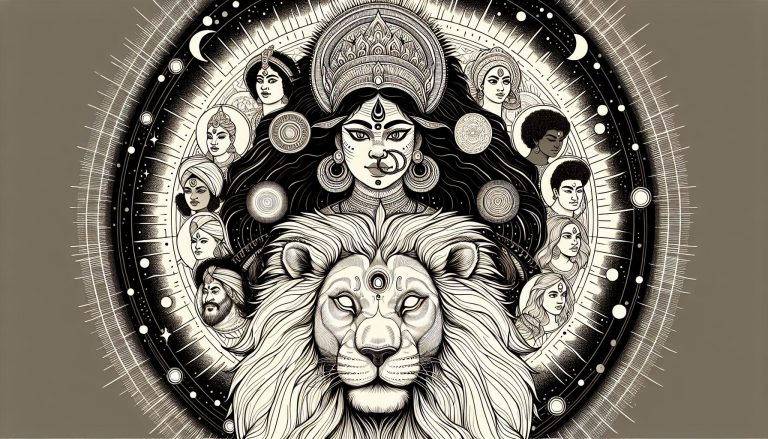
Durga’s origins lie in the collective energy of the principal deities Brahma – The Creator, Vishnu – The Protector, and Shiva. This combined shakti addresses cosmic imbalance. Created to defeat the buffalo demon Mahishasura – Buffalo Demon, her power stems from this divine coalition. Depictions often show her riding a lion or tiger, a symbol of ferocity, with multiple arms holding weapons gifted by gods.
- Rigveda
The Rigveda, one of Hinduism’s oldest scriptures, portrays Durga in hymns that associate her with war and protection. The Devi Sukta hymn praises her as the cosmic queen empowering creation and embodying universal essence. - Devi Mahatmya
The Devi Mahatmya, composed between 400 and 600 CE, is pivotal for Durga Puja. This text exalts her combat prowess and divine strength.
The Ten Divine Powers
The Ten Divine Powers of Durga, also known as the Saptamatrikas, form a group of formidable goddesses, each representing a divine energy or Shakti. Each goddess complements a specific deity, contributing to Durga’s supreme protection.
Maheshwari
Maheshwari, the Shakti of Shiva, embodies power and stability. With a white complexion and three eyes, she wields a trident and damaru. Her mount, Nandi the bull, signifies strength and righteousness.
Kaumari
Kaumari, linked to Kumara (Karttikeya), exudes youthful vigor and martial power. Depicted with a spear and rooster as her mount, she symbolizes victory in warfare and courage.
Varahi
Varahi, the Shakti of Varaha – The Boar, represents the earth’s nurturing aspects. She appears with a boar face, holding a discus and a mace, symbolizing the power to uplift and protect the earth. Her mount, a buffalo, signifies fertility and strength.
Chamunda
Chamunda, associated with fierce aspects, embodies destruction of evil. She has a skeletal form with blood-red eyes, carrying a skull cup and trident. Her mount, a jackal, accentuates her relentless pursuit of justice.
Vaishnavi
Vaishnavi, the Shakti of Vishnu, is depicted with a bluish complexion and multiple arms. She holds a conch shell, chakra, mace, and lotus. Her mount, Garuda, showcases her swift power to conquer evil.
Indrani
Indrani, Indra’s Shakti, embodies leadership and valor. With varied depictions of two, four, or six arms, she holds a Vajra and goad. Her mount, an elephant, symbolizes wisdom and regal authority.
Brahmani
Brahmani, the Shakti of Brahma, is shown in yellow with four heads and four arms. She holds a rosary and kamandalu, illustrating wisdom and creation. Her mount, a swan or goose, represents purity and knowledge.
Narasimhi
Narasimhi, the counterpart of Narasimha (Vishnu’s lion avatar), symbolizes fierce protection. She has a lion’s face and carries a discus and mace. Her unique blend of human and lion features signifies the power to eliminate demonic threats.
Durga Herself
Durga, the core of these divine powers, stands as a symbol of strength and protection. Depicted with multiple arms, each holding a weapon, she manifests the collective energy of Brahma, Vishnu, and Shiva.
Shakti
Shakti, the essential divine feminine energy, flows through each goddess. It represents the dynamic force behind creation and destruction. Each manifestation of Shakti reflects Durga’s infinite capacity to maintain cosmic balance.
Symbolism and Iconography
Durga’s symbolism and iconography convey profound meanings in Hindu mythology, representing divine attributes that facilitate the understanding of her powers.
Weapons and Tools
Durga wields multiple weapons and tools, each holding its unique significance. The trident (Trishul) represents the three fundamental qualities of living beings: calmness, salvation, and energy. The discus (Chakra) symbolizes the universal mind and the concept of dharma, marking the destruction of evil forces. The conch (Shankha) stands for the primordial sound that created the universe, while the bow and arrow indicate energy and potential energy. The sword (Khadga) represents intellect and wisdom, cutting through ignorance. The mace (Gada) signals authority and power, often used to crush malevolent forces.
Mount of Durga
Durga rides a lion, a symbol of power and determination. The lion represents her mastery over all forces, implying strength and unwavering courage. Her mount reinforces her role as the protector against evil and the dispeller of fears, fortifying her as a divine warrior.
Durga’s Divine Powers in Modern Times
Durga’s divine powers continue to hold cultural and spiritual relevance today. Her significance transcends ancient scriptures, embedding itself in contemporary contexts.
Cultural Significance
Durga, revered as the Mother of the universe, embodies the harmonious creation, sustenance, and dissolution of all beings and worlds. Her protective force is crucial now more than ever as she liberates the oppressed and combats injustice. She symbolizes strength and justice, bringing order amid chaos.
In India, Durga’s portrayal extends to nationalism. Her image as Mother India has inspired countless movements for independence and unity. Art, literature, and pop culture frequently draw on her narrative. Bollywood, for instance, showcases her story in films, while national songs extoll her virtues, reinforcing her enduring presence in modern culture.
Spiritual Influence
Durga’s spiritual influence transcends religious boundaries, representing a universal force that guides and protects. Devotees invoke her powers through rituals and prayers, seeking her blessings for overcoming personal and communal obstacles. Her warrior-like qualities serve as a source of inspiration for those facing adversities, empowering individuals to rise above challenges with courage and resilience.
Durga’s ten divine powers, known as the Saptamatrikas, each represent specific energies essential to navigating modern life. Whether seeking wisdom, strength, or compassion, her multifaceted abilities provide a spiritual foundation for fostering positive change in an ever-evolving world.
Conclusion
Goddess Durga’s divine powers continue to inspire and guide us in today’s world. Her embodiment of strength, resilience, and justice offers profound wisdom for navigating life‘s challenges. As a symbol of triumph over evil, Durga reminds us of the importance of courage and the power of good. Her influence transcends time and culture, providing spiritual support and empowerment for those who seek her blessings. Embracing Durga’s teachings can lead to a more empowered and just life, filled with compassion and strength.
Sources & further reading
These themes are explored in greater depth across the following authoritative resources:
- Encyclopaedia Britannica, Hindu Mythology
- Internet Sacred Text Archive, Hinduism
- Mythopedia, Hindu Mythology
- Harvard Pluralism Project, Hindu Tradition
- Wendy Doniger, The Hindus: An Alternative History (Penguin, 2009), ISBN 978-0143116691
External resources for further reading. Apam Napat is not affiliated with these publishers; citation does not imply endorsement.
Based on the classical texts of Hindu mythology, see our sources.