
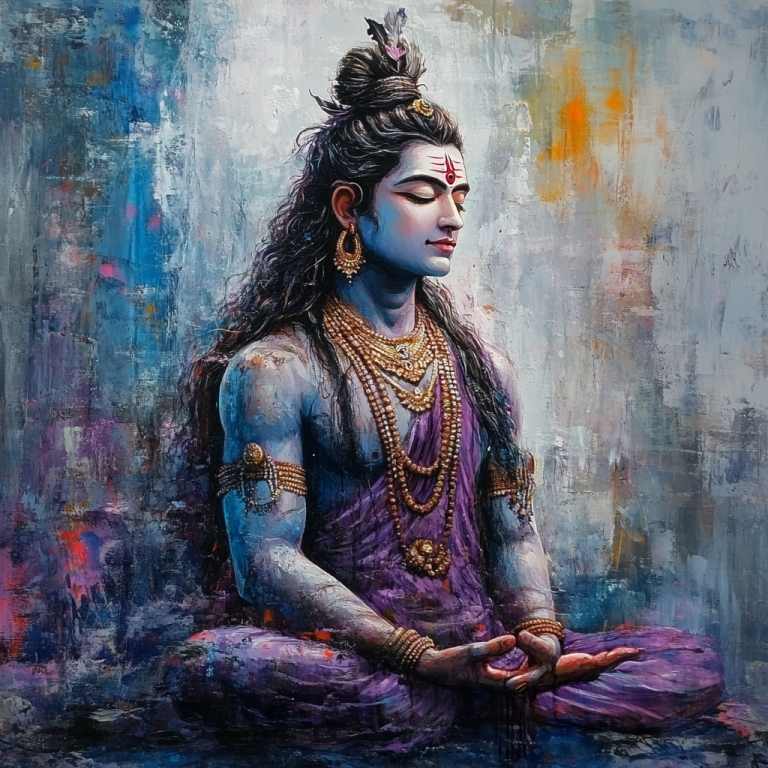
The Wrath of Mahadeva and the Restoration of Cosmic Order
Based on [Maha:10.18]
Once the Krita-Yuga, the golden age of truth and virtue, had ended, the celestials resolved to perform a grand sacrifice (Yagna) to replenish and enhance their divine powers. The rituals were meticulously prepared according to the instructions laid out in the sacred Vedas. A sacrificial altar of great magnificence was constructed, and clarified butter (ghee) along with other offerings were gathered in abundance. Each deity was assigned a portion of the sacrificial offerings (Havis), distributed in accordance with their might and influence.
However, the celestials, blinded by their arrogance and ignorance, made a grave error-they failed to recognize the supremacy of Lord Shiva, also known as Mahadeva, the destroyer of ignorance and the protector of dharma. In their folly, they excluded him from the sacrifice, allotting him no share of the offerings. This slight enraged Mahadeva, who is also Rudra – Father of the Maruts, the god of destruction and transformation.
The Forging of the Divine Bow
In his fury, Mahadeva resolved to teach the celestials a lesson they would never forget. From his divine power, he crafted a bow of unparalleled might, five cubits long and strung with a string infused with the potency of the sacred Mantra “Vashat”-a sound invoked in sacrifices to sanctify offerings to the gods. Armed with this bow and a quiver of unerring arrows, Mahadeva descended upon the sacrificial hall, his form radiating wrath and cosmic power.
As he advanced, his matted locks swayed like serpents, and his third eye burned with the fire of destruction. The sight of the enraged deity sent waves of terror through the assembled gods. The earth trembled violently, her mountains and oceans quaking in fear. Vayu, the wind god, froze in terror, and Agni, the fire god, became paralyzed, causing the sacred flames to sputter and die despite being fed with ghee. The Sun and the Moon lost their radiance, and the planets veered from their courses, plunging the cosmos into chaos. A suffocating gloom enveloped the world, and the celestial assembly descended into despair.
The Chase of the Sacrificial Deity
As the gods quailed under Mahadeva’s wrath, the sacrificial deity, who embodied the essence of the Yagna, assumed the form of a deer and fled, accompanied by Agni. Determined to punish those who had insulted him, Mahadeva pursued them relentlessly, shooting his celestial arrows with deadly precision. His arrows pierced the earth, the skies, and the very fabric of existence, each shaft radiating divine energy.
The pursuit of the sacrificial deity and Agni caused the celestial assembly to crumble further. Deprived of the sacrificial fire and the sacred rites, the gods began to lose their luster and power. Their immortality seemed to slip away, leaving them vulnerable and weakened.
The Subjugation of the Celestials
Having driven the sacrificial deity and Agni into hiding, Mahadeva turned his attention to the other gods. With the horn of his mighty bow, he unleashed a storm of destruction upon them. He broke the arms of Savitri – The Ideal Wife (Surya, the Sun god), plucked out the eyes of Bhaga – Wealth and Marriage, the god of prosperity, and shattered the teeth of Pushan – The Protector, the god of nourishment. Each act of destruction reverberated through the heavens, a stark reminder of the consequences of disrespecting the supreme deity.
Mahadeva then spun the horn of his bow and let out a booming laugh that paralyzed the remaining gods. The celestial assembly descended into chaos as the frightened gods scattered in all directions. The balance of the universe teetered on the brink of collapse.
Shiva’s connection to cosmic balance and his divine consorts, including Sati and Parvati, often underscores this dual nature.
The Celestial Plea for Forgiveness
Realizing that their arrogance had provoked this cataclysmic wrath, the gods rallied together in desperation. Combining their remaining power, they succeeded in breaking the string of Mahadeva’s bow. This brief moment of respite allowed them to approach him with humility. Prostrating themselves before him, they sang hymns in his praise, extolling his greatness as the ultimate destroyer of ignorance and the source of all power.
Their heartfelt pleas and sincere repentance melted Mahadeva’s anger. The benevolent Lord, who embodies both destruction and compassion, forgave the celestials for their folly. He restored the arms of Savitri, the eyes of Bhaga, and the teeth of Pushan, healing the wounds he had inflicted in his divine rage.
The Eternal Place of Mahadeva in Sacrifices
Mahadeva decreed that henceforth, no sacrifice would be complete without an offering to him. From that day, the sacred rites of the Vedic sacrifices included a portion of the Havis dedicated to Mahadeva, ensuring that his honor would never again be slighted. This episode reinforced Shiva’s role as the supreme deity, one who must be revered in every cosmic endeavor.
Connection to Other Mythological Events
This tale echoes the recurring theme in Hindu mythology of divine wrath leading to cosmic balance. The story of Shiva’s anger parallels other instances, such as:
- The Daksha Yagna: When Daksha insulted Shiva by not inviting him to his sacrificial rite, Shiva’s consort Sati immolated herself in protest. Sati, daughter of Prasuti – Wife of Daksha and Daksha, whose lineage itself highlights important divine ancestry. Enraged, Shiva destroyed the Yagna, further demonstrating the necessity of honoring him in all rituals.
- The Tripura Dahana: Shiva’s wrath was similarly invoked when he destroyed the three demon cities (Tripura) to restore cosmic order, symbolizing his role as the destroyer of adharma.
- Shiva as Rudra: The primordial essence of Shiva as Rudra, the terrifying archer mentioned in the Vedas, aligns with his role in this story as the wielder of the divine bow.
Conclusion
This story serves as a powerful reminder of the folly of hubris and the necessity of humility. It also illustrates Shiva’s dual nature as both the fierce destroyer and the compassionate protector, ensuring that balance and dharma are maintained in the universe. Through his wrath and subsequent forgiveness, Mahadeva reaffirmed his position as the ultimate guardian of cosmic order.
Sources & further reading
These themes are explored in greater depth across the following authoritative resources:
- Internet Sacred Text Archive, Rig Veda (Griffith translation)
- Internet Sacred Text Archive, Upanishads
- Britannica, Veda
- Britannica, Upanishad
- Patrick Olivelle, The Early Upanishads (Oxford University Press, 1998)
External resources for further reading. Apam Napat is not affiliated with these publishers; citation does not imply endorsement.
Frequently asked questions
Why did Shiva disrupt the celestial sacrifice?
What did Shiva do to the gods at the sacrifice?
How was Shiva's bow created?
How did the gods appease Shiva?
What was the lasting outcome of this episode?
Based on the classical texts of Hindu mythology, see our sources.