
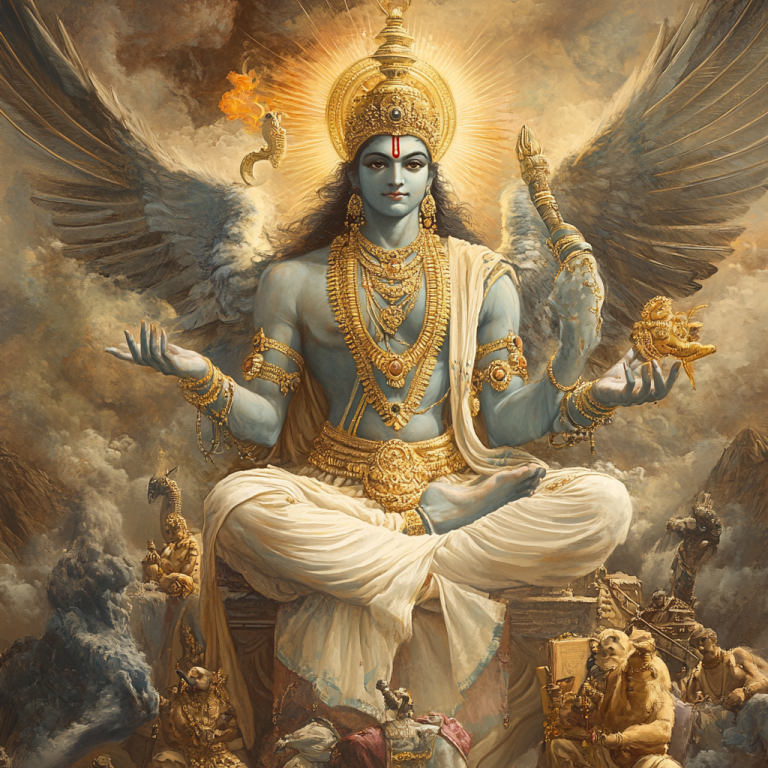
The Ten Incarnations of Vishnu: A Journey Through Cosmic Cycles
Controversies and Variations in the Dashavatara
While the ten primary avatars of Vishnu are widely accepted, there are variations in the list across texts and traditions. Those interested can explore a full list of Vishnu’s avatars, which highlights how traditions occasionally include alternate incarnations like Mohini or Buddha, reflecting regional and philosophical influences. Traditionally, the list includes:
- Matsya (Fish)
- Kurma (Tortoise)
- Varaha (Boar)
- Narasimha (Man-Lion)
- Vamana (Dwarf)
- Parashurama – Rama of the Axe (Axe-Wielding Sage)
- Rama (Prince of Ayodhya)
- Krishna (Cowherd and Charioteer)
- Mohini (Enchantress) or Buddha (Enlightened One)
- Kalki (Future Destroyer)
The Avatars and Their Purposes
Each of Vishnu’s incarnations is tied to specific cosmic events or challenges, emphasizing the cyclical nature of time and the perpetual struggle between good and evil in Sanatana Dharma. Understanding the deeper significance of Vishnu’s avatars reveals how each form serves a symbolic role far beyond the immediate narrative.
| Avatar | Purpose and Story |
|---|---|
| Matsya (Fish) | Vishnu assumed the form of a fish to save Manu (the progenitor of humanity) and the Vedas during the great deluge. This parallels other flood myths, symbolizing preservation and continuity. |
| Kurma (Tortoise) | In the Samudra Manthan (churning of the ocean of milk), Vishnu became a tortoise to support Mount Mandara as the churning rod. This avatar signifies Vishnu’s role as a stabilizer and sustainer in times of cosmic upheaval. |
| Varaha (Boar) | As a boar, Vishnu dived into the ocean to rescue Bhoomi Devi (Earth) from the demon Hiranyaksha, who had submerged it. This avatar highlights Vishnu’s role as the savior of creation from chaos. |
| Narasimha (Man-Lion) | To fulfill the boon that Hiranyakashipu could not be killed by man or beast, Vishnu appeared as a hybrid form to slay him, demonstrating his promise to protect his devotees, such as Prahlada, the demon’s virtuous son. |
| Vamana (Dwarf) | Vishnu humbled the mighty king Mahabali, who had gained control over the three worlds. As a dwarf, he asked for three paces of land, and then grew to cosmic size to reclaim the worlds for the Devas. |
| Parashurama (Axe-Wielder) | This avatar avenged the arrogance of the Kshatriyas by annihilating them 21 times. It reflects Vishnu’s wrathful justice and the necessity of resetting social order. |
| Rama (Prince of Ayodhya) | The hero of the Ramayana, Rama exemplifies Dharma and virtuous kingship. He defeated the demon king Ravana, restoring cosmic and social balance. |
| Krishna (Cowherd and Charioteer) | A central figure of the Mahabharata – The Great Epic, Krishna’s actions and teachings, especially the Bhagavad Gita, emphasize devotion, duty, and the ultimate surrender to the divine. |
| Mohini (Enchantress) | Vishnu took the form of an enchantress to distribute Amrit (nectar of immortality) to the Devas during the Samudra Manthan and to subdue the Asuras through illusion. |
| Kalki (Future Destroyer) | The prophesied avatar who will end the Kali Yuga, Kalki will ride a white horse, wielding a blazing sword to destroy evil and initiate the next cosmic cycle. |
Short and Long-Lasting Incarnations
Some avatars, such as Kurma and Mohini, were momentary and served specific, immediate purposes. For example:
- The Kurma avatar ended after Mount Mandara stabilized during the ocean churning.
- The Mohini avatar lasted only long enough to distribute Amrit to the Devas and to trick the Asuras.
In contrast, avatars like Rama and Krishna extended over lifetimes, shaping the narratives of the Ramayana and Mahabharata, respectively. These incarnations dealt with human dilemmas, relationships, and moral conflicts, offering profound lessons in Dharma.
The Unique Paradox of Parashurama
The Parashurama avatar is particularly intriguing as it overlaps with both Rama and Krishna’s timelines. Parashurama represents Vishnu’s martial prowess, avenging the injustices of the Kshatriyas.
- In the Ramayana, Parashurama confronts Rama after the latter breaks Shiva’s bow during Sita’s swayamvara. Parashurama realizes Rama’s divine nature and relinquishes his celestial power (Vishnu’s Amsa) to him, symbolizing the passing of the cosmic mantle.
- In the Mahabharata, Parashurama reappears as the teacher of great warriors like Bhishma and Karna, though his avatar is now purely mortal, having relinquished his divine essence.
This dual presence in separate epics underscores Vishnu’s omnipresence across cosmic events and his adaptability to different epochs.
The Controversy of Buddha as an Avatar
The inclusion of Buddha in the Dashavatara remains a point of contention. Some traditions regard Buddha as an avatar who diverted those inclined toward violence into a path of non-violence and self-realization. Others argue that this was a later interpolation to reconcile Buddhism with Hinduism. In certain lists, Mohini occupies this spot, reflecting Vishnu’s role as an enchanter and divine strategist.
The Awaited Kalki Avatar
The Kalki avatar, yet to come, is described vividly in the Puranas. Riding a white horse with a blazing sword, Kalki will appear at the end of Kali Yuga, the current age of darkness and decline. For a broader perspective, the history of Vishnu’s avatars illustrates how each incarnation has marked a pivotal shift in cosmic order, culminating in the awaited transformation.
The prophecy of Kalki reflects the cyclical philosophy of time in Hinduism, emphasizing destruction as a precursor to renewal-a theme seen in the dissolution and re-creation of the cosmos itself.
Connections Across Hindu Mythology
- The Principle of Dharma
Every avatar underscores Vishnu’s commitment to upholding Dharma, whether through direct intervention (e.g., Krishna in the Mahabharata) or symbolic acts (e.g., Vamana reclaiming the worlds). - Cyclic Time
The Dashavatara aligns with the concept of Yuga cycles, with Vishnu incarnating in every epoch to address specific challenges, reflecting the eternal struggle between good and evil. - Linking the Epics and Puranas
The overlapping avatars, such as Parashurama appearing in both the Ramayana and Mahabharata, or the reference to Vishnu’s Mohini avatar in the Samudra Manthan, illustrate the interconnectedness of Hindu mythology’s vast narrative tapestry.
Conclusion: Vishnu as the Eternal Protector
The Dashavatara is not merely a collection of tales but a profound philosophical framework. It portrays Vishnu as the eternal preserver of cosmic balance, adapting to the needs of every age. Whether as the playful Krishna, the dutiful Rama, or the apocalyptic Kalki, Vishnu’s avatars reaffirm his promise to protect the world, ensuring that Dharma triumphs, even in the face of overwhelming Adharma.
Sources & further reading
These themes are explored in greater depth across the following authoritative resources:
- Internet Sacred Text Archive, Rig Veda (Griffith translation)
- Internet Sacred Text Archive, Upanishads
- Britannica, Veda
- Britannica, Upanishad
- Patrick Olivelle, The Early Upanishads (Oxford University Press, 1998)
External resources for further reading. Apam Napat is not affiliated with these publishers; citation does not imply endorsement.
Based on the classical texts of Hindu mythology, see our sources.