
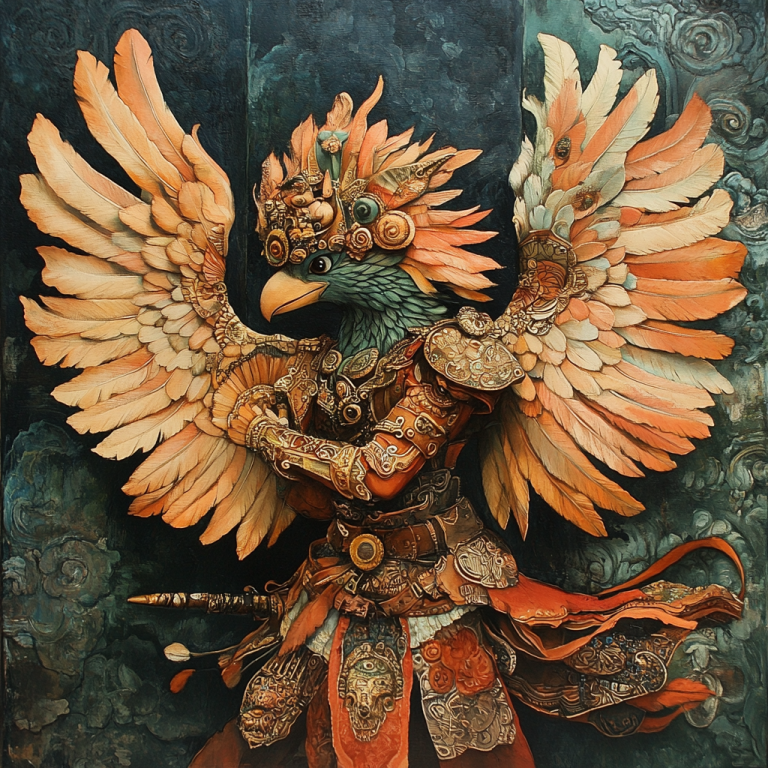
The Tale of Garuda: The King of Birds
From [Maha:1.16-35]
The Rivalry of Kadru and Vinata
The great sage Kashyapa, a wish-born son of Lord Brahma, was married to the daughters of Daksha Prajapati – The Creators. Among them were Kadru and Vinata, both exceptionally beautiful but fiercely jealous of each other. Kashyapa, pleased with their devotion, offered each a boon.
- Kadru’s Wish: “Let a thousand sons of incomparable strength and valor be born to me.” Kashyapa granted her wish, and Kadru became the mother of the mighty Nagas (serpents).
- Vinata’s Wish: “Let two sons be born to me, but may they surpass Kadru’s sons in strength, valor, and fame.” Kashyapa granted her wish, and Vinata laid two eggs.
While Kadru’s sons were born quickly, Vinata’s eggs did not hatch even after 500 years. Impatient, Vinata broke open one of the eggs, revealing an underdeveloped child with only its upper body formed. The child, Aruna, cursed his mother for her impatience, condemning her to slavery until her other son was born. However, he consoled her that her next son would deliver her from bondage. Aruna later became the charioteer of Surya (the Sun God).
The Bet Between Kadru and Vinata
Kadru, seeking to enslave her sister, devised a cunning plan. One day, she asked Vinata,
“Sister, what is the color of Uchaishravas – The Horse of Indra, the divine horse that emerged from the churning of the ocean?”
Vinata replied confidently, “It is pure white, from nose to tail.”
Kadru said, “No, its tail is black. Let us wager: if I am right, you will become my slave; if you are right, I shall serve you.”
Vinata agreed. Knowing the horse was entirely white, Kadru commanded her serpent sons to entwine themselves around Uchaishravas’s tail, making it appear black. When Vinata saw the horse, she realized she had lost. Bound by her word, Vinata became Kadru’s slave, forced to serve both her and the serpents.
The Birth of Garuda
After another 500 years, the second egg hatched, and Garuda emerged. His radiance was blinding, comparable to the Sun and Agni. Alarmed, the Devas asked Agni who this being was. Agni replied,
“This is Garuda, the son of Kashyapa and Vinata – A Daughter of Daksha, destined to be the king of birds. His brilliance surpasses even that of the immortals.”
The Devas, unable to bear his luminosity, prayed to Garuda,
“O mighty one, your brightness threatens to consume us. Please reduce your radiance.”
Garuda, heeding their prayers, reduced his brilliance a thousandfold. Despite his glory, like his mother, he was bound to serve Kadru and the serpents.
Garuda’s Quest for Amrit
Tired of servitude, Garuda asked his mother,
“Why must we serve Kadru and her serpent sons?”
Vinata recounted the tale of her wager. Determined to free himself and his mother, Garuda approached the serpents and said,
“What must I do to earn my freedom?”
The serpents replied,
“Bring us the Amrit (nectar of immortality) guarded by the Devas in heaven. If you succeed, we will release you and your mother.”
Garuda agreed but asked his mother where he might find enough food to sustain his strength for the arduous task. Vinata directed him to a tribe of Nishadas (fishermen) who had turned to evil. She warned him,
“Beware of consuming a Brahmana. If you accidentally swallow one, you will feel a burning sensation in your throat. Release him immediately, for the wrath of a Brahmana can destroy even the gods.”
Garuda devoured the Nishadas but inadvertently swallowed a Brahmana. Feeling the fire of his penance, he released him unharmed. Despite consuming the Nishadas, his hunger remained unsatisfied. He then sought his father Kashyapa for guidance.
Kashyapa directed him to a giant elephant and tortoise, who were once Rishis cursed to take these forms after quarreling over property. Garuda devoured them, finally satisfying his hunger.
The Battle for Amrit
Garuda soared toward heaven, where the Amrit was guarded by Devas. The vessel of Amrit was surrounded by:
- A wall of flames reaching the skies.
- A spinning razor-edged wheel.
- Two venomous serpents.
Garuda extinguished the flames by swallowing vast amounts of water from the ocean. He shrank his form to slip through the spinning wheel and blinded the serpents with the dust storm created by his wings before killing them. With the Amrit in his grasp, he ascended into the skies. “This daring retrieval of the nectar echoes the trials described in the Garuda Purana, emphasizing Garuda’s heroism and purity.”
Encounter with Vishnu and Indra
As Garuda carried the Amrit, Indra hurled his powerful Vajra (thunderbolt) at him. Out of respect for the sage Dadhichi, from whose bones the Vajra was crafted, Garuda shed a single feather but remained unharmed.
Impressed by his strength and selflessness, Vishnu appeared before Garuda and granted him two boons:
- Immortality without consuming Amrit.
- A place of honor as Vishnu’s mount and emblem on his banner.
Garuda, in turn, pledged eternal friendship with Vishnu.
Deceiving the Serpents
Garuda placed the vessel of Amrit before the serpents and said,
“I have fulfilled my promise. You are free to consume the nectar after purifying yourselves with a bath.”
As the serpents went to the river, Indra swooped in and reclaimed the Amrit. The serpents, thwarted, returned to find only a few drops of nectar on the Kusa grass. They licked the grass, hoping to gain immortality, but instead split their tongues. From that day, snakes have forked tongues, and Kusa grass became sacred.
Garuda’s Victory and Legacy
Garuda was freed from servitude and became the king of birds. As foretold, snakes became his natural prey. Despite his enmity with the serpents, Garuda fulfilled his role as Vishnu’s vahana (mount) and symbol of divine strength and speed.
Connections to Hindu Mythology
- Kadru’s Curse and the Snake Sacrifice
- Kadru’s curse led to the near extinction of the serpents during Janamejaya – Son of Parikshit’s snake sacrifice, averted only by Astika, a descendant of Vinata’s lineage.
- Garuda and Vishnu
- Garuda’s role as Vishnu’s mount is symbolic of the union of power and righteousness. Together, they represent the destruction of evil and the protection of dharma.
- The Role of Kusa Grass
- The sanctity of Kusa grass stems from its association with Amrit and its role in the Garuda narrative, making it integral to Vedic rituals.
- The Curse of the Valakhilyas
- The The Valakhilyas’ curse on Indra highlights the interplay of divine will and mortal action, culminating in Garuda’s rise.
This epic tale illustrates themes of duty, sacrifice, and divine intervention, showcasing Garuda as a symbol of strength, devotion, and liberation in Hindu mythology. “Explore more about Garuda’s role in the Mahabharata – The Great Epic here.”
Sources & further reading
These themes are explored in greater depth across the following authoritative resources:
- Britannica, Asura
- Britannica, Naga
- Mythopedia, Hindu Mythology
- Internet Sacred Text Archive, Mahabharata
- Wendy Doniger, Hindu Myths (Penguin Classics, 1975)
External resources for further reading. Apam Napat is not affiliated with these publishers; citation does not imply endorsement.
Based on the classical texts of Hindu mythology, see our sources.