
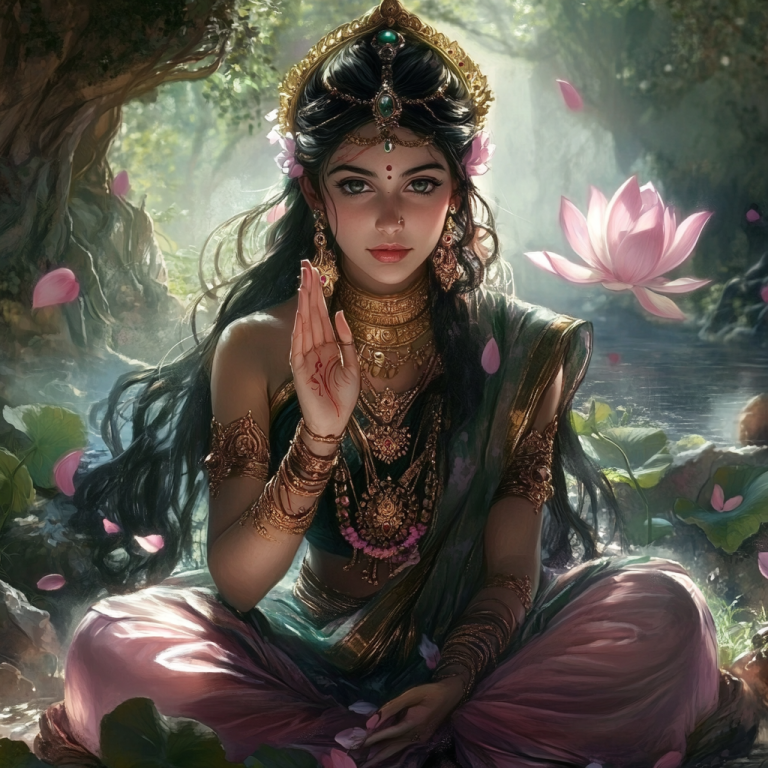
The Tale of King Uparichara Vasu
As narrated in [Maha:1.63]
King Uparichara’s Divine Connection
Long ago, there lived a virtuous and valorous king named Uparichara, also known as Vasu, who belonged to the illustrious Paurava dynasty (possibly linked to the Kuru lineage). Blessed by the king of the gods, Indra, Uparichara ruled the kingdom of Chedi and became a dear friend of Indra. Such was Indra’s affection for Uparichara that he gifted the king a celestial crystal chariot, enabling him to traverse the skies. Owing to his journeys through high places, Uparichara earned the epithet “Uparichara” (the one who wanders above).
The King’s might and piety attracted the attention of the Devas. However, after many years of successful rule, Uparichara renounced his royal duties and withdrew into the forests to perform severe penances. His ascetic endeavors alarmed the gods, especially Indra, who feared that Uparichara might be vying for his throne.
The Devas, led by Indra, approached Uparichara and persuaded him to abandon his penance, promising him eternal friendship and bliss in Svarga (heaven). Relenting to their request, Uparichara returned to his kingdom and resumed his duties as king. As a token of their bond, Indra gifted him a garland of ever-blooming lotuses, marking him as a special devotee of the king of gods.
The Festival to Indra
In gratitude for Indra’s favor, Uparichara instituted a grand annual festival in his kingdom, dedicated to Indra and the Devas. It was believed that Indra himself would descend during this festival, assuming the form of a swan, to accept the offerings and homage of the people. By the grace of Indra, the kingdom of Chedi flourished, untroubled by enemies and blessed with prosperity.
Uparichara’s Children and Their Legacy
In due course, Uparichara fathered five sons, all of whom inherited their father’s virtue and prowess. These sons were:
- Vrihadratha – Founder of the Magadha kingdom, also known as Maharatha.
- Pratyagraha – A prominent ruler in his own right.
- Kusamva (also called Manivahana) – Known for his strategic governance.
- Mavella – A warrior and statesman.
- Yadu – An ancestor of the Yadava dynasty, to which Krishna later belonged.
These five sons eventually established their own kingdoms, perpetuating Uparichara’s legacy.
The Birth of Girika and the Fish Twins
The Union of the River Suktimati and Kolahala Mountain
In Uparichara’s capital flowed the sacred Suktimati River, which was personified as a divine maiden. Once, the lustful Kolahala Mountain sought to unite with the river and began obstructing her flow. Distressed, the river sought Uparichara’s protection. The valiant king confronted the mountain, striking it with his foot and driving it away. From this union of the river and the mountain, twins were born: a boy and a girl. In gratitude, the river offered the twins to the king.
- The boy was appointed as the commander-in-chief of Uparichara’s army.
- The girl, named Girika (daughter of the mountain), became the king’s wife.
The Divine Conception and the Curse of Adrika
One spring day, Uparichara and Girika were together in the palace gardens when desire struck them. However, before they could unite, the Pitris (ancestral spirits) of the king appeared, requesting a ritual offering of deer for their monthly Shraddha ceremony. Dutifully, the king set out for the hunt.
In the forest, amidst a grove of Ashoka trees, Uparichara’s longing for his wife intensified. Unable to suppress his desire, he addressed a hawk perched nearby and said,
“O King of birds, carry my seed to my wife Girika so that a child may be conceived even in my absence.”
The hawk took the seed in its beak and flew toward the palace. However, it was attacked mid-flight by another hawk that mistook it for a piece of meat. In the ensuing battle, the seed fell into the Yamuna River, where it was swallowed by a fish.
This fish was no ordinary creature-it was the cursed form of an Apsara named Adrika, who had been transformed into a fish by a Brahmana’s curse. Upon swallowing the seed, Adrika became pregnant, and the curse was lifted. Her spirit left the fish’s body, which was later caught by fishermen. “Tales of mystical transformations like Adrika’s are echoed in other narratives such as Shweta M’s legends, where curses and blessings intertwine to shape destiny.”
The Discovery of Satyavati – Grandmother of Pandu and Dhritharashtra and the Founding of Matsya
When the fishermen cut open the fish, they found twin children-a boy and a girl-inside. They presented the children to King Uparichara.
- The boy was raised in the royal household and went on to found the kingdom of Matsya (fish).
- The girl, named Satyavati, was given to the chief of the fishermen to raise.
Satyavati grew into a woman of unparalleled beauty but was burdened with the odor of fish due to her unusual birth. Later, when she yielded to the sage Parashara’s desire, he transformed her fishy odor into a divine fragrance, earning her the epithet Yojana-Gandha (one who spreads her scent for a Yojana around). From their union, the great sage Vyasa was born.
Satyavati’s destiny intertwined her with the Kuru dynasty. She later married King Shantanu – Father of Bhishma and became the grandmother of the Pandavas and Kauravas, key figures in the Mahabharata – The Great Epic.
Connections to Broader Hindu Mythology
- Friendship with Indra
- Uparichara’s bond with Indra highlights the relationship between mortals and gods. Like other mythological kings, such as Harishchandra or Nahusha, Uparichara’s devotion to Indra shaped his life and legacy.
- The Curse of Adrika
- Adrika’s transformation into a fish echoes similar tales in Hindu mythology, where curses often lead to divine births or significant events, such as the story of Ahalya or Shukracharya’s curse on the Yadavas.
- Satyavati’s Role
- Satyavati’s connection to Vyasa and the Kuru dynasty underscores the idea of divine intervention in the lineage of dharma. Her transformation from a fisherwoman to a queen mirrors themes of destiny and transformation found throughout Hindu lore.
- Vasu’s Legacy
- Uparichara’s sons, particularly Yadu, connect to the broader Yadava lineage, culminating in the birth of Krishna, an avatar of Vishnu.
This tale intricately weaves themes of duty, desire, and divine intervention, showcasing the profound interconnectedness of mortals, gods, and nature in Hindu mythology. Through Uparichara, Satyavati, and Vyasa, it sets the stage for the epic narratives of the Mahabharata.
“For a deeper look into how Satyavati’s story connects to the Mahabharata’s broader saga, see this detailed retelling.”
Sources & further reading
These themes are explored in greater depth across the following authoritative resources:
- Britannica, Yoga in Hinduism
- Britannica, Puja
- Harvard Pluralism Project, Hindu Practice
- Internet Sacred Text Archive, Yoga Sutras of Patanjali
- Diana L. Eck, Banaras: City of Light (Princeton University Press, 1982)
External resources for further reading. Apam Napat is not affiliated with these publishers; citation does not imply endorsement.
Based on the classical texts of Hindu mythology, see our sources.