
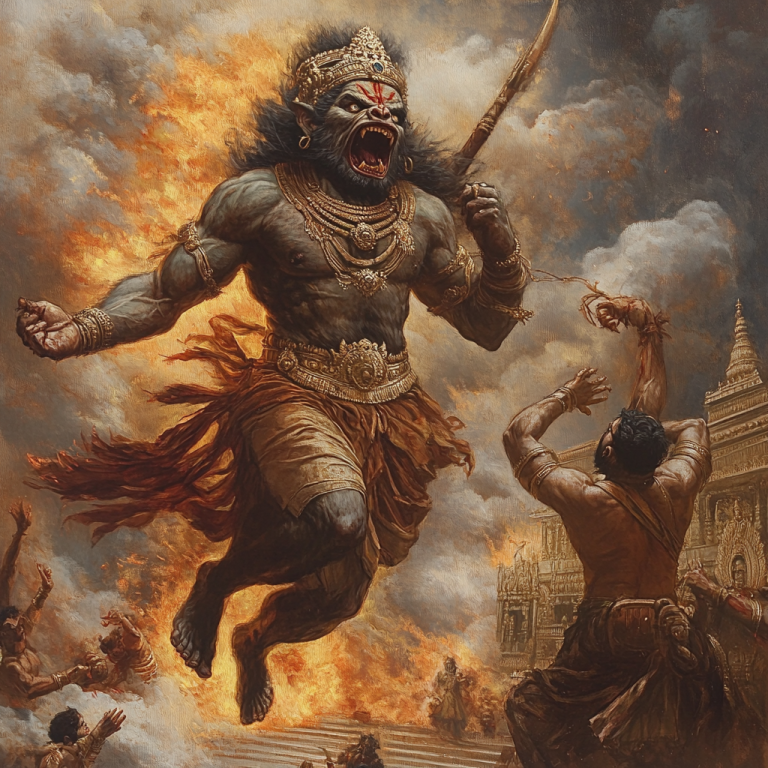
When the Pandavas, in the course of their exile, arrived in Ekachakrapura and took refuge with a humble Brahmana family, they learned of Bakasura’s reign of terror. Distressed by the suffering of their hosts, Kunti decided to send her mighty son, Bheema – The Strongest Pandava, to confront the Rakshasa and rid the town of this menace. She approached her son and said, “You are strong enough to subdue this creature. The people of this town suffer in silence, and it is in our power to help them.”
Bheema, ever ready to protect the innocent, took up the challenge without hesitation. Disguised as the usual sacrificial offering, he climbed onto the cart laden with food and went to the demon’s lair. Upon arriving, Bheema boldly called out to Bakasura, provoking him with his confidence. As the demon charged, a tremendous battle ensued, shaking the very earth. Bakasura, although powerful and almost equal in strength to Bheema, could not match Bheema’s skill and ferocity in combat. After a fierce struggle, Bheema ultimately overpowered and slew the Rakshasa, bringing an end to the terror that had plagued Ekachakrapura.
The people of the town, upon discovering that they had been freed from Bakasura’s terror, celebrated Bheema as their savior, though the Pandavas continued to maintain their anonymity.
Bakasura’s brother, Kirmira – A Rakshasa, also a Rakshasa, would later cross paths with the Pandavas during their time in the forest of Kamyaka. Unlike Bakasura, Kirmira – A Rakshasa harbored a personal enmity towards the Pandavas, especially Bheema, for the slaying of his brother. When the Pandavas, having lost their kingdom in a crooked game of dice, were forced to live in the forest, Kirmira saw an opportunity to exact vengeance. His character and role are further explored in mythological profiles of Rakshasa entities from the Mahabharata – The Great Epic and beyond. He confronted them with malevolent intent, challenging Bheema and reminding him of the fate of his brother Bakasura.
Bheema, undeterred by Kirmira’s threats, engaged him in a deadly duel. The battle between the two was intense and brutal, but Bheema’s unmatched strength and fighting skills eventually won the day. He killed Kirmira, thereby avenging the Pandavas for the wrongs inflicted by the Rakshasa’s kin and further establishing his reputation as a powerful warrior capable of subduing even the most fearsome of demons. Such rakshasa conflicts often parallel deeper themes seen in stories of celestial liaisons and divine interventions in Hinduism, where human courage collides with supernatural trials.
Thus, through these encounters with Bakasura and Kirmira, Bheema’s character as a protector of the innocent and a fearless warrior was solidified, showcasing his role in the epic Mahabharata as both a hero and a relentless force against evil. His valor and divine lineage also connect him to the broader tapestry of Vishnu’s avatars and their earthly interventions, reinforcing the Pandavas’ destiny-driven path.
Sources & further reading
These themes are explored in greater depth across the following authoritative resources:
- Britannica, Asura
- Britannica, Naga
- Mythopedia, Hindu Mythology
- Internet Sacred Text Archive, Mahabharata
- Wendy Doniger, Hindu Myths (Penguin Classics, 1975)
External resources for further reading. Apam Napat is not affiliated with these publishers; citation does not imply endorsement.
Based on the classical texts of Hindu mythology, see our sources.