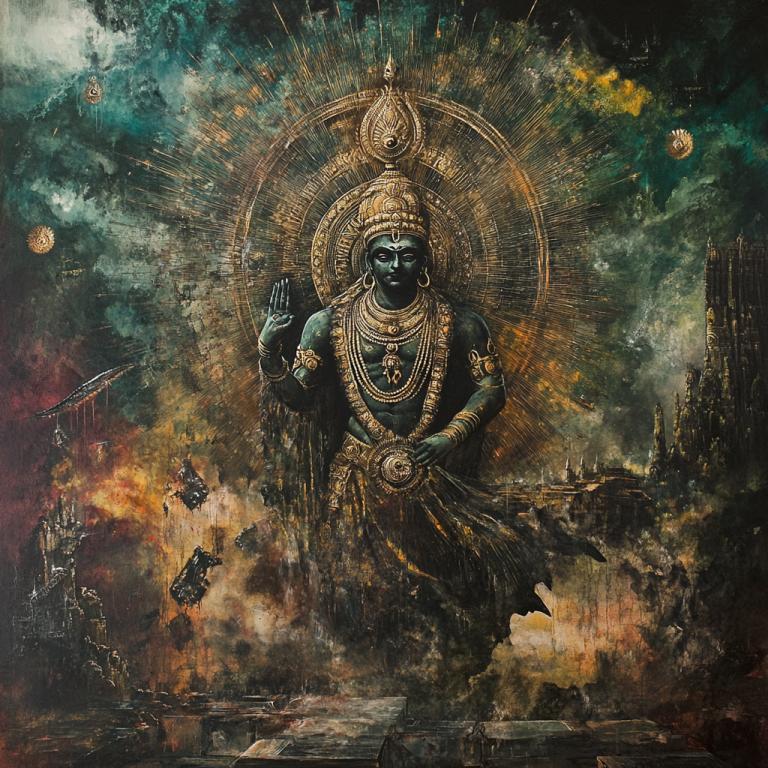
At this time, Vishnu, the eternal preserver of the universe, will incarnate as Kalki, a fierce and unstoppable force of destruction. This incarnation will be unique, as listed in the Dashavatara tradition that chronicles Vishnu – The Protector’s ten principal forms ,unlike his previous avatars who aimed to protect and restore dharma by teaching or vanquishing specific evildoers. As Kalki, Vishnu will descend not to save but to cleanse, to rid the world of the accumulated wickedness. Riding a radiant, snow-white horse symbolizing purity and divine power, Kalki will appear, bearing a blazing sword that embodies divine wrath and justice.
The scriptures describe him as “Kalki the terrible,” a manifestation that strikes fear into the hearts of those who have forsaken virtue. As he rides across the earth, he will seek out the wicked, those who have abandoned the path of dharma, and burn them to ashes, purifying the world with his righteous fury. No evil-doer will escape his sight; his flaming sword will act as a purifier, sweeping the world clean of corruption, greed, and darkness.
This is the destined moment when the universe, tainted by countless cycles of sin, will reach its threshold. With Kalki’s cleansing fury, the world will undergo a great dissolution or pralaya, bringing an end to the current cycle as detailed in Vishnu’s avataric timelines and characteristics , an event where the elements themselves will dissolve and merge back into the cosmic essence. This complete destruction will mark the end of the current Mahayuga, paving the way for a new cycle of creation.
After Kalki’s work is complete, Vishnu will withdraw, and from the cosmic waters, creation will arise once more. The world will be reborn in its pristine form, and a new Satyuga (Age of Truth) will begin, marked by purity, virtue, and righteousness.
In this way, Kalki stands as the final form in Vishnu’s avatars list, fulfilling the role of the destroyer of evil, ensuring that after all is undone, the cycle of creation, preservation, and destruction can begin afresh, renewed and untainted.
Sources & further reading
These themes are explored in greater depth across the following authoritative resources:
- Stanford Encyclopedia of Philosophy, Hindu Philosophy
- Britannica, Dharma
- Britannica, Karma
- Internet Sacred Text Archive, Bhagavad Gita
- A. K. Ramanujan, Speaking of Siva (Penguin Classics, 1973)
External resources for further reading. Apam Napat is not affiliated with these publishers; citation does not imply endorsement.
Based on the classical texts of Hindu mythology, see our sources.