
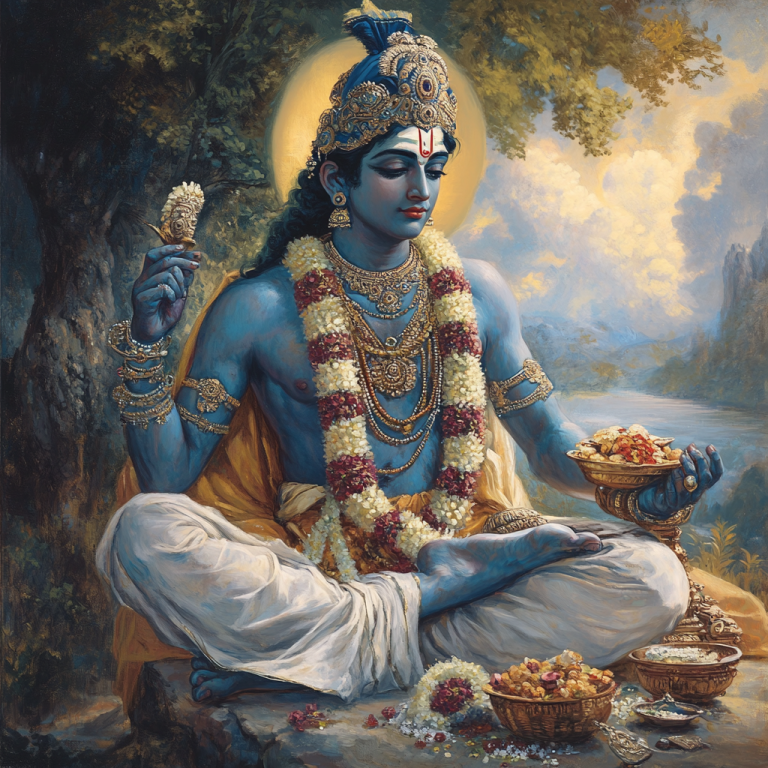
The Ultimate Goal in Hinduism: Realization of Brahman
The fundamental goal of a Hindu is the realization of Brahman, the ultimate and all-encompassing truth that forms the foundation of existence. This realization signifies liberation (moksha) from the cycles of birth and death (samsara) and unity with the infinite. Brahman is described as both immanent and transcendent, encompassing all things in the universe, animate and inanimate. For a more detailed perspective, explore this description of Brahman’s nature.
Brahman: The Ultimate Reality
Brahman is regarded as the supreme, eternal, and unchanging truth in Hindu philosophy. According to the Brahman definition in Hindu texts:
“Brahman is all things, and all things are Brahman.”
This phrase underscores the non-dualistic (Advaita) perspective of Hinduism, which posits that everything in the universe is an expression of the singular divine essence. Brahman is beyond human comprehension, described in the Upanishads as:
| Attribute | Description |
|---|---|
| Nirguna Brahman | The formless, attributeless reality. |
| Saguna Brahman | The manifestation of Brahman with form and qualities, often perceived as gods and goddesses. |
The Hindu Trinity – Shiva, Vishnu and Brahma: Aspects of Brahman
The Trimurti-the trinity of Brahma – The Creator, Vishnu, and Shiva-represents different aspects of Brahman. While they are divine in their own right, they are ultimately manifestations of the greater, infinite Brahman (see full discussion):
| Deity | Role in the Trinity |
|---|---|
| Brahma | The Creator: Represents the creative force of Brahman, responsible for the formation of the universe. |
| Vishnu | The Preserver: Symbolizes the sustaining power of Brahman, maintaining balance and dharma in the universe. |
| Shiva | The Destroyer: Embodies transformation, clearing the path for renewal and rebirth in the cosmic cycle. |
Though the Trimurti forms the primary triad, Brahman transcends them, being infinite and greater than the sum of its manifestations.
Brahman and the Universe
Brahman is not confined to deities alone. Nature (Prakriti), the soul (Atman), and the cosmic order (Rta) are all manifestations of Brahman, a concept deeply discussed in ancient Hindu philosophical texts (explore texts). It includes:
| Aspect | Connection to Brahman |
|---|---|
| Nature (Prakriti) | Nature and its elements are considered manifestations of Brahman, emphasizing its immanence. |
| Atman (Soul) | The individual soul, or Atman, is regarded as identical to Brahman, as articulated in the Upanishadic phrase: “Tat Tvam Asi” (“Thou art that”). |
| Cosmic Order (Rta) | Brahman governs the universal law and order, ensuring harmony in creation and existence. |
Connection to Other Entities in Hindu Mythology
The concept of Brahman is interwoven with numerous deities, stories, and philosophical doctrines in Hindu mythology:
| Entity/Story | Relation to Brahman |
|---|---|
| Gayatri Mantra | The mantra is a hymn to the eternal light of Brahman, symbolizing the pursuit of divine wisdom. |
| Avatars of Vishnu | Each avatar of Vishnu (e.g., Rama, Krishna – An Incarnation of Vishnu) represents a facet of Brahman’s role as the preserver. |
| Devi (Shakti) | As the cosmic energy, Shakti is the dynamic aspect of Brahman, giving it motion and power to create. |
| Aitareya Upanishad | Describes how Brahman manifests as the creator of the cosmos and the consciousness within beings. |
Paths to Realization of Brahman
In Hinduism, the realization of Brahman can be achieved through various spiritual disciplines and paths, collectively known as the four Yogas:
| Path | Description |
|---|---|
| Jnana Yoga | The path of knowledge, involving deep study of scriptures and self-inquiry to discern the nature of Brahman. |
| Bhakti Yoga | The path of devotion, where one surrenders to a personal deity, recognizing them as a representation of Brahman. |
| Karma Yoga | The path of selfless action, where every act is performed without attachment to the fruits, as an offering to Brahman. |
| Raja Yoga | The path of meditation and control of the mind, enabling direct experience of Brahman through inner stillness. |
Analogies of Brahman in the Scriptures
The Upanishads and other sacred texts employ various analogies to explain the abstract concept of Brahman:
- The Ocean and the Wave:
- Just as waves arise from the ocean but are never separate from it, all forms and entities arise from Brahman and remain connected to it.
- The Sun and its Rays:
- The sun represents Brahman, and its rays symbolize the individual souls (Atman), which are inseparable from the source.
- Clay and Pots:
- Brahman is likened to clay, which takes on various forms (pots) but remains fundamentally unchanged.
Brahman in the Rig Veda and Other Texts
The earliest references to Brahman can be found in the Rig Veda, where hymns describe the unity and interconnectedness of all creation. The notion of Vritra’s slaying by Indra, for instance, symbolizes the victory of cosmic order (Rta), an expression of Brahman’s will.
| Scriptural Reference | Explanation |
|---|---|
| Rig Veda | Describes Brahman as the underlying force behind cosmic phenomena. |
| Chandogya Upanishad | Expounds on the nature of Brahman as both the material and efficient cause of the universe. |
| Bhagavad Gita | Krishna reveals himself as Brahman, encompassing creation, preservation, and destruction. |
Themes and Symbolism
| Theme | Symbolism |
|---|---|
| Unity in Diversity | Brahman represents the underlying unity behind the diversity of forms and beings in the universe. |
| Immanence and Transcendence | Brahman is both present in every particle of the universe and beyond human comprehension. |
| Eternal Truth | Brahman embodies Sat (truth), Chit (consciousness), and Ananda (bliss), the triadic nature of ultimate reality. |
Legacy of Brahman in Hindu Philosophy
In every aspect of Hindu philosophy-whether it’s the meditative stillness of Nirguna Brahman or the dynamic love for Saguna Brahman-the realization of Brahman is the spiritual destination. For further reflections on this, the article on Exploring Brahman and Ultimate Reality: From Ancient Texts to Modern Interpretations offers deeper insight. The teachings of Brahman emphasize:
- The oneness of existence.
- The temporary nature of material life.
- The pursuit of liberation through knowledge, devotion, and self-discipline.
Brahman’s infinite nature transcends the gods, the cosmos, and human understanding, making it the supreme goal for spiritual seekers across time. Its teachings inspire a harmonious vision of life where all things are interconnected, unified by the eternal essence of Brahman.
Sources & further reading
These themes are explored in greater depth across the following authoritative resources:
- Internet Sacred Text Archive, Rig Veda (Griffith translation)
- Internet Sacred Text Archive, Upanishads
- Britannica, Veda
- Britannica, Upanishad
- Patrick Olivelle, The Early Upanishads (Oxford University Press, 1998)
External resources for further reading. Apam Napat is not affiliated with these publishers; citation does not imply endorsement.
Based on the classical texts of Hindu mythology, see our sources.