
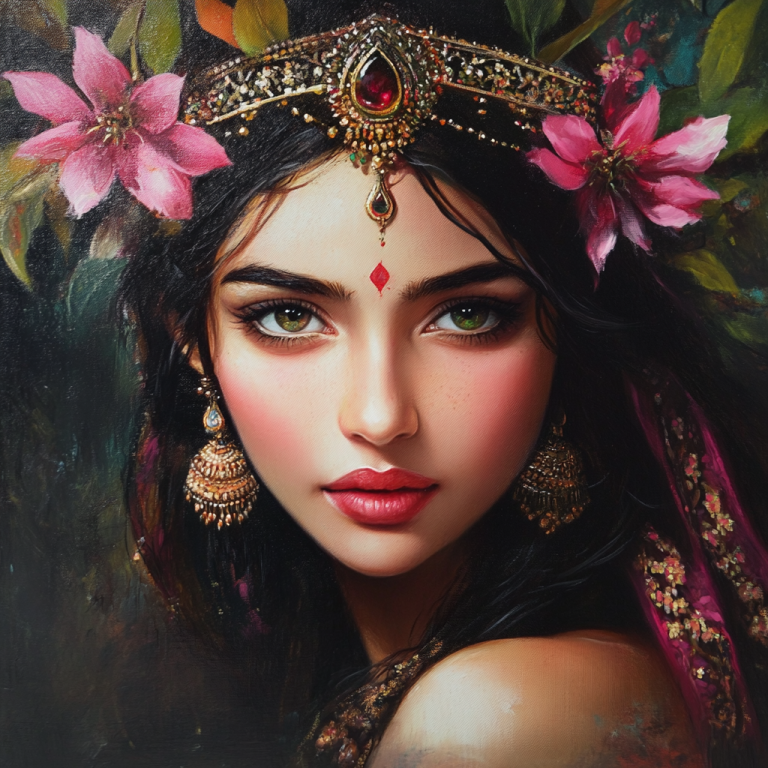
Sita – The Divine Consort of Rama
Sita, a central figure in the Ramayana – Epic of Hinduism, is revered as an incarnation of Mahalakshmi, the goddess of wealth, prosperity, and virtue. Her life is a tale of devotion, resilience, and adherence to dharma. Born of divine origin, Sita represents purity, self-sacrifice, and unwavering faith, making her one of the most venerated figures in Hindu mythology.
Birth and Adoption
Sita’s birth is shrouded in divine mystery. She was discovered by King Janaka – The King of Videha of Videha while he was plowing the ground as part of a yajna (sacrifice). She emerged from the furrow, symbolizing her connection to the earth goddess, Bhumi Devi. Recognizing her as a divine gift, Janaka adopted Sita and raised her as his daughter. Her name “Sita” reflects her origin, meaning “furrow” or “born of the plough.”
Sita’s childhood in the royal court of Mithila is often described as idyllic, where she was known for her unparalleled beauty, grace, and virtue. Her father, Janaka, ensured that she was educated and groomed to fulfill her role as a queen and spiritual guide.
Marriage to Rama
Sita’s marriage to Rama, the prince of Kosala, was ordained by fate. Janaka declared that only the man who could string the mighty bow of Shiva could win Sita’s hand. The bow, gifted by Lord Shiva to Janaka’s ancestors, was so heavy and powerful that none of the assembled kings and princes could even lift it.
When Rama, the incarnation of Vishnu – The Protector, entered the swayamvara (self-choice ceremony), he effortlessly lifted and strung the bow, even breaking it in the process. This act of strength and divinity affirmed Rama’s worthiness, and Sita joyfully garlanded him, sealing their union.
The marriage of Sita and Rama symbolizes the divine union of Vishnu and Mahalakshmi, reinforcing their cosmic purpose to restore dharma and balance in the universe.
Exile and Abduction
After their marriage, Sita accompanied Rama to Ayodhya, where he was to be crowned as the king. However, due to palace intrigue and the demands of Kaikeyi – Mother of Bharata of the Ramayana, Rama’s stepmother, Rama was exiled to the forest for fourteen years. Sita, embodying loyalty and devotion, insisted on accompanying her husband, despite his protests. She declared that her place was by his side, regardless of the hardships.
During their exile, the demon king Ravana – The Demon King abducted Sita from their hermitage in Panchavati. His actions, described in detail in the Sita’s abduction tale, highlight his obsession and the deceit he employed, including the golden deer as a distraction. Despite her captivity in Lanka, Sita remained devoted to Rama and resisted Ravana’s threats and temptations.
Sita was taken to Lanka, where she was held captive in the Ashoka Vatika. Despite Ravana’s advances and threats, Sita remained steadfast in her devotion to Rama, demonstrating her unshakeable faith and inner strength.
Rescue and the Battle of Lanka
Rama’s search for Sita was aided by Hanuman, whose unwavering loyalty and bravery are central to their reunion. Hanuman’s discovery of Sita in Ashoka Vatika, his offer of hope, and his fiery warning to Lanka form the heart of Hanuman’s relationship with Sita, exemplifying the ideal of servitude to dharma.
Names and Their Significance
| Name | Meaning | Significance |
|---|---|---|
| Sita | “Born of the Plough” | Reflects her divine origin from the earth, symbolizing fertility, purity, and resilience. |
| Janaki | “Daughter of Janaka” | Highlights her lineage as the adopted daughter of King Janaka of Videha. |
| Vaidehi | “Princess of Videha Kingdom” | Indicates her royal heritage and her role as a princess of Mithila (Videha). |
| Bhumi Devi | “Daughter of the Earth” | Symbolizes her connection to the earth goddess, embodying patience, strength, and nurturing nature. |
Connections to Other Entities and Stories
| Entity/Character | Role and Story | Connection to Sita |
|---|---|---|
| Rama | Sita’s husband, the prince of Ayodhya and an incarnation of Vishnu. | Their marriage symbolizes the divine union of Vishnu and Mahalakshmi, central to the Ramayana. |
| Janaka | King of Videha and Sita’s adoptive father. | Found Sita while plowing the earth; raised her as a princess and arranged her marriage to Rama. |
| Ravana | Demon king of Lanka who abducted Sita. | His actions set the stage for the great battle in the Ramayana, leading to his defeat by Rama. |
| Hanuman | Devotee of Rama and Sita, instrumental in finding Sita in Lanka and aiding in her rescue. | Hanuman’s devotion to Sita underscores his role as a servant of dharma and protector of righteousness. |
| Lakshmana | Rama’s younger brother who accompanied them in exile. | Created the protective Lakshmana Rekha to guard Sita, which she crossed during Ravana’s deceitful act. |
| Mahalakshmi | Goddess of wealth, prosperity, and virtue; Sita’s divine incarnation. | Sita’s actions embody Mahalakshmi’s qualities of devotion, patience, and resilience. |
Themes and Symbolism
- Devotion and Dharma
Sita’s unwavering commitment to Rama reflects the highest ideals of devotion and duty, even in the face of extreme adversity. - Strength in Adversity
Despite her abduction and trials, Sita’s strength and resilience serve as an inspiration for perseverance and virtue. - Divine Feminine
As an incarnation of Mahalakshmi, Sita embodies the divine feminine energy, nurturing and supporting the cosmic balance alongside Rama. - Cosmic Purpose
The events of Sita’s life-her miraculous birth, divine union with Rama, exile, abduction, and rescue-are often framed within the broader scope of divine interventions in the Ramayana. These episodes underscore the orchestrated balance between righteousness and cosmic justice.
Legacy of Sita
Sita’s story resonates deeply within Hindu tradition, representing ideals of virtue, sacrifice, and devotion. Her character is celebrated in literature, art, and devotion, particularly during Ram Navami and Diwali, which commemorate the triumph of good over evil. Temples dedicated to Sita, such as the Janaki Mandir in Nepal, honor her legacy as a divine mother and queen.
Sita’s trials and triumphs continue to inspire discussions about dharma, gender roles, and morality, making her one of the most enduring and revered figures in Hindu mythology.
Sources & further reading
These themes are explored in greater depth across the following authoritative resources:
- Stanford Encyclopedia of Philosophy, Hindu Philosophy
- Britannica, Dharma
- Britannica, Karma
- Internet Sacred Text Archive, Bhagavad Gita
- A. K. Ramanujan, Speaking of Siva (Penguin Classics, 1973)
External resources for further reading. Apam Napat is not affiliated with these publishers; citation does not imply endorsement.
Based on the classical texts of Hindu mythology, see our sources.