
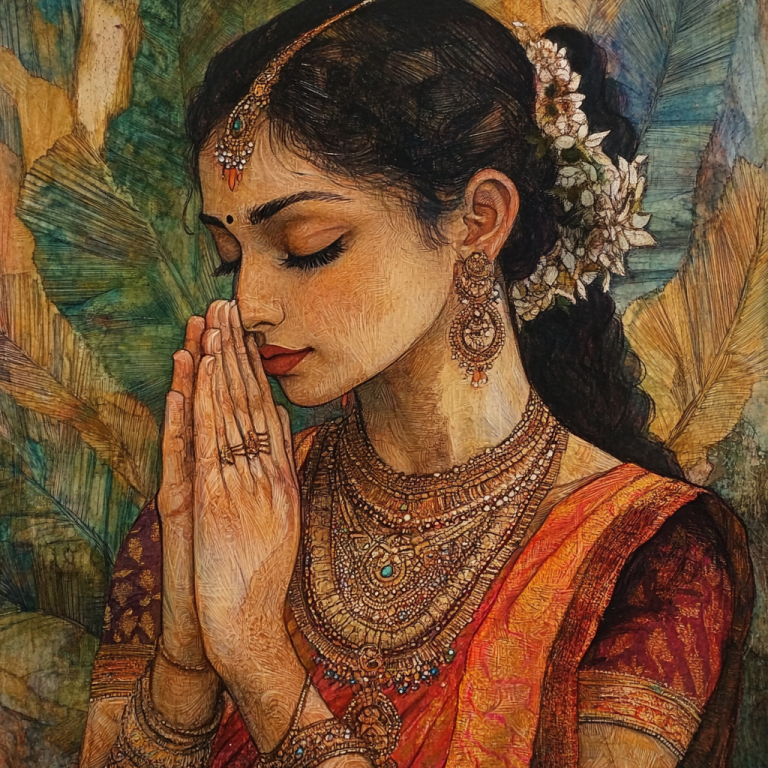
Uttara – The Youngest Prince of Matsya
Uttara, the youngest son of Virata, the King of Matsya, was a prince full of youthful vigor and pride. Pampered by his family, especially his sister Uttara and his mother, Uttara’s early years were marked by indulgence and favor. However, as destiny unfolded, he played a pivotal role in some of the most dramatic events leading up to the Kurukshetra War, marking a transition from youthful arrogance to heroic sacrifice.
The Kuru Threat to Matsya
When the Kaurava army mounted an invasion on the borders of the Matsya kingdom, King Virata, accompanied by his eldest son Shweta and the disguised Pandavas, marched out with the Matsya forces to confront the attackers.
Disappointed by his exclusion, Uttara boasted that he could have easily defeated the enemy had he been allowed to join the fight. His words, spoken in youthful arrogance, set the stage for his fateful encounter with the Kuru army.
The Real Threat and Uttara’s Reluctance
While the initial attack by the Kauravas turned out to be a diversion, a far more formidable division of the Kuru army, led by the greatest warriors of the time-Bhishma, Drona, and Karna-launched a direct assault on the Matsya capital. With the city defenseless and the women of the royal household looking to him, Uttara was compelled to step forward and defend his kingdom.
Despite his earlier bravado, Uttara hesitated, fully aware of the insurmountable odds. He tried to excuse himself by claiming the lack of a capable charioteer. This reluctance was met with insistence from his family, and he was provided with a charioteer in the form of Brihannala, the eunuch music teacher of his sister. Unknown to all but the Pandavas, Brihannala was none other than Arjuna, who had assumed this disguise during the thirteenth year of their exile.
The Encounter with the Kuru Army
As Uttara approached the battlefield with Arjuna disguised as his charioteer, he was horrified by the sight of the massive Kuru army, which included legendary warriors like Bhishma, Drona, Karna, and Ashwatthama – Son of Drona. His courage faltered, and in a moment of panic, he abandoned the chariot and fled, much to the amusement of the Kuru warriors.
Arjuna pursued the fleeing prince, urging him to return and fight. When words failed to move Uttara, Arjuna revealed his true identity and reassured him of victory. He reminded Uttara of the responsibility and honor of a Kshatriya, instilling courage in the young prince.
Retrieving the Divine Weapons
Arjuna led Uttara to the Sami tree, where he had hidden his Gandiva bow and other divine weapons before entering Matsya in disguise. With his weapons retrieved, Arjuna took charge as the warrior, while Uttara assumed the role of his charioteer. Together, they returned to face the Kuru army.
The Battle of Matsya
The ensuing battle was one of the most significant preludes to the Kurukshetra War. Arjuna, single-handedly wielding his celestial weapons, routed the mighty Kuru forces. Bhishma, Drona, and Karna were forced to retreat, and the Kaurava army fled in disarray back to Hastinapura. The people of Matsya hailed Uttara as a hero, believing him to have led the defense of the kingdom, with the aid of a divine archer.
Uttara’s Role in the Pandava Exile
The victory over the Kuru army coincided with the end of the Pandavas’ incognito exile. The next day, the Pandavas revealed their identities to King Virata, who was overwhelmed with gratitude and offered his daughter Uttara in marriage to Arjuna. Arjuna, however, declined, explaining that she was like a daughter to him, having been his student during his time as Brihannala. Instead, he proposed her marriage to his son Abhimanyu – The Brave Young Warrior, which was solemnized soon after.
Uttara’s Role in the Kurukshetra War
Though his martial career had begun on a less-than-heroic note, Uttara grew into a valiant warrior. During the Kurukshetra War, he fought bravely on the side of the Pandavas, representing the Matsya kingdom. Uttara faced some of the most formidable Kuru warriors and upheld the honor of his lineage.
Tragically, Uttara fell in battle, joining the ranks of countless warriors who sacrificed their lives in the pursuit of dharma. His transformation from a hesitant youth to a courageous warrior underscores the themes of growth, duty, and sacrifice that permeate the Mahabharata – The Great Epic.
Connections to Other Entities in Hindu Mythology
| Entity/Story | Connection to Uttara |
|---|---|
| Virata and Matsya | As the youngest prince of Matsya, Uttara represents the kingdom’s resilience and alliance with the Pandavas. |
| Arjuna | Arjuna’s mentorship and guidance played a pivotal role in shaping Uttara’s bravery and actions. |
| Uttara (Sister) | Uttara’s sister married Abhimanyu, and through their union, gave birth to Parikshit – Son of Abhimanyu, who would later ascend the throne of Hastinapura, ensuring the survival and continuation of the Kuru dynasty after the war. |
| Kuru Army | His encounter with the Kuru army underscores the immense power of Bhishma, Drona, and Karna as well as Arjuna’s valor. |
| Abhimanyu and Parikshit – Son of Abhimanyu | Through his sister’s marriage to Abhimanyu, Uttara is connected to the lineage that carried forward the Kuru dynasty. |
Legacy of Uttara
Uttara’s story, though often overshadowed by greater figures in the Mahabharata, is a testament to the transformative power of courage, mentorship, and duty. From a pampered young prince to a warrior who stood on the side of dharma, his life reflects the dynamic nature of human growth in the face of adversity. His legacy continues through his sister’s lineage, marking his place in the grand tapestry of the Mahabharata.
For a deeper look into his character arc and historical significance within the epic, this dedicated article on Uttara offers further insights into his transformation, courage, and ultimate sacrifice.
Sources & further reading
These themes are explored in greater depth across the following authoritative resources:
- Internet Sacred Text Archive, Mahabharata (Ganguli translation)
- Internet Sacred Text Archive, Ramayana of Valmiki
- Britannica, Mahabharata
- Britannica, Ramayana
- Bibek Debroy, The Mahabharata (10 vols., Penguin, 2010 to 2014)
External resources for further reading. Apam Napat is not affiliated with these publishers; citation does not imply endorsement.
Based on the classical texts of Hindu mythology, see our sources.