
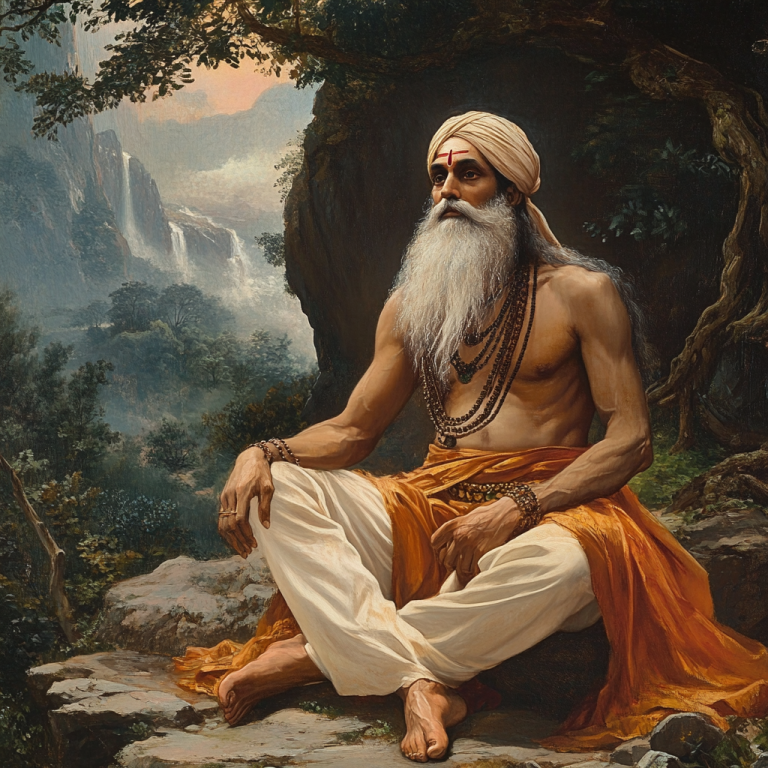
The Sage Valmiki: Composer of the Ramayana – Epic of Hinduism
The sage Valmiki, often referred to as the Adi Kavi (the first poet), is credited as the composer of the Ramayana, the timeless epic of Lord Rama. Born as the son of the sage Prachetasa, his journey from a hunter and dacoit to a revered sage illustrates themes of redemption, devotion, and divine inspiration.
Early Life as Ratnakara
Valmiki’s early life was far removed from the sanctity he later embodied. As a child, he became separated from his family in the forest and was discovered by a hunter who adopted and raised him as his own son. Named Ratnakara, he grew up learning the ways of the forest and hunting.
- Life as a Bandit:
After the death of his adoptive father, Ratnakara struggled to support his family. Unable to sustain them through hunting alone, he turned to robbery and murder, becoming infamous for his cruelty. He preyed upon travelers in the forest, showing no mercy to his victims.
| Aspect of Life | Details |
|---|---|
| Adoptive Upbringing | Raised by a hunter after being lost in the forest. |
| Turning to Crime | Became a dacoit to provide for his family. |
| Renowned for Cruelty | Killed with impunity and instilled fear in travelers. |
Meeting with Sage Narada – The Divine Musician-Sage
Ratnakara’s transformation began when he encountered the divine sage Narada, who wandered into the forest singing the praises of Lord Narayana – The Lord Himself. Ratnakara attempted to rob him but was struck by the sage’s serenity and joy despite his lack of possessions.
- Narada’s Question:
Narada asked Ratnakara to approach his family and determine if they were willing to share the burden of the sins he had committed for their sake. To his shock, his family refused, claiming that while they benefited from his actions, the responsibility for his deeds rested solely on him. - Realization and Repentance:
Confronted with the reality of his actions and abandoned by those he thought he was protecting, Ratnakara sought guidance from Narada. The sage initiated him into the chanting of Rama Nama (the name of Lord Rama) as a means of penance and redemption.
Transformation into Valmiki
Ratnakara chose a secluded spot under a tree and immersed himself in deep meditation, chanting the name of Lord Rama. Such was his commitment that years passed, and an ant-hill grew around him.
| Transformation | Details |
|---|---|
| Penance | Performed intense meditation while chanting Rama’s name. |
| Name Change | Renamed Valmiki after emerging from the ant-hill (Valmika in Sanskrit). |
When Narada returned and awoke Ratnakara from his penance, he declared him absolved of his sins. Thus, Ratnakara became Valmiki, a sage devoted to righteousness and the divine.
Birth of the Ramayana
One day, as Valmiki wandered near a stream by his hermitage, he witnessed a pair of Krauncha birds enjoying each other’s company. Suddenly, an arrow struck the male bird, killing it. Overcome with sorrow and anger, Valmiki spontaneously uttered a curse against the hunter, which emerged in the form of a perfectly metered Sanskrit verse:
“Maa Nishada Pratishtham Tvam Agama Shaashvati Samaah,
Yat Krauncha Mithunadekam Avadheeh Kaamamoohitam.”
(O hunter, may you not gain any rest for eternity, for you have killed one of a pair of Krauncha birds intoxicated by love.)
This moment marked the birth of Sanskrit poetry, with Valmiki becoming the Adi Kavi (first poet). While he regretted his curse, he was visited by Lord Brahma – The Creator, who instructed him to compose the Ramayana, the story of Lord Rama. For an in-depth overview of the Ramayana Epic Story: The Timeless Tale of Good vs. Evil and Its Cultural Impact and its divine inspiration, readers can explore how Valmiki’s composition shaped Hindu literature and spirituality.
- Brahma’s Command:
Brahma revealed that the epic had already occurred and granted Valmiki divine insight to narrate the story as it transpired. His verses continue to guide generations through the mythological origins of the Ramayana, where cosmic purpose and dharma converge in Rama’s life.
Valmiki’s Hermitage
Valmiki established his ashrama in the forest, dedicating his life to spiritual pursuits. It was here that he became the guardian of Sita, Rama’s wife, during her exile.
- Shelter for Sita:
When Rama banished Sita due to public suspicion of her chastity, she found refuge in Valmiki’s hermitage. It was here that she gave birth to her twin sons, Lava and Kusha. Valmiki raised the boys, teaching them the Ramayana, which they later recited before Rama himself. This episode forms a pivotal moment in the heroic journey of the Ramayana, showcasing how the next generation became both bearers and performers of divine history.
Connections to Other Entities and Stories
| Entity/Story | Connection to Valmiki |
|---|---|
| Narada | Instrumental in Valmiki’s transformation by initiating him into Rama Nama. |
| Krauncha Birds | Their tragic death inspired the first metered verse in Sanskrit. |
| Brahma | Commissioned Valmiki to compose the Ramayana. |
| Rama, Sita, Lava, Kusha | Valmiki’s hermitage served as a refuge for Sita and a training ground for her sons. |
Legacy of Valmiki
As the composer of the Ramayana, he played a pivotal role in preserving the story of Lord Rama for generations, emphasizing the virtues of dharma, devotion, and righteousness. His role in shaping the historical context of the Ramayana is essential to understanding how the epic has evolved across time, cultures, and interpretations.
Valmiki’s legacy endures not just through his epic but also through his profound teachings on the potential for transformation and the eternal nature of devotion. The full Ramayana epic remains a timeless reflection of spiritual ideals and narrative beauty.
| Theme | Valmiki’s Contribution |
|---|---|
| Redemption | His life exemplifies that no sin is beyond forgiveness when met with genuine repentance. |
| Creation of Poetry | Valmiki pioneered the art of Sanskrit poetry with his metered verses. |
| Ramayana | Authored the first epic, immortalizing Rama’s life and virtues. |
Valmiki’s legacy endures not just through his epic but also through his profound teachings on the potential for transformation and the eternal nature of devotion.
Sources & further reading
These themes are explored in greater depth across the following authoritative resources:
- Britannica, Yoga in Hinduism
- Britannica, Puja
- Harvard Pluralism Project, Hindu Practice
- Internet Sacred Text Archive, Yoga Sutras of Patanjali
- Diana L. Eck, Banaras: City of Light (Princeton University Press, 1982)
External resources for further reading. Apam Napat is not affiliated with these publishers; citation does not imply endorsement.
Based on the classical texts of Hindu mythology, see our sources.