
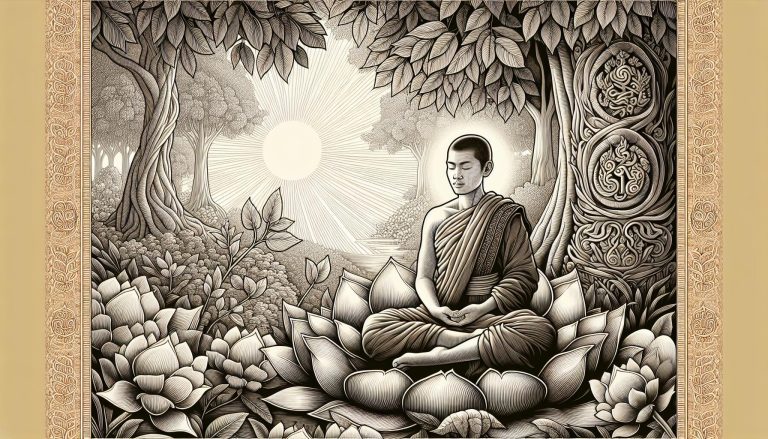
In Advaita Vedanta, Maya is the force that veils the true nature of reality, making the one appear as many. This illusion keeps us entangled in a cycle of ignorance and suffering, obscuring the ultimate truth of Brahman – The Supreme Truth, the singular, infinite consciousness. By unraveling the mysteries of Maya, we can begin to see beyond the illusion and move closer to spiritual enlightenment.
Understanding Advaita Vedanta
Advaita Vedanta emphasizes the concept of non-duality, asserting that there is no second reality apart from Brahman. Brahman is the ultimate, unchanging reality. Everything else is considered illusory.
- Brahman: The absolute, unchanging reality, central to Advaita Vedanta. It’s indivisible and the only true existence.
- Atman – The Soul: The individual self, which is identical with Brahman. Realizing this identity is the path to liberation.
- Jiva: The empirical self that experiences the world. Jiva is bound by illusion and dependent on Brahman.
- Maya: The power of illusion creating the perception of duality. From Brahman’s perspective, Maya is unreal.
Concept of Maya
Maya, in Advaita Vedanta, denotes the cosmic illusion or veil that obscures our true nature and the real nature of the world.
Definition and Origin
Maya originally represented the magical power through which gods made humans believe in illusions. Over time, it came to signify the cosmic force creating the illusion that the phenomenal world is real. While the etymology of the word “Maya” remains unclear, it translates to “illusion” or “magic” in Vedanta philosophy.
Role in Advaita Vedanta
Maya is seen as the manifestation of Brahman. It is responsible for the creation of the phenomenal world. This cosmic illusion leads to human ignorance, Avidya, where individuals mistake the empirical ego for the true self. In reality, the self is identical with Brahman.
Key Scriptures Discussing Maya
Key texts in Advaita Vedanta discuss Maya extensively. The Upanishads describe Maya as the power that creates the illusion of multiplicity. The Bhagavad Gita states that Maya binds the soul to the cycle of birth and death. Adi Shankaracharya’s commentaries explore Maya’s nature and its role in obscuring the true self.
Philosophical Implications of Maya

In Advaita Vedanta, Maya holds a central role, shaping our understanding of reality and illusion.
Illusion and Reality
Maya creates an illusion that the material world is real. But, this perceived reality is only an apparent one. The world of names and forms (e.g., objects, living beings) we experience depends on Brahman for its existence. Even though appearing diverse and distinct, everything is interconnected through Brahman, the ultimate reality. I find it crucial to recognize that merging individual self (Atman) with Brahman can dispel the illusion created by Maya, leading to spiritual enlightenment.
Maya and Brahman
Maya acts as a veil that obscures our true nature. While Brahman remains the singular, unchanging truth, Maya fosters the perception of diversity. It’s important to understand that Maya is a neutral and creative aspect of Brahman, not an evil force. This creative power enables Brahman to manifest in various forms. By overcoming the ignorance that Maya represents, we grasp that the multiplicity and duality perceived are just extensions of the one Brahman.
Influential Thinkers on Maya
Several scholars and philosophers have influenced the understanding of Maya in Advaita Vedanta, adding depth and contemporary relevance to the concept.
Adi Shankaracharya’s Perspective
Adi Shankaracharya views Maya as the veil of ignorance obscuring our true nature and the ultimate reality, Brahman. He illustrates this with the example of mistaking a rope for a snake, showing how Maya distorts perception. Although not a predominant theme in his works, Maya remains crucial in understanding Advaita Vedanta philosophy. Shankara’s interpretation centers on Maya creating a false perception that prevents individuals from recognizing the unity of Atman and Brahman.
Modern Interpretations
Modern thinkers like K.C. Bhattacharyya and S. Radhakrishnan have further expanded on Maya. Bhattacharyya integrates Western philosophies, such as those of Kant and Hegel, to provide a more comprehensive explanation. He explores how different philosophical traditions can inform our understanding of Maya. Radhakrishnan attempts to reconcile Advaita Vedanta with empirical reality and human experiences. His reinterpretation aims to bridge the gap between classical texts and contemporary human understanding.
These modern interpretations build on Shankaracharya’s foundational concepts while considering new philosophical insights.
Criticisms and Counterarguments
Critics of Advaita Vedanta’s concept of Maya argue several points that challenge its philosophical underpinnings and practical implications. Let’s explore these criticisms and the responses from Advaita Vedanta scholars.
Common Criticisms
- Maya as Illusion
Critics argue that the concept of Maya implies the world is an illusion, which could foster nihilism and indifference towards the empirical world. They assert Maya creates the world and conceals Brahman, reinforcing the self and not-self distinction.
- Pseudo-Buddhist Accusations
Some critics, such as those in the Padma Purana, label Advaita Vedanta as “pseudo-Buddhist,” alleging it borrows ideas from Buddhism without proper understanding or contextual integration.
- Meaninglessness of Holy Texts
Critics claim Advaita Vedanta renders holy texts meaningless. They argue the philosophy emphasizes abandoning one’s duties and equating the Highest Lord with the individual soul, seemingly devaluing scriptural teachings.
- Clarifying Maya’s Nature
Scholars argue Maya’s conception as an illusion doesn’t negate the empirical world’s reality. Instead, it highlights the world’s relative reality compared to Brahman’s absolute reality, so encouraging a deeper understanding without existential nihilism.
- Distinct Philosophical Foundation
Addressing pseudo-Buddhist accusations, scholars assert Advaita Vedanta’s unique foundation in Upanishadic texts. They emphasize that while there are similarities, the differences in metaphysical and epistemological frameworks set Advaita Vedanta apart.
- Interpreting Holy Texts
Scholars contend that understanding the identity of the Highest Lord and the individual soul enriches the comprehension of holy texts. They argue that rather than rendering duties meaningless, this understanding elevates one’s spiritual pursuit and aligns it with higher philosophical truths.
Practical Application of Maya
In Advaita Vedanta, Maya isn’t just a theoretical concept; it’s integral to spiritual practice and daily life. Its practical application aims to dispel ignorance and reveal the true nature of reality.
In Spiritual Practice
Threefold Practice guides the application of Maya in spiritual practice:
- Sravana (hearing): Listening to teachings of sages and studying Vedantic texts, like the Brahma – The Creator Sutras, with a guru’s guidance.
- Manana (thinking): Reflecting on teachings and contemplating ideas based on self-study and previous listening.
- Nididhyasana (meditation): Engaging in deep meditation to internalize truths and achieve non-duality.
Each phase dismantles the veil of ignorance, bringing one closer to self-realization.
In Daily Life
In daily life, Maya serves to identify and eliminate ignorance:
- Awareness: Recognizing Maya as the veil obscuring true nature and reality.
- Discrimination: Differentiating between the transient world and the eternal self through conscious thought.
- Mindfulness: Practicing ongoing mindfulness to see beyond illusions and maintain awareness of the ultimate truth.
Actively applying these principles in everyday scenarios promotes a liberated life, aligned with the higher self.
Conclusion
Understanding Maya in Advaita Vedanta offers profound insights into the nature of reality and our spiritual journey. By recognizing Maya as the veil that obscures our true essence, we can begin to peel back the layers of illusion and connect with our higher self. This journey isn’t just theoretical; it’s a practical path that involves daily mindfulness, discrimination, and awareness.
Through consistent practice, we can dispel ignorance and align our lives with the ultimate truth of Atman and Brahman. Embracing this wisdom can lead to a more liberated and enlightened existence, enriching our spiritual pursuits and daily experiences.
Sources & further reading
These themes are explored in greater depth across the following authoritative resources:
- Stanford Encyclopedia of Philosophy, Hindu Philosophy
- Britannica, Dharma
- Britannica, Karma
- Internet Sacred Text Archive, Bhagavad Gita
- A. K. Ramanujan, Speaking of Siva (Penguin Classics, 1973)
External resources for further reading. Apam Napat is not affiliated with these publishers; citation does not imply endorsement.
Based on the classical texts of Hindu mythology, see our sources.