
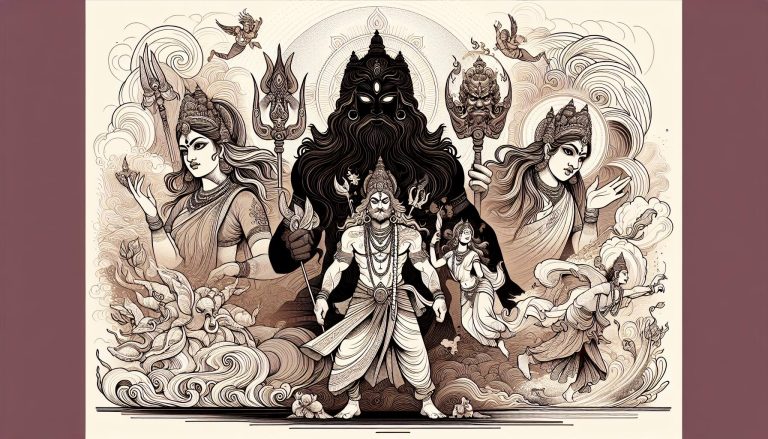
Understanding Shiva’s relationship with his consorts offers profound insights into Hindu cosmology. These divine partnerships illustrate the balance between creation and destruction, love and power, and chaos and order. By exploring these relationships, we can better appreciate the intricate tapestry of beliefs that form the foundation of Hindu thought.
Parvati: The Divine Mother
Parvati, often referred to as the divine mother, holds a central role in Hindu mythology. She represents both creation and nurturing aspects, complementing Shiva’s cosmic functions.
Origins and Mythology
Parvati’s origins trace back to the ancient texts of the Puranas where she’s portrayed as the reincarnation of Sati, Shiva’s former wife. Sati immolated herself due to a familial dispute, and Parvati was born to King Himavan and Queen Mena. Through intense penance and devotion, Parvati won Shiva’s heart, leading to their celestial union. Their marriage symbolizes the union of Purusha – The Primordial Man (spirit) and prakriti (matter).
Symbolism and Attributes
Parvati symbolizes fertility, love, and devotion, and she’s often depicted with aspects that reflect her nurturing nature. She embodies Shakti, the divine feminine energy, and is revered as the mother of Ganesha and Kartikeya. Parvati’s attributes include her gentle demeanor, her role as a protector of women and children, and her ability to transform into the fierce goddess Durga when confronting evil. These diverse aspects highlight her importance in maintaining cosmic order and balance.
Kali: The Fierce Protector
Kali, one of Shiva’s consorts, embodies fierce protection and transformation. Her role in Hindu cosmology highlights her powerful aspect, vital for maintaining cosmic order.
Historical Background
Kali’s origins trace back to ancient Hindu texts, including the Puranas and the Tantras. Her representation as a fierce deity emerges during battles against demons like Raktabija. In these accounts, Kali’s invincible power and terrifying appearance underscore her role in vanquishing evil. She often appears with multiple arms, each holding a weapon, symbolizing her battle prowess.
Cultural Significance
In Hindu culture, Kali is revered as a protector against negative influences and forces. Devotees seek her blessings for strength during adversities. Festivals like Kali Puja in West Bengal celebrate her power and protective nature. Kali’s imagery, often depicted with her tongue protruding and a garland of skulls, represents both destruction and creation, crucial elements in the cyclical process of the cosmos.
Sati: The First Consort
Sati, Shiva’s first consort, plays a crucial role in Hindu mythology. She represents devotion, sacrifice, and cosmic cycles.
Mythological Tales
In Hindu lore, Sati is born as the daughter of Daksha, a powerful king. From a young age, she feels a deep connection to Shiva, often meditating on his divine form. Despite her father’s disapproval, she marries Shiva, symbolizing the union of earthly and divine realms. In one famous tale, Daksha organizes a grand yagna (sacrifice) but deliberately disrespects Shiva by not inviting him. Outraged by the insult to her husband, Sati immolates herself in the sacrificial fire. This act of supreme sacrifice underscores the depth of her devotion to Shiva. Her tragic end leads to turmoil in the cosmos, resulting in Daksha’s downfall and the eventual reconciliation with divine principles.
Transformation and Rebirth
Sati’s death doesn’t mark her end. She reincarnates as Parvati, who resumes her place beside Shiva, signifying cycles of death and rebirth. As Parvati, she again undergoes severe penance to win Shiva’s heart. Her journey from Sati to Parvati echoes themes of transformation and renewal in Hindu cosmology. Through Sati’s story, we see the continuous interplay of destruction and creation that sustains the universe.
Cosmological Significance
Shiva’s role in Hindu cosmology extends beyond mere mythological narratives, reflecting the underlying principles of existence and balance in the universe.
Shiva and Shakti: The Cosmic Balance
Shiva and Shakti embody the dynamic balance of cosmic forces. Shiva represents the static, formless reality, while Shakti (manifested as Parvati, Kali, and Sati) stands for dynamic energy. Together, they symbolize the interplay of stillness and movement. Without Shakti, Shiva remains inert; without Shiva, Shakti lacks direction.
Role in Hindu Cosmology
In Hindu cosmology, Shiva’s presence signifies transformation and the cyclical nature of the universe. The stories of his consorts, such as Parvati’s nurturing role and Kali’s fierce protection, illustrate facets of cosmic functions. These narratives underscore the continuous cycle of creation and destruction, essential for universal equilibrium.
Depictions in Art and Literature
Shiva’s consorts, Parvati, Kali, and Sati, appear prominently in art and literature, underscoring their importance in Hindu mythology.
Parvati in Art
Traditionally, Parvati is depicted as a gentle, nurturing figure. Artists often paint her in serene poses, illustrating her calm nature. Statues and paintings feature her alongside Shiva, symbolizing matrimonial harmony. For example, the Elephanta Caves in Maharashtra contain intricate sculptures of Parvati, showcasing her as the divine consort.
Parvati in Literature
In literature, Parvati embodies devotion and love. The “Shiva Purana” and “Mahabharata – The Great Epic” detail her stories, emphasizing her role in cosmic balance. In these texts, her unwavering devotion to Shiva highlights the power of love and commitment.
Kali in Art
Kali, in contrast, appears fierce and powerful. Artists often depict her with a garland of skulls and a weapon in hand, representing destruction and transformation. Temples across India, such as Dakshineswar Kali Temple in Kolkata, feature imposing statues of Kali, symbolizing her protective nature.
Kali in Literature
Kali’s literary depictions focus on her ferocity and strength. Texts like the “Devi Mahatmya” describe her battles against evil forces. Her stories underscore the cyclical nature of creation and destruction, essential for maintaining universal balance.
Sati in Art
Sati is frequently shown in scenes of sacrifice and devotion. Artistic representations often depict her in the moment of self-immolation, highlighting her ultimate act of devotion. These depictions can be found in various temples and art forms across India, such as miniature paintings from Rajasthan.
Sati in Literature
Literature portrays Sati as a symbol of devotion. Her story in the “Shiva Purana” narrates her deep love for Shiva and her tragic self-sacrifice. This tale leads to her reincarnation as Parvati, which illustrates the themes of rebirth and cosmic continuity.
Overall, these depictions in art and literature not only preserve their mythological narratives but also reflect the cultural and religious values attributed to Shiva’s consorts.
Conclusion
Exploring Shiva’s consorts and their roles in Hindu cosmology reveals a rich tapestry of themes like creation, transformation, and cosmic balance. Parvati, Kali, and Sati each bring unique attributes that complement Shiva’s multifaceted nature. These divine partnerships highlight the intricate interplay between destruction and creation, emphasizing the importance of balance in the universe. Through art and literature, the stories of Shiva’s consorts continue to inspire and reflect cultural and religious values. Understanding these dynamics offers deeper insights into Hindu mythology and the timeless principles it embodies.
Sources & further reading
These themes are explored in greater depth across the following authoritative resources:
- Encyclopaedia Britannica, Hindu Mythology
- Internet Sacred Text Archive, Hinduism
- Mythopedia, Hindu Mythology
- Harvard Pluralism Project, Hindu Tradition
- Wendy Doniger, The Hindus: An Alternative History (Penguin, 2009), ISBN 978-0143116691
External resources for further reading. Apam Napat is not affiliated with these publishers; citation does not imply endorsement.
Based on the classical texts of Hindu mythology, see our sources.