
When I first encountered Upanishadic philosophy, I was struck by its depth and relevance. The teachings emphasize inner knowledge and the interconnectedness of all life, resonating with anyone seeking a deeper understanding of existence. Let’s explore how these ancient insights can illuminate our modern lives.
Origins Of Upanishadic Philosophy
The Upanishadic philosophy emerged during the later part of the Vedic period, around 800 to 500 BCE. Rooted in the Vedas, the oldest sacred texts of Hinduism, the Upanishads represent the spiritual and philosophical culmination of Vedic thought. These texts form the end portion of the Vedas, often referred to as Vedanta, which means “the end of the Veda.”
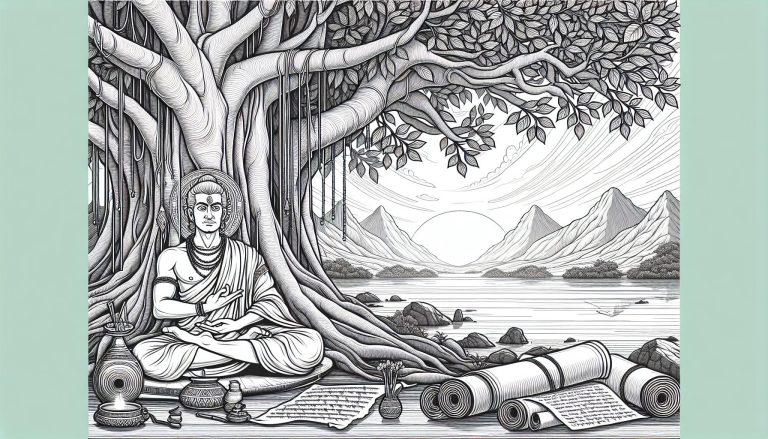
The teachings of the Upanishads were traditionally transmitted orally through a teacher-student relationship, ensuring the preservation of their profound ideas. Sages, seeking deeper understanding, would retreat to forests or ashrams to meditate and engage in deep discussions. This environment fostered an atmosphere of reflection and inquiry, essential for developing the complex concepts found in the Upanishads.
Several key historical figures played a role in disseminating Upanishadic wisdom. For instance, Yajnavalkya, a renowned sage, is frequently mentioned for his profound contributions, especially in the Brihadaranyaka Upanishad. Another central character is Uddalaka – Grandfather of Ashtavakra Aruni, who is well-known for his teachings in the Chandogya Upanishad.
The Upanishads cover various themes, such as the nature of reality (Brahman – The Supreme Truth), the individual soul (Atman – The Soul), and the cycle of rebirth (Samsara). They emphasize self-realization and understanding one’s connection to the cosmos. These insights continuously influence how people perceive identity and existence, reflecting their timeless relevance.
Core Concepts
Upanishadic philosophy revolves around several core concepts that investigate into the nature of reality and the self. These principles form the foundation of the teachings found in the Upanishads.
The Atman
The Atman represents the individual self or soul. It’s considered eternal and unchanging, distinct from the physical body and mind. In the Upanishads, realizing one’s Atman is synonymous with understanding one’s true nature. For example, the Chandogya Upanishad emphasizes, “Tat Tvam Asi” (Thou art that), highlighting the essential identity of the individual soul with the universal.
The Brahman
The Brahman is the ultimate reality or cosmic principle. It’s infinite, eternal, and transcendent, beyond all attributes. The Upanishads often describe Brahman as the source and sustainer of everything. For instance, the Brihadaranyaka Upanishad declares, “Sarvam Khalvidam Brahma – The Creator” (All this is indeed Brahman), illustrating the omnipresence of this principle.
Karma and Reincarnation
Karma and reincarnation are interconnected concepts in Upanishadic philosophy. Karma refers to the actions and their consequences, influencing one’s future lives. Reincarnation is the cycle of birth and rebirth driven by accumulated karma. The Bhagavad Gita, though not an Upanishad, aligns with these teachings, stating that the soul transmigrates based on karma till achieving liberation.
Moksha
Moksha signifies liberation or release from the cycle of birth and death. It’s achieved through true knowledge, self-realization, and understanding one’s unity with Brahman. The Katha Upanishad discusses how, through discernment and meditation, an individual can realize this ultimate freedom, culminating in eternal bliss and peace.
Major Upanishads
Several Upanishads stand out for their profound insights into the nature of reality, the self, and the cosmos. Here are four of the major ones: Isha, Kena, Katha, and Mundaka.
Isha Upanishad
The Isha Upanishad, also known as Ishavasya Upanishad, is one of the shortest but most significant Upanishads. It consists of just 18 verses and emphasizes the oneness of the self (Atman) with the ultimate reality (Brahman). This text begins with the famous line “Ishavasyam idam sarvam,” meaning “the Lord pervades everything.” Its teachings focus on detachment and the importance of living a life of renunciation and righteous action.
Kena Upanishad
The Kena Upanishad is named after its first word “Kena,” meaning “by whom.” It explores the source of all senses and the mind. Divided into four parts, it discusses the metaphysical concepts of Brahman by questioning and understanding consciousness. It delves into the nature of knowledge and the mysterious force that is beyond ordinary perception, stressing that true wisdom comes from recognizing this transcendent source.
Katha Upanishad
The Katha Upanishad presents its teachings through a dialogue between a young boy named Nachiketa – The Boy Who Obtained the Secrets of Death and the god of death, Yama. This Upanishad elaborates on the immortality of the soul and the ultimate knowledge of Brahman. Through its narrative, it imparts lessons on how to overcome fear and ignorance by understanding the self’s eternal nature. It famously includes the analogy of the body as a chariot, with the soul as its master and the intellect as its charioteer.
Mundaka Upanishad
The Mundaka Upanishad is known for its systematic approach to spiritual knowledge. Divided into three sections (Mundakas), each of two chapters, it categorizes knowledge into “higher” (para) and “lower” (apara) wisdoms. The text underlines that higher wisdom leads to the realization of Brahman, while lower wisdom deals with rituals and worldly understanding. It introduces the metaphor of two birds on a tree, symbolizing the soul and the divine observer.
Influence On Other Philosophical Systems
Upanishadic philosophy has deeply impacted various philosophical systems, leaving a lasting legacy on many traditions and thoughts. These influences span Vedanta, Yoga, and Modern Interpretations.
Vedanta
Vedanta, one of the six orthodox schools of Hindu philosophy, derives its principles from the Upanishads. Central concepts like Brahman and Atman form the core of Vedantic thought. Vedanta posits that realizing the non-duality of Atman and Brahman is the ultimate truth. Adi Shankaracharya, a key proponent, emphasized Advaita Vedanta, teaching that the individual soul and supreme reality are one. This non-dualistic understanding is foundational in Vedanta, influencing spiritual practices focused on self-realization.
Yoga
Yoga, a spiritual and ascetic discipline, integrates Upanishadic philosophies, particularly in Jnana Yoga, the path of knowledge. The Upanishads speak about the union of the individual self with the universal self, which aligns with Yoga’s aim of achieving Samadhi, or transcendental consciousness. Practices like meditation and breath control (pranayama) are directly influenced by Upanishadic teachings on controlling the senses and mind to reach higher states of awareness. Patanjali’s Yoga Sutras also reflect these ideas, emphasizing concentration and meditation as vital practices.
Modern Interpretations
Modern interpretations of Upanishadic philosophy reveal its relevance today. Influencing thinkers like Swami Vivekananda and Sri Aurobindo, the Upanishadic teachings inspire contemporary spiritual and philosophical discourses. Vivekananda popularized the notion that all humanity’s essence is divine and promoted universal principles derived from Upanishadic teachings. Sri Aurobindo integrated Upanishadic thoughts in his Integral Yoga, advocating for a synthesis of physical, mental, and spiritual practices for holistic transformation. These modern perspectives continue to draw from the ancient wisdom of the Upanishads, demonstrating their enduring influence.
Conclusion
Upanishadic philosophy offers timeless wisdom that transcends cultural and temporal boundaries. Its teachings on self-realization and cosmic unity remain relevant, providing profound insights into the nature of existence. The influence of these ancient texts is evident in various philosophical and spiritual traditions, from Vedanta and Yoga to modern interpretations by visionary thinkers. Embracing these principles can lead to a deeper understanding of oneself and the universe, fostering a sense of interconnectedness and holistic transformation. The Upanishads continue to inspire and guide us on our journey toward self-discovery and enlightenment.
Sources & further reading
These themes are explored in greater depth across the following authoritative resources:
- Internet Sacred Text Archive, Rig Veda (Griffith translation)
- Internet Sacred Text Archive, Upanishads
- Britannica, Veda
- Britannica, Upanishad
- Patrick Olivelle, The Early Upanishads (Oxford University Press, 1998)
External resources for further reading. Apam Napat is not affiliated with these publishers; citation does not imply endorsement.
Based on the classical texts of Hindu mythology, see our sources.