
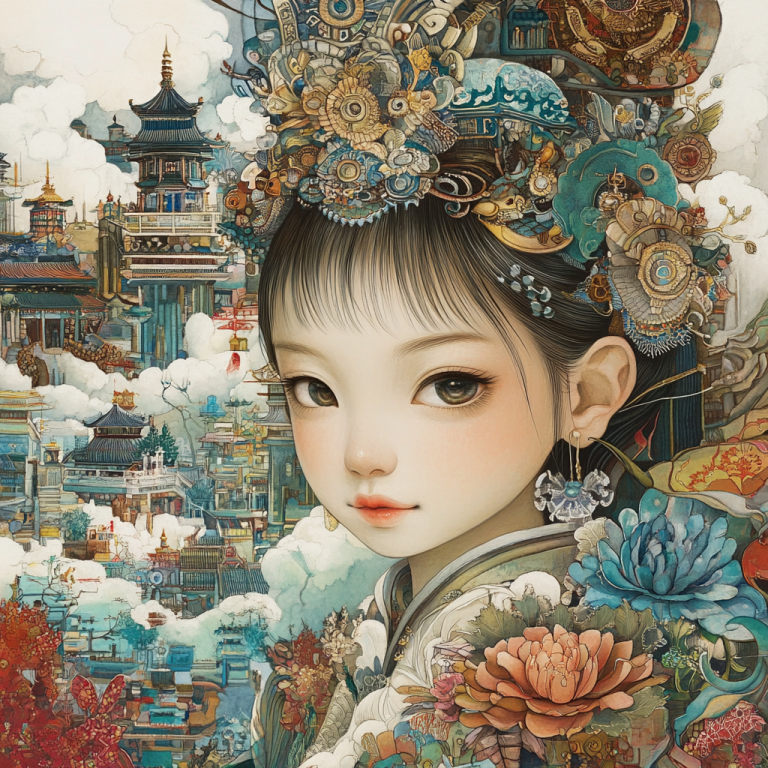
The Tale of Kartikeya and the Slaying of Taraka
Based on Ms.P. and [Maha:9.45-46]
In the ancient days, the Asura Taraka was born as the son of Vajranaga and Varangi, his birth itself rooted in vengeance. Vajranaga – Son of Diti had obtained a boon from Lord Brahma to avenge his wife, who had been tormented by Indra, the king of the Devas. Upon his father’s death, Taraka ascended the throne of the Asuras and vowed to fulfill his father’s unfulfilled purpose.
The Boon of Invincibility
Determined to secure his power, Taraka embarked on an arduous penance in the Pariparta Mountains. For years, his devotion remained unwavering, and at last, Lord Brahma appeared before him. Denied the boon of immortality, Taraka requested instead that he could only be slain by a seven-year-old boy. Pleased yet wary, Brahma granted the boon, knowing its implications.
Emboldened by this boon, Taraka amassed a formidable army. His generals included fearsome warriors like Jambha, Kujambha, Mahisha, Kunjara, Megha, Kalanemi, Nimi, Mathana, Jambhaka, and Shumbha. Together, they launched a devastating invasion of the heavens, forcing the Devas to defend themselves.
The Invasion of the Heavens
The Devas, led by Indra, marshaled their forces. Yama rode his buffalo, Varuna his snake, and Agni his goat, forming an impressive battle line. Yet the Asuras proved overwhelming. Kubera was forced to flee under Kujambha’s attack, while Chandra – The Moon and Surya were subdued by Kalanemi. Even the twin Ashwinis could not withstand Kalanemi’s might.
Desperate, the Devas sought the aid of Vishnu, who entered the battlefield with divine force. Vishnu managed to kill the Asura Grasana and knock Kalanemi unconscious, but even he was temporarily subdued by Jambha’s mace. Enraged, Indra slew Jambha with his thunderbolt, shifting the momentum of the battle briefly in favor of the Devas. However, Taraka himself was invincible due to Brahma’s boon. The Devas were ultimately routed, many captured, and the survivors fled in disarray.
A Divine Solution
The Devas, led by Indra, approached Lord Brahma for guidance. “O Creator, your boon to Taraka has left us powerless! Where can we find a seven-year-old boy to challenge this demon? The heavens are doomed!”
Brahma reassured them, saying, “Fear not. The child of Rudra (Shiva) will slay Taraka. However, Shiva remains immersed in meditation after the loss of Sati. She has been reborn as Parvati – The Consort of Shiva, the daughter of Himavan, and her devotion to Shiva is unwavering. Arrange their union, and the child born of their union will fulfill this prophecy.”
With Brahma’s counsel, the Devas enlisted Kama, the God of Love, to awaken Shiva’s heart. Though Kama succeeded, his act cost him dearly, as Shiva’s third eye reduced him to ashes. However, at the pleading of Rati, Kama’s wife, Shiva restored Kama in a formless state as Ananga (the bodiless one). Eventually, Shiva and Parvati were wed, and their divine union led to the birth of Skanda, also known as Kartikeya.
Skanda’s Coronation as Commander
When Skanda turned seven, the Devas, eager to end Taraka’s reign of terror, prepared to crown him as their commander-in-chief. A grand ceremony was held on the banks of the Saraswati – The Goddess of Learning and Wisdom River, with Brihaspati – The Guru of the Devas officiating. The Devas bestowed gifts upon the boy-warrior, including celestial weapons and allies.
The gifts were as follows:
- Indra: A blazing dart and an effulgent banner.
- Shiva: His divine followers, armed with celestial weapons.
- Vishnu: A garland that magnified the wearer’s might.
- Parvati: Radiant garments.
- Ganga: A celestial water pot filled with Amrit.
- Garuda: A peacock, who became Skanda’s mount.
- Aruna: A fighting cock with sharp talons.
- Varuna: A powerful snake.
- Brahma: A deer-skin garment and the boon of invincibility.
Additionally, Skanda was given a massive army of both male and female warriors, endowed with powers granted by various deities.
The Battle Against Taraka
With his army ready, Skanda led the Devas to battle near the Krauncha Mountains, where Taraka’s forces awaited. The battlefield was a spectacle of divine and demonic might. Skanda’s army, equipped with celestial weapons and bolstered by divine allies, clashed fiercely with the Asuras.
Taraka’s generals-Jambha, Kujambha, Mahisha (including warriors from the lineage of Vali – The King of Monkeys, famed for their strength), and others-fought valiantly but were gradually overpowered. Millions of Asuras fell under Skanda’s command. The boy-warrior’s skill, strength, and strategy demoralized the enemy forces, who began to flee.
The Final Duel: Skanda vs. Taraka
At last, Taraka himself entered the fray. Towering and invincible, he mocked Skanda’s youth, calling him unworthy of battle. But his taunts soon turned to caution as he realized the boy’s exceptional prowess. A fierce duel ensued, with Taraka’s club clashing against Skanda’s divine spear. The ground trembled under their blows, and the heavens, along with sages like Lomasa, watched in suspense.
Finally, Skanda hurled his spear, charged with the blessings of all the Devas. The weapon pierced Taraka’s chest, felling the mighty Asura. With Taraka’s death, the balance of the universe was restored, and the Devas erupted in jubilant celebration.
Aftermath and Skanda’s Legacy
Though Taraka was slain, his generals, including Bana, continued the fight. Skanda pursued Bana to the Krauncha Mountain, where he used a divine dart to annihilate him. The younger son of Bali, another powerful Asura, also met his end at Skanda’s hands.
With the Asuras vanquished, the Devas returned to their celestial abodes, lauding Skanda as their savior and new leader. From that day, Kartikeya became the commander-in-chief of the Devas, revered for his courage, skill, and leadership.
This tale immortalizes Skanda’s birth, his divine mission, and his victory, underscoring themes of destiny, devotion, and the ultimate triumph of good over evil. His legacy endures in temples and festivals, particularly in South India, where he is venerated as Murugan, the god of war and wisdom.
Sources & further reading
These themes are explored in greater depth across the following authoritative resources:
- Britannica, Asura
- Britannica, Naga
- Mythopedia, Hindu Mythology
- Internet Sacred Text Archive, Mahabharata
- Wendy Doniger, Hindu Myths (Penguin Classics, 1975)
External resources for further reading. Apam Napat is not affiliated with these publishers; citation does not imply endorsement.
Based on the classical texts of Hindu mythology, see our sources.