

In this text, I’ll jump into the various perspectives that seek to explain ultimate reality. Whether you’re inclined toward scientific theories like quantum mechanics or philosophical ideas like idealism, you’ll find a comprehensive exploration that aims to shed light on this profound topic. Let’s begin on this journey to uncover the fundamental truths that shape our universe.
Understanding Ultimate Reality
Understanding ultimate reality requires delving into complex and diverse perspectives that span philosophy and science. This section will explore prominent viewpoints to offer a comprehensive overview of what constitutes ultimate reality.
Philosophical Perspectives
Philosophical perspectives provide profound insights into ultimate reality. Idealism posits that reality is fundamentally mental, suggesting that consciousness is the essence of existence. Plato’s Theory of Forms, for instance, suggests that non-material abstract forms represent the truest reality. On the other hand, materialism asserts that everything perceivable is physical, and so, ultimate reality consists solely of matter. Realism, the doctrine that objects exist in reality independently of our perception, has significantly influenced scientific methods and objective inquiry.
Scientific Perspectives
Scientific perspectives offer empirical approaches to understanding ultimate reality. Quantum mechanics, for example, challenges classical conceptions by suggesting particles can exist in multiple states simultaneously. The Many-Worlds Interpretation hypothesizes that every quantum event spawns a parallel universe, which implies an infinite number of realities. The General Theory of Relativity explains how gravity affects space-time, providing a framework to understand cosmic-scale phenomena. Also, string theory proposes that the universe comprises one-dimensional strings, potentially unifying all fundamental forces and particles.
Combined, philosophical and scientific perspectives provide a multidimensional approach to grasping ultimate reality, each contributing unique interpretations that enrich our understanding.
Historical Context

Understanding ultimate reality has intrigued thinkers for centuries, shaping human exploration from ancient times to modern philosophy.
Ancient Civilizations
Ancient civilizations laid the foundation for the concept of ultimate reality. In Egypt, the notion of Ma’at encapsulated truth, balance, and cosmic order. In India, the Upanishads introduced Brahman – The Supreme Truth, the unchanging reality amidst and beyond the world. Greek philosophers, like Plato, proposed the Theory of Forms, asserting that non-material abstract forms represent the most accurate reality. Each of these civilizations contributed to foundational beliefs.
Medieval Thinkers
Medieval thinkers expanded on ancient concepts to integrate religious ideologies. St. Augustine combined Christian doctrine with Platonic thought to argue for the existence of a perfect, immutable God. Thomas Aquinas further developed this synthesis, using Aristotle’s philosophy to rationalize the coexistence of faith and reason. Islamic philosophers like Avicenna and Al-Ghazali also grappled with ultimate reality, intertwining Greek philosophy with Islamic theology, thereby preserving and enhancing philosophical traditions.
Modern Philosophers
Modern philosophers continued investigating ultimate reality against the backdrop of scientific advancement. Immanuel Kant shifted the focus to human perception with his theory that our understanding of reality is limited by our sensory experience. G.W.F. Hegel proposed an Absolute Reality that unfolds through historical progression. In the 20th century, philosophers like Ludwig Wittgenstein and Martin Heidegger examined language and existence, questioning how these influence our grasp of reality. Their contributions reflect a persistent try to decode the essence of ultimate reality in an ever-evolving intellectual world.
Theories and Interpretations
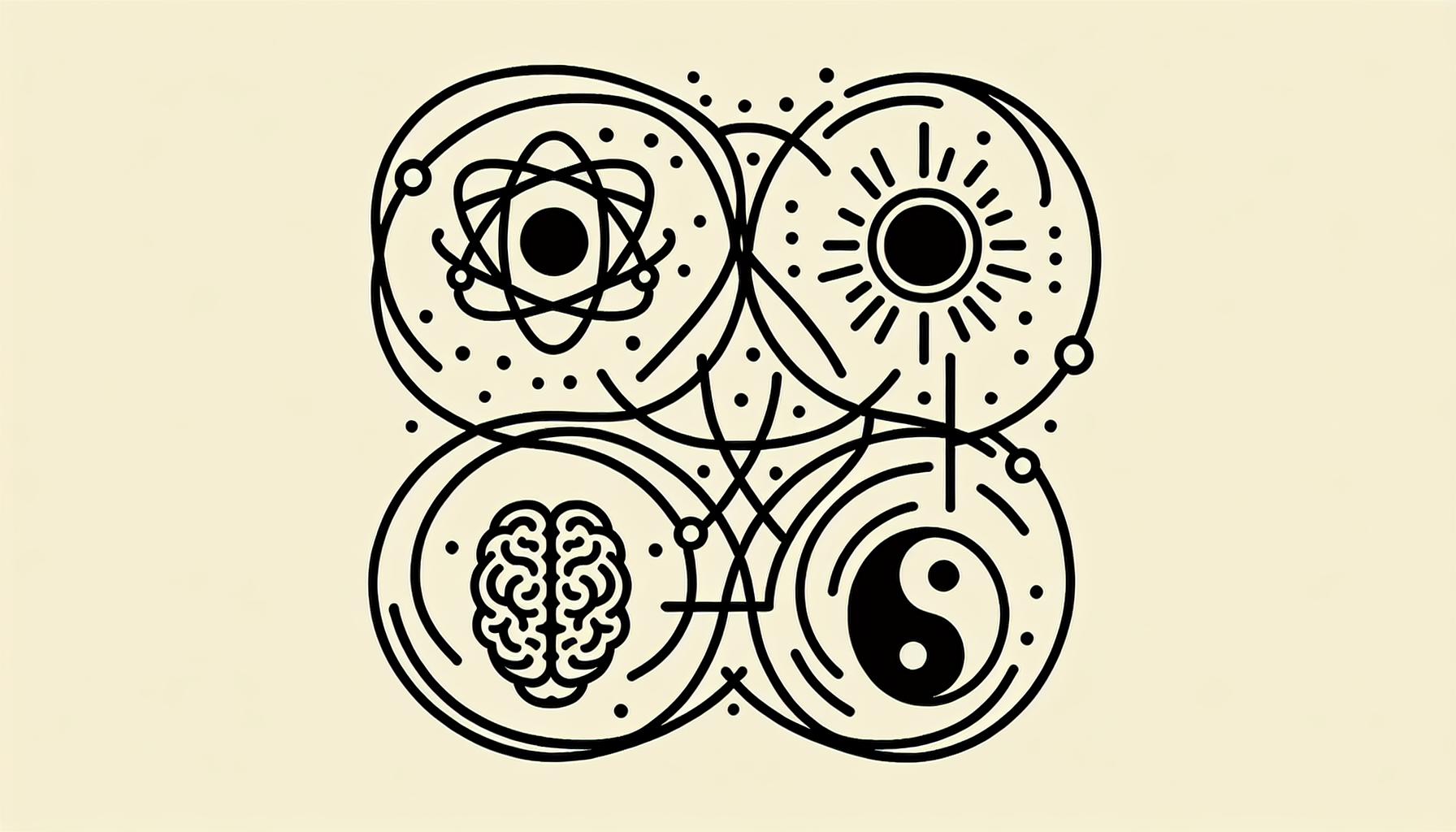
Investigating ultimate reality invites a variety of theories and interpretations from different philosophical and scientific viewpoints. Below, I explore three main schools of thought.
Materialism
Materialism holds that physical matter constitutes the only reality. It asserts that everything, including consciousness, arises from material interactions. Followers believe that observable phenomena and measurable variables offer explanations for existence. Prominent figures like Democritus and Epicurus laid its foundations by stating that all things result from the motions and collisions of atoms. Modern materialists rely on advancements in neuroscience and physics to support the notion that mental states, such as thoughts and emotions, derive from physical processes within the brain.
Idealism
Idealism posits that reality is fundamentally mental or immaterial. Unlike materialism, it suggests that consciousness and ideas form the essence of existence. Philosophers like Plato and Berkeley claim that our perceptions and thoughts shape reality. For instance, Berkeley argues that objects only exist when perceived, encapsulated in his famous assertion, “esse est percipi” (“to be is to be perceived”). Idealists maintain that the mind’s nature and its contents are primary, interpreting the physical world as a manifestation of inner consciousness or spirit.
Dualism
Dualism proposes that both mind and matter exist as distinct yet interrelated entities. Originating from René Descartes’ philosophy, it contends that mental and physical realms are separate but interact with each other. Descartes famously concluded, “Cogito, ergo sum” (“I think, hence I am”), grounding his assertion that consciousness exists independently of the physical body. This theory allows for the coexistence of spiritual and material realities, suggesting that neither can be reduced to the other. Modern discussions in dualism explore the intricacies of mind-body interaction and aim to reconcile these two aspects of existence.
Religious and Spiritual Views
The concept of ultimate reality carries significant weight in religious and spiritual traditions. Various belief systems provide different interpretations of existence and the nature of reality.
Eastern Philosophies
Eastern philosophies, especially Hinduism, Buddhism, and Taoism, offer unique perspectives on ultimate reality. Hinduism introduces Brahman, an eternal and unchanging reality. In Buddhism, the idea of anatta (non-self) and impermanence guide one’s understanding of ultimate truth, emphasizing the interconnectedness of all beings. Taoism presents the concept of the Tao, the fundamental principle that is the source of everything and underpins natural order and consciousness.
Western Religions
Western religions, such as Christianity, Judaism, and Islam, interpret ultimate reality through the lens of monotheism. Christianity views God as the ultimate reality, existing beyond the physical universe yet intimately involved in it. Judaism holds a similar belief in a transcendent yet personal God, who is both creator and sustainer of the universe. Islam centers on Allah, who embodies absolute reality and guides all existence through divine will.
Mystical Traditions
Mystical traditions within various religions offer profound insights into ultimate reality. Sufism in Islam seeks direct experiential knowledge of God through spiritual practices and inner purification. Christian mysticism emphasizes union with God through contemplation and prayer, transcending the material world. In Hinduism, Vedanta explores the realization of the self (Atman – The Soul) as one with Brahman, the ultimate reality, through meditation and renunciation.
Contemporary Debates
Contemporary debates on ultimate reality explore diverse viewpoints, integrating insights from philosophy, science, and spirituality. These debates reveal the complex nature of reality and challenge prevailing paradigms.
Philosophical Arguments
Philosophical arguments on ultimate reality span several schools of thought. Existentialism, led by figures like Jean-Paul Sartre, posits that individuals create meaning in an inherently meaningless world. In contrast, phenomenology, developed by Edmund Husserl, asserts that reality is shaped by consciousness and subjective experience. Postmodernism, represented by thinkers like Jacques Derrida, questions the existence of any absolute truths, proposing that reality is constructed through language and cultural paradigms. These varied perspectives illustrate the ongoing discourse within philosophy concerning the nature of ultimate reality.
Scientific Discoveries
Scientific discoveries offer new dimensions to the understanding of ultimate reality. Quantum mechanics, for instance, suggests that particles exist in multiple states until observed (source: Richard Feynman’s lectures). This challenges the classical deterministic view. Also, the theory of relativity, proposed by Albert Einstein, reveals that time and space are interwoven, altering our perception of the physical universe. Neuroscience contributes by exploring consciousness, with studies showing how brain activity correlates with experiences of reality (source: Antonio Damasio’s research). These scientific breakthroughs continually reshape our understanding of ultimate reality.
Integration Efforts
Efforts to integrate philosophical, scientific, and spiritual insights into ultimate reality seek a holistic understanding. Scholars and researchers across disciplines collaborate to merge subjective and objective views of reality. Integrative approaches, like Ken Wilber’s Integral Theory, aim to synthesize various perspectives, proposing that reality comprises different levels of experience and existence. Conferences and publications often help these cross-disciplinary dialogues, promoting a comprehensive exploration of ultimate reality. These integration efforts highlight the potential for a unified theory that encompasses diverse aspects of reality.
Conclusion
Exploring ultimate reality is a profound journey that spans across philosophy science and spirituality. Each perspective offers unique insights yet the complexity of reality remains elusive. The ongoing dialogue between these diverse viewpoints highlights the richness of human understanding and the quest for a unified theory of existence. As we continue to integrate these perspectives we move closer to a more comprehensive understanding of ultimate reality. This try not only deepens our knowledge but also enriches our experience of the world and our place within it.
Sources & further reading
These themes are explored in greater depth across the following authoritative resources:
- Stanford Encyclopedia of Philosophy, Hindu Philosophy
- Britannica, Moksha
- Britannica, Brahman
- Internet Sacred Text Archive, Upanishads
- Sarvepalli Radhakrishnan, Indian Philosophy (2 vols., Oxford University Press, 1923)
External resources for further reading. Apam Napat is not affiliated with these publishers; citation does not imply endorsement.
Frequently asked questions
What is ultimate reality?
What does idealism say about ultimate reality?
What does materialism say about ultimate reality?
How does quantum mechanics view ultimate reality?
What does string theory propose about reality?
Based on the classical texts of Hindu mythology, see our sources.