
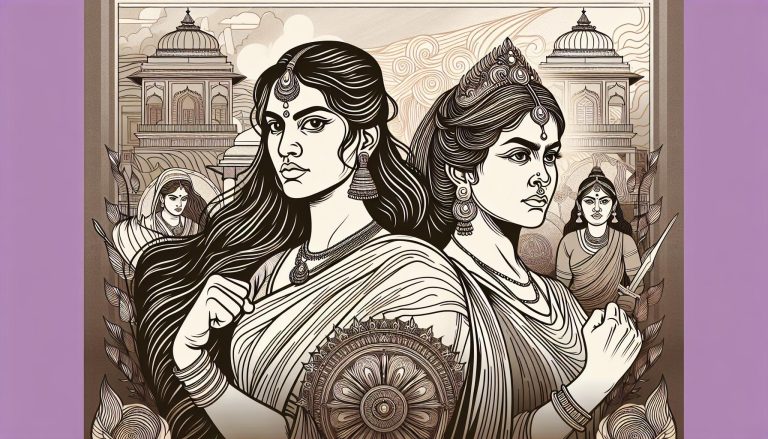
As I delve into the Ramayana’s gender perspectives, I find a rich tapestry of roles and relationships that challenge and reinforce traditional norms. From Sita’s unwavering virtue to Kaikeyi – Mother of Bharata of the Ramayana’s assertive ambitions, each character’s journey offers insights into the societal values and gender roles of ancient India. Let’s explore how these timeless stories continue to shape and reflect our understanding of gender today.
Overview of Ramayana Gender Perspectives
The Ramayana offers rich insights into gender roles and expectations in ancient Indian society. Characters like Sita and Kaikeyi navigate complex dynamics that reflect societal norms and individual agency.
Sita’s Virtue
Sita, the wife of Rama, embodies ideal womanhood through her devotion and virtue. Her actions, like following Rama into exile and undergoing the trial by fire, highlight the expectations placed on women regarding purity and loyalty. She represents the epitome of wifely duty and moral integrity.
Kaikeyi’s Ambition
Kaikeyi, one of King Dasaratha’s wives, challenges traditional female roles through her political ambitions. By demanding her son Bharata – The King Who Gave His Name to India’s enthronement and Rama’s exile, she uses her influence to alter the kingdom’s fate. Kaikeyi’s assertiveness and strategic thinking disrupt the conventional passive female archetype, showing a different dimension of womanhood.
Masculine Ideals
Masculine ideals in the Ramayana are exemplified by Rama and other male characters. Rama symbolizes dharma (righteousness), valiance, and responsibility. His adherence to duty over personal desires underscores the ideal masculine virtues. Meanwhile, his relationships with Lakshmana, Bharata, and Hanuman emphasize loyalty, brotherhood, and service.
Devotional Love
The epic also explores themes of devotional love that transcend gender roles. Devotees like Hanuman exhibit unconditional love and loyalty to Rama, reflecting ultimate devotion that goes beyond traditional masculine or feminine expectations. This dimension adds a nuanced layer to the understanding of gender through devotion and service.
Societal Implications
The gender perspectives in the Ramayana influence societal norms even today. Values like chastity, loyalty, duty, and devotion continue to shape gender expectations. The epic’s portrayal of these attributes provides a lens to scrutinize contemporary gender roles, examining how ancient texts shape modern perspectives.
Contrast Between Characters
The contrast between characters like Sita and Kaikeyi highlights the range of female agency in the Ramayana. Sita’s adherence to virtue versus Kaikeyi’s ambition illustrates the spectrum of roles women occupied. These contrasting representations offer a composite picture of the diverse capabilities attributed to women.
The gender perspectives in the Ramayana, from virtuous devotion to political strategy, present a comprehensive view of the roles and expectations in ancient India. Through its characters and their actions, the epic provides timeless insights into the fabric of gender dynamics.
Feminine Strength in Ramayana
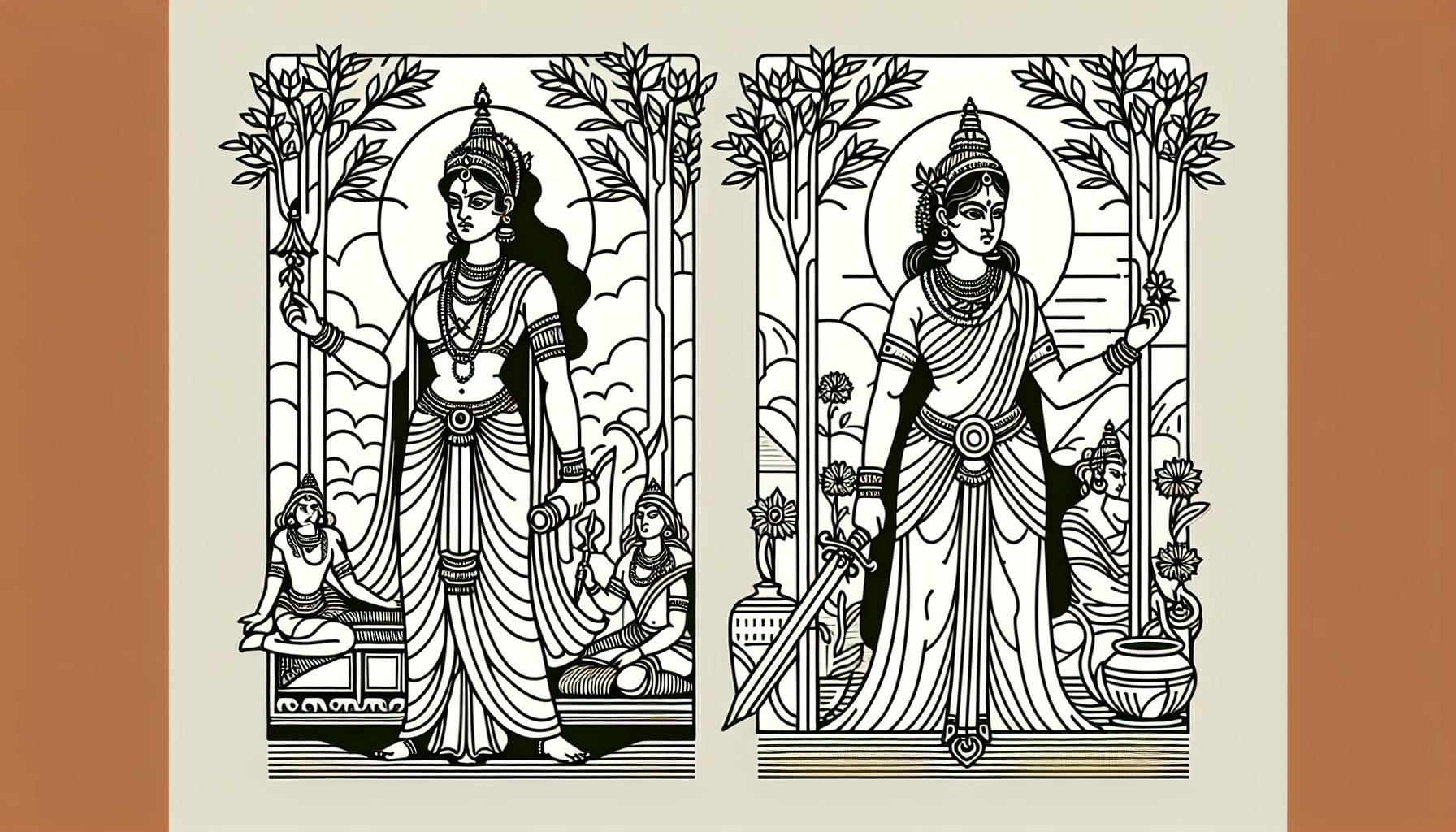
The Ramayana showcases significant examples of feminine strength through its characters. This section focuses on how Sita and Kaikeyi exhibit resilience and influence.
Sita’s Role and Resilience
Sita stands as a paragon of perseverance and devotion. Known for her unwavering commitment to her husband Rama, she epitomizes the ideal of conjugal loyalty. Her decision to accompany Rama during his exile, despite the harsh conditions, illustrates her steadfastness.
In Lanka, Sita’s resilience shines through during her captivity. She refuses Ravana – The Demon King’s advances, relying on her moral strength to remain unyielding. Her faith and fortitude become symbols of resistance against oppression. Sita’s trial by fire, Agni Pariksha, further highlights her unwavering virtue.
Kaikeyi’s Motivation and Influence
Kaikeyi, a pivotal character in the Ramayana, wields considerable influence due to her strategic acumen. Initially presented as a devoted wife and mother, she later employs her boons to alter the course of the narrative.
Her motivations stem from a complex interplay of love for her son Bharata and political foresight. By demanding Rama’s exile and Bharata’s coronation, she challenges the traditional passive role of women in that era. Though her actions appear antagonistic, they underscore her agency within a patriarchal framework.
Kaikeyi’s decisions catalyze significant events within the epic, demonstrating her profound impact. Her assertive actions, although controversial, reveal the multi-dimensional aspects of feminine strength in Ramayana.
Masculine Virtues and Flaws
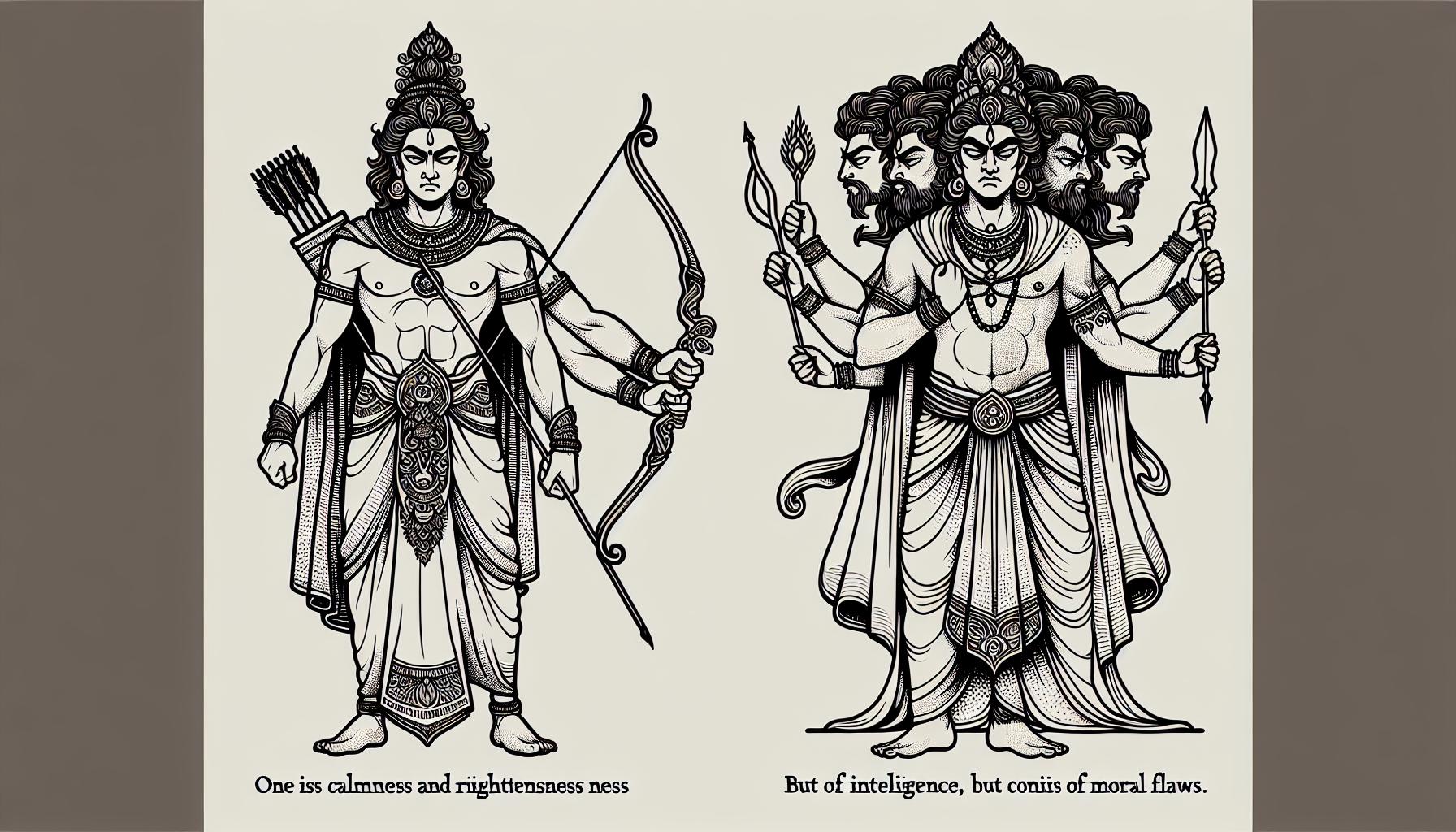
In the Ramayana, male characters are depicted with distinct virtues and flaws, reflecting the complexity of gender dynamics. Two central figures, Rama and Ravana, illustrate contrasting masculine attributes.
Rama as the Ideal Man
Rama demonstrates ideal masculine virtues through his actions and decisions. As depicted in the Ramayana, Rama embodies honor, virtue, and righteousness. He consistently follows Dharma (duty) even under challenging circumstances. For instance, when exiled for 14 years, he accepts his fate without complaint, showcasing his unwavering commitment to moral principles. Rama’s dedication to his wife, Sita, exemplifies loyalty and respect. Throughout the epic, his primary focus remains on rescuing Sita, reflecting his perseverance and sense of responsibility.
Ravana’s Ambiguity
Ravana presents a more complex portrayal of masculinity. As the antagonist, he exhibits both virtues and flaws, challenging the simplistic hero-villain dichotomy. Ravana’s intelligence and prowess make him a formidable leader; he effectively governs Lanka and demonstrates extensive knowledge in many fields. However, his lust and arrogance undermine his positive qualities. His abduction of Sita stands as a prominent example of moral failure, driven by desire rather than honor. This duality in Ravana’s character underscores the multifaceted nature of masculinity in the epic, presenting a nuanced perspective on male virtues and flaws.
The Ramayana’s exploration of these masculine traits, filtered through its central characters, highlights the broader themes of duty, honor, and moral integrity. These qualities and their complexities shape the narrative and offer timeless insights into gender dynamics.
Gender Equality and Its Limits

Gender dynamics in the Ramayana reveal both advancements and constraints in gender equality within ancient societal constructs.
Challenges Faced by Female Characters
Female characters in the Ramayana face significant challenges, showcasing the limitations of gender equality. Sita endures an arduous trial by fire to prove her chastity, highlighting the severe trials women must undergo to validate their virtue. Despite her unwavering devotion, she’s repeatedly subjected to societal scrutiny and suspicion.
Kaikeyi, a queen with considerable political acumen, manipulates royal decisions but faces ostracism and vilification for prioritizing maternal love over societal norms. Her strategic move to ensure her son’s ascension results in her being condemned, illustrating the substantial backlash against women exercising political influence.
Societal Expectations and Double Standards
Societal expectations and double standards prominently impact gender equality in the Ramayana. Women are expected to embody absolute virtue and loyalty, while men are often celebrated for their righteousness and valor, despite their flaws. Sita’s loyalty to Rama is extolled, yet she’s made to undergo severe tests of purity, underscoring the gender-biased expectations placed upon women.
Conversely, Ravana’s complex personality includes intelligence and bravery, yet his flaws like lust dominate his narrative. These differences underscore societal double standards, where men’s virtues are weighed against their flaws, while women’s virtues must be unequivocal. This reveals deep-seated gendered biases and the limits of gender equality in ancient narratives like the Ramayana.
Modern Interpretations
Modern interpretations of the Ramayana offer insight into how gender perspectives have evolved over time. They reflect changing societal norms and highlight ongoing debates around gender equality.
Feminist Readings of the Ramayana
Feminist readings of the Ramayana scrutinize the roles and agency of female characters. Scholars argue that Sita embodies both subservience and defiance. Her abduction and trial by fire symbolize female suffering and resilience. Kaikeyi’s character, often vilified, is reassessed as a complex figure exercising agency in a patriarchal society. Feminists highlight these narratives to question and reinterpret traditional gender roles.
Contemporary Adaptations
Contemporary adaptations reframe the Ramayana to address modern gender concerns. Novels like “Sita’s Ramayana” by Samhita Arni and “The Liberation of Sita” by Volga retell the epic from Sita’s perspective, emphasizing her strength and autonomy. TV series and films also depict a more nuanced view of female characters, challenging patriarchal norms. These adaptations aim to resonate with today’s audience by promoting gender inclusivity and equality.
Cultural Impact of Gender Perspectives
Gender perspectives in the Ramayana have significantly influenced societal norms and cultural behaviors across diverse communities. They shape the roles and expectations within various spheres of life.
Influence on Indian Society
The portrayal of characters like Sita and Rama deeply impacts Indian society’s view on virtue, duty, and morality. Sita’s embodiment of purity and devotion sets a benchmark for womanly virtues, while Rama’s adherence to dharma models ideal masculine behavior. These depictions mold societal gender roles and expectations, reinforcing traditional values.
Organizations and movements often invoke these characters to advocate for gender roles, sometimes limiting progressive discussions about gender equality. However, modern feminist perspectives challenge these traditional interpretations, using Sita’s narrative to highlight the need for female agency and autonomy.
Gender Dynamics in Regional Variants
Regional variants of the Ramayana offer diverse portrayals of gender dynamics. The Tamil Kamba Ramayanam and the Bengali Krittivasi Ramayana introduce nuanced perspectives on feminine resilience and strength. In the Andhra Mahabharatam, characters like Sabari and Tara provide different angles on gender roles, emphasizing devotion and wisdom.
Local adaptations incorporate cultural specificities, altering character representations to align with regional norms. These modifications reflect the dynamic interplay between the epic and evolving societal values, sometimes supporting, other times challenging, established gender norms. By examining these variants, one can discern the fluid nature of gender perspectives and their enduring cultural impact.
Conclusion
Exploring the Ramayana through a gender lens reveals a complex tapestry of societal norms and expectations. Characters like Sita and Kaikeyi challenge and reinforce these norms, offering a rich ground for modern feminist interpretations. The portrayal of Rama and Sita continues to shape contemporary views on virtue and duty, but it’s essential to question and reinterpret these roles to promote gender equality.
By understanding the nuanced gender dynamics in the Ramayana, we can appreciate the resilience and strength of its characters. This epic remains a powerful tool for reflecting on and evolving our societal values, emphasizing the importance of female agency and autonomy in today’s world.
Sources & further reading
These themes are explored in greater depth across the following authoritative resources:
- Internet Sacred Text Archive, Mahabharata (Ganguli translation)
- Internet Sacred Text Archive, Ramayana of Valmiki
- Britannica, Mahabharata
- Britannica, Ramayana
- Bibek Debroy, The Mahabharata (10 vols., Penguin, 2010 to 2014)
External resources for further reading. Apam Napat is not affiliated with these publishers; citation does not imply endorsement.
Based on the classical texts of Hindu mythology, see our sources.